
Phoenician Scheme, The (4K UHD Review)
- Review Date: Aug 14, 2025
- Format: 4K Ultra HD
-


Director
Wes AndersonRelease Date(s)
2025 (July 29, 2025)Studio(s)
Focus Features/Indian Paintbrush/American Empirical Pictures (Universal Pictures Home Entertainment)- Film/Program Grade: A
- Video Grade: A+
- Audio Grade: A+
- Extras Grade: D+

Review
In many ways, The Phoenician Scheme is a return to form for Wes Anderson. His previous films, 2021’s The French Dispatch and 2023’s Asteroid City, were very stuffed, focusing on many different characters, shifting perspectives, and jumping from present day to the past and back again with little abandon. That’s certainly a lot to take in, even for longtime fans of his work. By contrast, The Phoenician Scheme offers a single narrative that never wavers, centering on the story at hand in an almost simplistic way, at least as simplistic as a Wes Anderson film can get.
Wealthy business tycoon Anatole “Zsa-Zsa” Korda (Benicio del Toro) finds himself the survivor of repeated assassination attempts. Meanwhile, the governments of the world have conspired to covertly bankrupt Korda by raising the prices on building materials, thwarting his plans for a high-risk business enterprise in Phoenicia. Realizing that his days may be numbered, he calls upon his estranged daughter, Sister Liesl (Mia Threapleton), to become his sole heir and take over his business should he die before his plan is completed. Their relationship is strained by the murky circumstances of her mother’s death, but she nevertheless agrees to come with him on a “trial basis,” bringing Bjorn (Michael Cera), Korda’s Norwegian assistant and tutor, along as well. Korda’s plan is to talk his fellow investors into putting more money into the proposal, but with Liesel’s influence, becomes a more open and honest man along the way. The cast also includes Tom Hanks, Bryan Cranston, Riz Ahmed, Jeffrey Wright, Mathieu Amalric, Richard Ayoade, Rupert Friend, Scarlett Johansson, and Benedict Cumberbatch, with appearances by Stephen Park, Willem Dafoe, F. Murray Abraham, Charlotte Gainsbourg, Hope Davis, and Bill Murray.
It’s old hat at this stage to lay criticism at the Wes Anderson “style” of filmmaking. His body of work stretches all the way back to 1996 with Bottle Rocket, though it’s fair to say that he didn’t truly find his visual voice until his next film, 1998’s Rushmore. He must certainly be doing something right to be in the business for that long, making exactly the kinds of films that he wants to make with seemingly little to no compromise. In other words, it is what it is, and you either enjoy his type of aesthetic or you don’t. As a lifelong Wes Anderson fan who began watching his films when I as a late teenager, I’ve always approved of everything he makes without much question. Because of this, I’ve had a somewhat difficult time in critiquing his work, only because it’s such a joy every time to see a filmmaker with such a distinct style and a clear vision who adores art direction, music, and language so much that I can overlook what many of his critics see as “flaws.”
In The Phoenician Scheme, we see Anderson getting back to basics with a single storyline and three main characters in the foreground. There’s a menagerie of walk-ons and smaller parts, but our focus is more strongly attuned to the leading characters and getting to know them, which is the film’s greatest strength. The few cutaways that are present tie in to the story without ever leaving it, informing it rather than feeling like asides. It can be likened to The Darjeeling Limited in its approach, giving our three leads plenty of screen time to exist with each other and grow as the story progresses. The familial trappings and complicated leading man angle hearken back to The Royal Tenenbaums as Benicio del Toro’s Anatole “Zsa-Zsa” Korda is very much akin to Gene Hackman’s Royal O’Reilly Tenenbaum. They can be beloved, even pitiful, but also complex.
As for the other two main cast members, Mia Threapleton is a treasure and a talent to watch out for, and it’s the best thing Michael Cera has taken part in since his awkward and hilarious brief appearance in the third season Twin Peaks. In both cases, he’s used well, meaning efficiently and effectively. Del Toro is, of course, outstanding, and it’s nice to see him given the lead role in something that requires more of him than to shoot guns and generally be a badass (not that he isn’t fully adept at that, as well). The surrounding players mostly feel like the usual Wes Anderson side characters, perhaps because they’re not given nearly the same amount of screen time as the three leads. Jeffrey Wright, Mathieu Amalric, and Richard Ayoade stand out the most, and it wouldn’t quite be a Wes Anderson film without even just a random appearance by Bill Murray, now would it? And he’s certainly used appropriately here, at least in Wes Anderson terms.
Above all else, The Phoenician Scheme is a very sweet and surprisingly uncomplicated story, one that deserves an appreciative and receptive audience who can see past the “style” straight through to the heart of the matter, and The Phoenician Scheme is certainly full of heart.
The Phoenician Scheme was shot by cinematographer Bruno Delbonnel on Super 35mm film (Kodak Vision3 200T 5213) using Arricam LT and ST cameras with Cooke S4/i lenses, finished as a 4K Digital Intermediate, and presented in the aspect ratio of 1.47:1. Universal’s 4K Ultra HD debut of the film is sourced from the same 4K DI, which has been graded for High Dynamic Range in HDR10 and Dolby Vision, and presented on a dual-layered BD-66 disc. It’s a beautifully film-like presentation with a light layer of photochemical grain (and the most minor of instances of speckling if you’re paying close enough attention), with vast levels of high detail and an amazing depth of field. The bitrate sits in the 50 to 70Mbps range most of the time, but since about a quarter of the screen is made up of black bars on either side of the frame, nothing is really sacrificed. The HDR passes, especially the Dolby Vision, manage to wring out the richest of hues in the multifaceted palette, as well as the deep, inky blacks, allowing for perfect contrast. Everything is solid and stable without fault, making the overall picture highly attractive.
The main audio option is English Dolby Atmos (7.1 Dolby True HD compatible) with optional subtitles in English SDH. Anyone who’s seen a Wes Anderson film knows that the soundtracks to his films are more about textures and subtleties than cacophony, and The Phoenician Scheme is no exception. It’s a highly immersive track, full of varying sonic nuances. Dialogue is, of course, king, but the film’s use of score and sound effects envelope the listener with rich tapestries of sound. No speaker is wasted and no moment isn’t carefully considered and balanced. Other audio options included Spanish and French 5.1 Dolby Digital, with corresponding subtitle options, as well. The Blu-ray included with this release includes the same audio and subtitle options, but with the addition of an English DVS track.
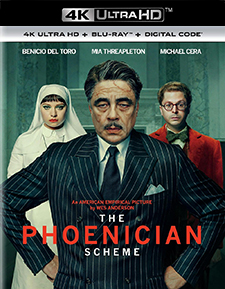
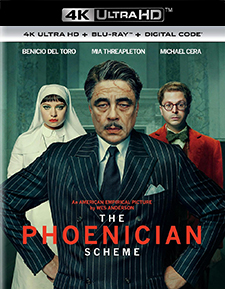
The Universal Pictures Home Entertainment 2-Disc 4K Ultra HD release of The Phoenician Scheme sits in a black Amaray case alongside a 1080p Blu-ray copy of the film and a Digital Code on a paper insert. The artwork on the insert and the slipcover appears to be unique to this release. The following extras are included on both discs in HD:
- Behind The Phoenician Scheme (w/Play All Option – 15:07):
- The Cast (7:36)
- The Airplane (1:21)
- Marseille Bob’s (2:03)
- Zsa-Zsa’s World (4:17)
The extras are all too brief, but we do get glimpses into the creation of the film, including some overviews of the special and visual effects, as well as the storyboards, but we also get a taste of what it’s like to work with Wes Anderson. Interviewees include Benicio del Toro, Mia Threapleton, Michael Cera, and Wes Anderson (audio only), along with some juicy behind-the-scenes footage.
With the upcoming release The Criterion Collection’s massive The Wes Anderson Archive: Ten Films, Twenty-Five Years 4K Ultra HD boxed set containing his first ten films, it’s only a matter of time before The Phoenician Scheme joins their catalog; though like most of the previous Wes Anderson films, it will likely be a few years down the road. For now, this is a fantastic 4K UHD presentation that belongs on your shelf if you’re a fan. Highly recommended.
- Tim Salmons
(You can follow Tim on social media at these links: Twitter, Facebook, BlueSky, and Letterboxd. And be sure to subscribe to his YouTube channel here.)