
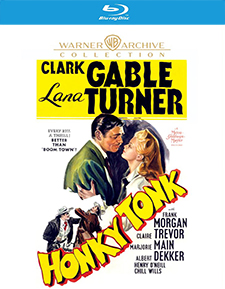
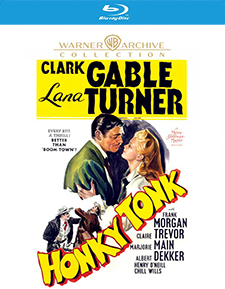
Honky Tonk (Blu-ray Review)
Director
Jack ConwayRelease Date(s)
1941 (March 31, 2026)Studio(s)
Metro-Goldwyn-Mayer (Warner Archive Collection)- Film/Program Grade: B-
- Video Grade: A
- Audio Grade: A-
- Extras Grade: B+

Review
Westerns are as old as the film industry. The Great Train Robbery, directed by Edwin S. Porter and released in 1903, was one of the first of the genre to hit movie screens. The Western remained popular through the 1930s with such films as Cimarron, The Plainsman, Dodge City and Stagecoach. In 1941, MGM produced Honky Tonk, a Western romance featuring one of the studio’s biggest stars.
Clark Gable plays con men Candy Johnson. He and his and buddy, Sniper (Chill Wills), escape being tarred and feathered after scamming a group of angry townsfolk. The two pals set their sights on Yellow Creek, Nevada, a town they feel is ripe for the picking because of a recent gold strike. On the train, Candy meets prim and proper Elizabeth (Lana Turner), a young lady en route from Boston to meet her widowed father, Judge Cotton (Frank Morgan). Elizabeth is unaware that the judge is a drunk and a con man. Serving as the town’s justice of the peace, he’s stolen most of the money he’s collected in fines and has no way to pay it back. Candy, recognizing Cotton as an old scam artist, doesn’t expose him. Instead, he makes a deal; Candy will pay back the town and not reveal the truth if the judge agrees to work with him.
When a cheated gambler complains in the local saloon, Candy forces the crooked saloon owner and town sheriff, Brazos Hearn (Albert Dekker), into a high-stakes game of Russian roulette. By sleight of hand, Candy removes the single bullet from the gun, ensuring his own safety and intimidating Brazos into chickening out. As a result, Candy wins $5,000 from Hearn and buys his own saloon, the Square Deal, guaranteeing honest gambling and putting a considerable dent in Hearn’s business.
To cement his reputation as a pillar of the community, Candy also convinces Elizabeth’s landlady, the widow Mrs. Varner (Marjorie Main), whose late husband was a preacher, to open a church mission with some of the money he won from Hearn. Now known as a morally upright citizen, he begins courting Elizabeth. Candy’s old flame, tough-talking dance hall gal “Gold Dust” Nelson (Claire Trevor) warns Elizabeth that Candy is a con artist who will never change and will never wed. Elizabeth, however, is smitten with the brash, attractive Candy and they do marry.
Gradually, Candy expands his influence in town through crooked schemes and becomes its most powerful figure. The judge, unhappy with Candy’s machinations and fearful for his daughter, tells everyone his son-in-law is a crook and can prove it. Certain people feel the judge must be silenced, while Candy figures getting him out of town will be enough to satisfy his jumpy partners in corruption.
Honky Tonk stars Gable in the kind of role he played often—a scoundrel who gets to show a decent side—in such films as Manhattan Melodrama, No Man of Her Own, San Francisco and Gone With the Wind. Gable commands the screen with a strong presence and winning personality. When we first see him in Honky Tonk, it looks as if his Candy is in for some nasty retribution for fleecing a bunch of people eager to dispense their own justice. Yet Gable’s charm convinces us that Candy can sweet talk his way out of this. Fast talking and a bit of simple magic for distraction puts his captors off guard long enough for him and his partner to get away. Gable’s chemistry with Turner adds heat to an otherwise ho-hum Western. When he sweeps Elizabeth off her feet, we believe she can’t resist his aggressive approach.
Lana Turner was a well-established star when she was cast in Honky Tonk. This was the first of four films she and Gable would make together. Clearly, the camera loves her. She looks radiant, filmed in MGM’s glamor style by Harold Rossen. The role requires her to look demure in the early scenes and later display growing affection for Candy. The only heavy lifting she does is in a scene in which Elizabeth is close to death. Looking pale and disoriented, she gives her “big scene” her all, proving she’s more than just a pretty face.
Character actors Chill Wills, Marjorie Main and Albert Dekker complete the impressive supporting cast. Claire Trevor steals a few scenes as Gold Dust with her lustful glances, swagger and feathery hats.
The screenplay has an unusual amount of dialogue for a Western and not that much action. The romantic interludes slow the picture’s momentum and bog down the narrative. Fewer of these scenes would have improved the pace. Audiences of the time regarded Gable as a matinee idol and wanted to see him romance his leading ladies, which explains the odd fit of the Candy-Elizabeth sub-plot into a genre that typically concentrates on action. Director Jack Conway isn’t especially creative when it comes to how scenes are filmed, content to rely on establishing long shots and a series of medium shots and close-ups for conversations. Few tracking shots, crane shots, or unusual camera angles are employed to give the film a distinctive look.
Honky Tonk was shot by director of photography Harold Rossen on 35mm black & white film with spherical lenses and presented in the aspect ratio of 1.37:1. The Blu-ray from the Warner Archive Collection is sourced from a new 4K scan of the original nitrate camera negative. The image quality is first rate, in keeping with Warner Archive’s high standard for Blu-ray releases of older films. It also helps that MGM preserved many of their films carefully through the decades. Any visual imperfections have been cleaned up, resulting in a pristine print. Details such as elaborate hats worn by Turner and Trevor, a bubbling cauldron of tar, liquor bottles behind a saloon bar, a vintage train, and a splintered door are well delineated. Blacks are deep and velvety within a pleasing grayscale. Complexions are nicely rendered and both Turner and Trevor seem to glow with flattering make-up and lighting.
The soundtrack is English 2.0 mono DTS-HD Master Audio. English SDH subtitles are an available option. Dialogue is easily understood. Sound effects include gun shots, a door being broken down, bodies being pummeled, a train chugging along, ambient noise in a restaurant, and Elizabeth moaning in bed. Franz Waxman’s score adds drama but the limited dynamic range of the original monophonic Western Electric sound system source doesn’t compare to more modern film soundtracks.
Bonus materials on the Blu-ray release from Warner Archive include the following:
- The Midnight Snack (9:11)
- Fightin’ Fools (8:58)
- Lux Radio Theater Broadcast (50:45)
- Theatrical Trailer (2:06)
The Midnight Snack – This 1941 Technicolor cartoon directed by William Hanna and Joseph Barbera is the second Tom and Jerry cartoon and the first in which the characters have names. The setting is a kitchen. In the middle of the night, Jerry attempts to steal a hunk of cheese from the refrigerator. Tom watches him, deciding to toy with the mouse. Then Tom raids the refrigerator and a scuffle with Jerry causes a mess. Tom frames Jerry for the mess when Mammy investigates and she orders him to catch the mouse, leading to a chaotic chase sequence. The cartoon concludes with Jerry besting his feline adversary and Mammy scolding Tom and kicking him out of the house while Jerry enjoys his cheese in peace.
Fightin’ Fools – While the Our Gang kids are enjoying the local swimming hole, a rival group led by Slicker tie all their clothes in knots. In response, the Our Gang kids declare war and wage a military-style battle. Led by Spanky, Buckwheat and Tubby, the gang clashes with Slicker’s “troops,” using a barrage of fruits and vegetables as ammunition. Things look bad for the gang until they mount an aerial counteroffensive. This 1941 short, directed by Edward L. Cahn, stars Spanky McFarland, Robert Blake, Billie Thomas, Billy Laughlin, and Joe Strauch, Jr.
Lux Radio Theater – This CBS radio show, originally aired on April 8, 1946, stars Lana Turner and John Hodiak in an adaptation of the movie Honky Tonk. The program is introduced by director William Keighley.
Honky Tonk benefits from a solid performance by Clark Gable in a role that takes advantage of his twinkle-in-the-eye scoundrel character. The romantic relationship between Candy and Elizabeth slows the narrative momentum. More action would have helped the picture considerably. Its message is odd—corruption and violence aren’t that bad if you love a woman and give some of your ill-gotten gains to charity. Honky Tonk was MGM’s highest-grossing film of the year and the second highest-grossing film of 1941 overall.
- Dennis Seuling