
Anaconda (1997) (4K UHD Review)
Director
Luis LlosaRelease Date(s)
1997 (December 9, 2025)Studio(s)
Columbia Pictures/Sony Pictures Releasing (Sony Pictures Home Entertainment)- Film/Program Grade: C
- Video Grade: A-
- Audio Grade: A-
- Extras Grade: B-

Review
The “animal attack” genre has a long history going all the way back to Alfred Hitchcock’s The Birds and beyond, but the real godfather of nearly everything that followed has been, and forever shall be, Steven Spielberg’s Jaws. Yet that adds an interesting wrinkle to the equation. Yes, a great white shark is indeed a real animal, but Bruce the shark in Jaws is anything but a real great white. Setting aside the outdated scientific details in the film that were derived from Peter Benchley’s book, in terms of size, mass, temperament, and behavior, Bruce bears about as much resemblance to a real great white shark as King Kong does to a gorilla. Sure, they may look similar, but it’s the form without the content. There’s always been a fine line between the animal attack genre and full-blown monster movies, but Jaws obliterated that line entirely. Yes, Virginia, Jaws is indeed a monster movie, not a shark movie (not that there’s anything wrong with that).
While the initial wave of imitators that swam in Bruce’s wake started to peter out a few years down the road (the diminishing returns of the Jaws sequels didn’t help much in that regard), the hybrid monster-animal attack genre has never completely faded away, just found new avenues instead. Some films like Tremors dispensed with the animals entirely in favor of mysterious prehistoric creatures, but in a weird way, Tremors is the reverse of Jaws in that these creatures may be monsters, but the film itself is pure animal attack. But then along came Steven Spielberg, once again, to bring slightly more historical prehistoric animals back to life in monster movie form with Jurassic Park, and the world has never been the same again. These days, it’s nearly impossible to make an animal attack film without openly exploiting monster movie tropes. And that, finally, brings us to Luis Llosa’s Anaconda.
There are many ways to read Anaconda, most of them not particularly useful, but any attempt to analyze it outside of a monster movie context is a fool’s errand. And that fact is borne out by the author of the original script, Hans Bauer, who admits that he was finally able to give form to his inchoate ideas about a giant snake movie after sitting down and rewatching—wait for it—the 1933 version of King Kong. While this particular ill-fated expedition down the Amazon river may be on behalf of a National Geographic film crew, the giant snakes that they encounter are more Willis O’Brien than David Attenborough. Bauer’s script was heavily rewritten by Top Gun screenwriters Jim Cash and Jack Epps Jr., but it’s not like they were known for a strict adherence to realistic behavior (animal, human, or otherwise). So, whenever anyone complains that Anaconda is completely ridiculous, the only proper response is, “And?” They’re clearly judging it by the wrong standards.
Befitting a story that was, if not actually inspired by King Kong, at least motivated by it, Anaconda features a group of adventurers (Jennifer Lopez, Ice Cube, Eric Stoltz, Jonathan Hyde, Owen Wilson, and Kari Wuhrer) who are traveling downstream into the jungle in search of ancient civilizations—in this instance, a long-lost Amazonian tribe. Like Carl Denham before them, they hope to film what they find, in their case on behalf of National Geographic. Along the way, they pick up the mysterious Paraguayan snake hunter Paul Serano (John Voight), who seems to be stranded on the river. Naturally, there’s more going on with him than meets the eye (although given Voight’s shameless scenery-chewing, not really), and soon you have most of the crew on one side and Serano on the other, with the boat’s skipper (Vincent Castellanos) and one of their own caught somewhere in the middle. Eventually, they all start to—oh, who cares, let’s get to the monsters.
A monster movie is only as good as its monsters, all other priorities rescinded, and unfortunately, that’s where Anaconda is something of a mixed bag. Just like the overworked histrionics that govern the melodramatic story, it’s a tale of two sides. On the one hand, you have some outstanding full-sized animatronic snakes designed and built by Walt Conti’s Edge Innovations, which has always been one of the best in the business when it comes to animatronic effects. The various practical snakes have real weight and mass, and they look genuinely menacing, too. On the other hand, you’ve got some genuinely atrocious CGI from Sony Pictures Imageworks, which is weightless, floaty, and looks like something out of a Looney Tunes cartoon. (And no, that’s not hindsight talking; the CGI looked just as bad in 1997 as it does now.) The low-resolution textures don’t help, but Jurassic Park has stood the test of time not because of the quality of its renderings, but rather because of the caliber of the animation. Anaconda just doesn’t have it.
So, in the end, you’ve got some amazing animatronic work by Walt Conti and his crew, balanced by terrible CGI, an implausible story, and zealous overacting. Is that enough? You’ll have to judge for yourself, but monster movie fans are a forgiving lot as long as at least part of their monster itch is scratched, and Conti managed to do just that. To be fair, Anaconda has built up a minor cult following over the years, but that’s mostly due to its camp qualities, not Walt Conti. There’s really no right or wrong way to read a film, and if you enjoy campiness for its own sake, then you do you. For the monster movie faithful, however, it takes a little more than that, and Anaconda delivers just enough monstrous goodness to make it worth enduring the rest—barely, but sometimes you have to take what you can get.
Cinematographer Bill Butler shot Anaconda on 35mm film (in Super-35 format) using Panavision cameras with spherical lenses. Release prints were anamorphic blowups, framed at 2.39:1 for theatrical release. This version is based on a 4K scan of the original camera negative, digitally remastered and graded for High Dynamic Range in Dolby Vision and HDR10. It’s the usual impeccably fine work from Sony, showing improvements across the board in terms of detail, grain management, color reproduction, and contrast. The grain is generally refined, like a Super-35 negative scan should be, and overall levels of fine detail are noticeably better resolved. The improvements in contrast help in that regard as well, with John Voight’s subtle scar makeup standing out more than it ever has previously thanks to better gradations across the spectrum from light to dark. There’s an appealingly faint hint of a silvery bleach-bypass glow to the proceedings, and while I did see Anaconda back in 1997, I wouldn’t presume to say that I could possibly remember if that’s accurate to the theatrical version. But accurate or not, it looks lovely.
Primary audio is offered in English Dolby Atmos and 5.1 DTS-HD Master Audio. Anaconda was released theatrically in 8-track SDS and 5.1 Dolby Digital, and the latter was likely the source for the 5.1 mix that’s been used on home video. But the selling point here is the Dolby Atmos remix, and it’s definitely a big step up from 5.1. Sony also excels at Atmos remixes that expand the soundstage while still remaining faithful to the spirit of the original mix, and Anaconda is no exception. Environmental effects like rain, thunder, and the sounds of the jungle have been subtly (and sometimes not so subtly) moved into the overhead channels, and all of the effects in general benefit from the advantages of an object-based mix. There’s more precision when sounds are panned from channel to channel, and the overall soundstage is much more immersive. The score by Randy Edelman benefits from the upgrade, too. It’s not exactly reference quality, but it’s still fine work from Sony.
Additional audio options include French (France), German, Italian, and Spanish 5.1 DTS-HD Master Audio; French (Canada) 2.0 Dolby Digital; and Thai 5.1 Dolby Digital. Subtitle options include English, English SDH, Arabic, Chinese (Simplified), Chinese (Traditional), Danish, Dutch, Finnish, French, German, Italian, Korean, Norwegian, Portuguese, Spanish (Spain), Spanish (Latin America), Swedish, Thai, and Turkish.
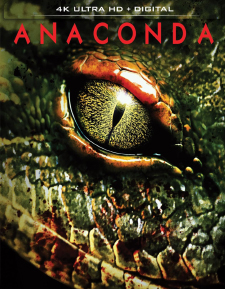
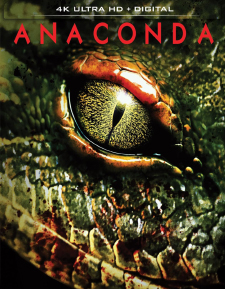
The Sony Pictures 4K Ultra HD Steelbook release of Anaconda is UHD only—there’s no Blu-ray included in the package, but there is a Digital Code on a paper insert tucked inside. There’s also a J-card slipcover. The following extras are included, all of them in HD:
- Commentary with Scott Harrison
- There’s a Devil Inside Everyone: Directing Anaconda (19:04)
- A Perfect Killing Machine: Writing Anaconda (9:20)
- Deleted & Extended Scenes:
- The Expedition Assembles (No Dialogue) (1:57)
- Westbridge’s Complaints (:30)
- Restless Monkeys (3:56)
- Dinner Conversation (4:16)
- Mating Rituals (1:24)
- Domestic Trailer (1:52)
- International Trailer (1:19)
Sony has added two new extras for this release. A Perfect Killing Machine: Writing Anaconda is an interview with original screenwriter Hans Bauer, who discusses how he had been thinking about writing a giant snake story for a long time, but rewatching the 1933 King Kong provided the impetus that he needed to finally sit down and do it. He also discusses how the story and the characters evolved through multiple drafts of the script (although unsurprisingly, he doesn’t mention Jim Cash and Jack Epps, Jr. by name). There’s also a new set of Deleted & Extended Scenes, none of which are particularly interesting—at 89 minutes, Anaconda is long enough as it is.
The archival extras include a commentary featuring author, playwright, and screenwriter Scott Harrison, which was originally recorded for the 2019 Anaconda Quadrilogy Blu-ray set from 88 Films in the U.K. Harrison says that he’s “delighted to be able to spend the next 90 minutes with you” watching Anaconda, and good for him. He considers the film to be a modern creature feature, and given that King Kong helped drive Bauer to write it, he’s not too far off the mark. (I still prefer to go straight for the less ambiguous “monster movie” appellation.) Harrison offers biographical information about Luis Llosa and most the cast, minor roles included, and also discusses the locations, the many references to Jaws, and the special effects. (His enthusiasm gets the better of him when he says that the integration of the practical anaconda effects with the CGI are seamless, something that wasn’t even true in 1997, let alone now.) Not a great commentary, but a diverting enough listen.
There’s a Devil Inside Everyone: Directing Anaconda was added for the 2014 Blu-ray from Mill Creek Home Entertainment in the U.S. It’s an interview with Luis Llosa, who says that he has always liked thrillers but has never been a fan of horror. He took on the Anaconda job as a way of challenging himself. Speaking of challenges, he explains how difficult that it was to put together a marketable ensemble cast when so much of the budget was going to visual effects. They weren’t all happy to be working on location, so he jumped in the water—literally—to make them more comfortable with the shooting conditions. Llosa discusses why he hired Bill Butler to lens the film even though the two of them had experienced friction on the set of Sniper, and he also describes working with Walt Conti and Sony Imageworks.
Considering the fact that these days, some studios are actually dropping old extras from catalogue titles when upgrading them to 4K, it’s nice that Sony has put together a collection of old and new ones for Anaconda. The only things missing here are the rest of the extras from the 88 Films set: interviews with Kim Newman, Steve Johnson, Leonard Rabinowitz, and Jonathan Melville. But they’ve never been included on a North American release anyway, and at least Sony was able to license the Harrison commentary. Combine that with significantly improved picture and sound quality, and Sony’s 4K Ultra HD release of Anaconda is the one to beat for fans of the film (you know who you are).
-Stephen Bjork
(You can follow Stephen on social media at these links: Twitter, Facebook, BlueSky, and Letterboxd).