
Malpertuis (Blu-ray Review)
Director
Harry KümelRelease Date(s)
1972 (October 28, 2025)Studio(s)
Artemis Film/Les Productions Artistes Associés (Radiance Films)- Film/Program Grade: C+
- Video Grade: A-
- Audio Grade: B+
- Extras Grade: A

Review
One of the most bizarre and fascinating horror films of its time, Harry Kümel’s Malpertuis, released in the United States and the United Kingdom as The Legend of Doom House, defies not only its genre, but expectations entirely. Primarily a Gothic horror tale at the outset, it sets the stage for a densely-constructed and sometimes disturbing labyrinth of unusual ideas, a striking visual palette, and a cluster of human jetsam. Kümel, who also directed the more popular erotic horror film Daughters of Darkness one year prior, was given a rather lavish budget by United Artists to adapt Jean Ray’s 1943 novel of the same name. Though many things were ultimately left out of the film version as the director deemed it impossible to adapt from the very beginning, it still manages to capture the madness of the original text, proving to be provocative and demented right through to its head-scratching ending that leaves far more questions than answers.
On shore leave with his friends, young sailor Jan (Mathieu Carrière) attempts to locate his childhood home, only to be abducted by the odd and mysterious Dideloo (Michel Bouquet). He wakes up with his beloved sister Nancy (Susan Hampshire) by his side, who’s eager to introduce him to Malpertuis, a secluded mansion with a tangled web of rooms and corridors. There he meets the owner, his bedridden uncle Cassavius (Orson Welles), whom is on the verge of death and wishes to gather his various relatives and servants living in the mansion for the reading of his will. Since they’re all eager to obtain his vast fortunes, he decrees that his wealth will be divided up among them, but with the provision that they never leave Malpertuis. Jan attempts to take his sister away and return to civilization, unconcerned with his inheritance, but a dark mystery lurks within the mansion walls, eventually revealing itself to everyone. Among the cast are Jean-Pierre Cassel, Daniel Pilon, Walter Rilla, Dora van der Groen, Charles Janssens, and Sylvie Vartan.
One would be hard-pressed to come out on the other side of Malpertuis without being left in a state of confusion. Indeed, the general summation of the plot doesn’t even begin to scratch the surface of what this film offers. As it continues on, it descends full on into an almost dreamlike state, chaotic and enigmatic at every turn. You’re given answers, but even those answers are not entirely reliable. Like the original novel, it purposefully leaves the story in a state of ambiguity, making it more of an art piece than a straight horror narrative. By the end, you have to make up your own mind about what it all means, if you get anything out of it at all.
What’s impossible to ignore is how the film looks and feels. It doesn’t look like anything you’ve ever seen, except perhaps in a nightmare. The gloomy and sometimes disgusting passageways of Malpertuis are meticulously crafted, as is the lighting and framing of the varying shots. It aids the disorientating feeling in your gut that you can’t quite place, but you can’t stop looking at it. In addition, performances are solid across the board, even great, although Orson Welles has little to do other than bellow for his breakfast and look cold and pensive to those around him. What Malpertuis winds up being more than anything is a tour-de-force group of performances by Susan Hampshire, who portrays five different characters, although you might not notice them all on an initial watch since they’re all quite different in appearance and approach.
Sadly, Malpertuis did not light the world on fire when it was released in 1972 at the Cannes Film Festival. The version that was shown there was cut together with an editor assigned by United Artists to try and make it more streamlined, but it wasn’t well-received. Amazingly, Harry Kümel was later given the opportunity to create his own director’s cut in Belgium. It didn’t garner any praise either, but it allowed the director to have a version of the film available that he was satisfied with. Since that time, more attention has been given to the film, particularly among cinephiles more than horror fans, but it still isn’t quite as celebrated or discussed as it perhaps should be.
Cinematographer Gerry Fisher shot Malpertuis on 35mm film with spherical lenses, which was finished photochemically, and presented theatrically in the aspect ratio of 1.85:1. Radiance Films debuts a 2023 4K restoration of the Flemish director’s cut version as the main option (the original Cannes Cut is included as an extra), which was scanned in from the original camera negative by CINEMATEK, overseen by director Harry Kümel, authored by David Mackenzie of Fidelity in Motion, and encoded to a dual-layered BD-50 disc. It’s worth noting that there are moments when the film freezes by necessity to match the audio. By and large, this is an outstanding upgrade from previous DVD releases. It might be a frustrating experience for those more familiar with the film as Kümel has performed some aggressive revisioning in the color grading, making hues incredibly vivid and some moments much darker that they were prior. If this is too much of an issue, there’s always the Cannes Cut option (though it’s presented in much lesser quality). The director’s cut also offers a consistently strong picture with sharper detail and maxed out bitrates that often sit in the 30 to 40Mbps range. Blacks are super deep, even if contrast isn’t all that ideal, particularly during scenes later in the film in the city streets at night where very little light can be seen and figures appear to be lost in the darkness. Some mild damage is visible, which is mostly limited to speaking and scratches, but the overall presentation is stable and organic to its source.
Audio is included in Dutch mono LPCM with optional English subtitles. It’s a bit on the thin side, but relatively strong with only mild hiss. Dialogue is obviously loose against the picture, but it’s prioritized well enough, as are sound effects and Georges Delerue’s score.
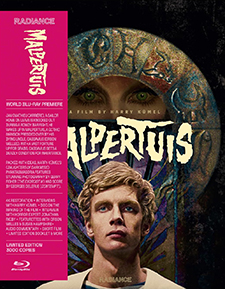
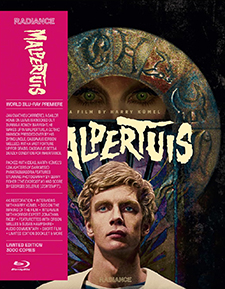
The Radiance Films Limited Edition Blu-ray release of Malpertuis sits a clear Amaray case with double-sided artwork, featuring new artwork on the front by Time Tomorrow and the Belgian theatrical poster artwork on the reverse. Alongside it is an 80-page booklet containing cast and crew information, The French Connection by Lucas Balbo, The Trickster’s Maze by Maria J. Pérez Cuervo, Post-War European Horror and the Labyrinth of Malpertuis by Willow Catelyn Maclay, Malpertius and the Golden Age of Transcendental Horror by David Flint, From Art House to Doom House: Harry Kümel’s Short Films by Jonathan Owens, transfer notes, release credits, very special thanks, and special thanks. Everything is housed in rigid slipbox with a removable OBI strip, also featuring new artwork by Time Tomorrow, and limited to 3,000 units. Though this edition is mostly out of circulation at this point, a standard edition without the slipbox and booklet is also available. The following disc-based extras are included on both releases:
- Audio Commentary by Harry Kümel and Françoise Levie
- Harry Kümel on Malpertuis (HD – 19:43)
- Jonathan Rigby on Malpertuis (HD – 26:00)
- Malpertuis de archieven (SD – 37:22)
- Orson Welles Uncut (SD – 25:54)
- Susan Hampshire: One Actress, Three Parts (SD – 11:43)
- Archival Interview with Michel Bouquet and Harry Kümel (SD – 13:36)
- Jean Ray, John Flanders 1887–1964 (HD – 7:53)
- Malpertuis Revisited (SD – 4:54)
- Malpertuis: The Cannes Cut (Upscaled SD – 103:52)
- French Trailer (Upscaled SD – 3:35)
- De grafbewaker (Upscaled SD – 36:43)
Many of the extras included with this release carry over from the 2005 Belgian Royal Filmarchive DVD and the 2007 Barrel Entertainment DVD, which shared a lot of the same materials. First is an English-language audio commentary with Harry Kümel, which is moderated by his assistant director Françoise Levie. Despite some quiet passages, they happily share their memories of the making of the film while watching it together. Next are a pair of new interviews. Kümel discusses being introduced to the original novel and initially finding it impossible to adapt, the difficulties in working with Orson Welles, initially meeting with Catherine Deneuve for the lead, casting Susan Hampshire, being forced to edit the film with an editor who didn’t understand the material, later re-cutting a Flemish version, restoring the film, and its legacy. Author and Gothic horror expert Jonathan Rigby then examines how the film affects viewers, details its production and release history, analyzes its content and thematics, points out differences from the original novel, and summarizes his thoughts on how the film could be seen today by modern viewers.
The documentary Malpertuis de archieven (Malpertuis Archive) by Erik Martens follows, which features interviews with Kümel, Mathieu Carrière, Gerry Fisher, and producer Pierre Levie; as well as footage from Cannes in 1972, vintage interviews with Josef von Sternberg and Alfred Hitchcock, scenes from Kümel’s other films, and Kümel touring filming locations. Some of the same interviews are utilized for Orson Welles Uncut, as well as an interview with Susan Hampshire, and outtakes from the film. Speaking of Hampshire, Susan Hampshire: One Actress, Three Parts is dedicated to her work, which also includes silent screen test footage. Next is an archival interview with Michel Bouquet and Harry Kümel who discuss the film for Belgian television in 1971. Jean Ray, John Flanders 1887–1964 offers a brief fireside chat with the titular novelist about his life. Presented in Dutch, Malpertuis Revisited sees Harry Kümel revisiting locations from the film more fully. Malpertuis: The Cannes Cut is the aforementioned rejected version not overseen by Kümel. It’s taken from a standard definition source with quite a bit of telecine wobble, presented with English or French mono Dolby Digital audio and optional subtitles in English SDH. Last is the film’s French trailer and De grafbewaker, or The Warden of the Tomb, a 1965 short film by Kümel, based upon Franz Kafka’s play of the same name.
It’s worth noting that the 2005 Belgian Royal Filmarchive DVD release included a French version of the audio commentary, as well as an exclusive Dutch language commentary by Kümel, and his silent short film Aether from 1960. The 2007 Barrel Entertainment DVD release also includes Reflection of Darkness: Del Valle on Kümel, which features an interview with David Del Valle.
Many newcomers will find Malpertuis to be challenging, and it’s not hard to understand why. At the same time, one can’t help but be fascinated by it, even if it doesn’t entirely work for them. Radiance Films’ Blu-ray release brings the film to Blu-ray in a rather stunning package with terrific extras package, one that should fully aid those in search of further enlightenment. Highly recommended.
- Tim Salmons
(You can follow Tim on social media at these links: Twitter, Facebook, BlueSky, and Letterboxd. And be sure to subscribe to his YouTube channel here.)