
Key, The (4K UHD Review)
Director
Tinto BrassRelease Date(s)
1983 (March 24, 2026)Studio(s)
Selenia Cinematografica/International Video Service/San Francisco Film (Cult Epics)- Film/Program Grade: N/A
- Video Grade: A-
- Audio Grade: B
- Extras Grade: A-

Review
The Key (La Chiave) was certainly not Tinto Brass’ first foray into erotic filmmaking, but it was post the aftermath of Caligula, which is the most overtly sexual film that Brass ever had a hand in. Of course, that wasn’t by his making since the film was notoriously re-cut with newly-shot scenes of hardcore sex, a version of the film that both Brass and screenwriter Gore Vidal completely disowned. In retrospect, The Key, despite being sourced from a Japanese novel published in 1956, is clearly Tinto Brass fully unleashed as an erotic filmmaker. It illustrated his desire to see more playful erotic cinema that both men and women could enjoy, which was only further exemplified in his future works, but it was also the moment when the Tinto Brass house brand was fully formed without any outside interference. It stirred up some mild controversy, as his films often did, but through and through, it was his film, and there was no denying that.
Twenty years into their marriage, Nino (Frank Finlay) finds himself unable to arouse his beautiful younger wife Teresa (Stefania Sandrelli), recording his dissatisfaction and his deepest desires in a secret diary. Their daughter Lisa (Barbara Cupisti) brings home her fiancé Laszlo (Franco Branciaroli), who loans Nino his camera wherein Nino feels inspired and begins taking secret photos of his wife in the nude while she’s passed out drunk. He gives the film to Laszlo to develop it, getting off on the idea of being jealous that Laszlo will see his wife undressed. Sometime later things escalate as Teresa becomes more lustful, culminating in an affair with Laszlo, the details of which she records in her own secret diary. This re-ignites the passion in her marriage to Nino, playing sexual mind games with him as he continues to be inflamed by her private affair.
Based on the novel Kagi by Junichiro Tanizaki, Tinto Brass’ adaptation keeps the basic spine and events of the original story intact, but it isn’t revealed until later in the book that “The Professor” and “Ikuko” (Nino and Teresa) were actually reading each other’s diaries and that each of them knew it. Obviously this was something that Tinto Brass felt worked better as a part of the main narrative, heightening the intimacy between Nino and Teresa. He also chose to transplant the story into 1940s Rome during World War II with Benito Mussolini as the prime minister. It’s mostly referenced early on and as the film comes to close, perhaps to help illustrate that sexually repressed and unsatisfied individuals can become more carnal, not just “deviants”. He had already explored eroticism in a fascistic setting in 1976’s Salon Kitty, but in a much different context.
Of course, Nino’s and Teresa’s activities are seen as immortal by society, both outside the film and within it, especially by their daughter Lisa who discovers what’s occurring early on and becomes indignant and detached in light of it, almost as if she’s pretending that nothing is happening at all. The Key is nothing if not an overt moral quandary about marital bliss and how it is achieved, but also Tinto Brass’ continued fascination with human sexuality and the female form. The film was a success in European territories and established Brass as one of the kings of art house erotica, offending many, enlightening others, and entertaining everyone in between.
Cinematographer Silvano Ippoliti shot The Key on 35mm film with spherical lenses, the results of which were processed photochemically, and presented theatrically in the aspect ratio of 1.66:1. Cult Epics debuts the film on Ultra HD with a 4K restoration from the original camera negative, which has been graded for High Dynamic Range in HDR10, and encoded to a dual-layered BD-66 disc. It’s another beautiful presentation by Cult Epics, who are slowly bringing all of his films back to life in 4K. It’s highly filmic with mostly well-resolved grain and a bitrate that sits between 60 and 90Mbps most of the time. Detail is high, not just in foreground and daytime scenes, but in dimly-lit nighttime interiors and exteriors. The HDR grade isn’t overly aggressive, allowing for natural swatches of red, blue, and green, but never appearing oversaturated or unnatural. Blacks are super deep with terrific contrast, and the overall image is clean and stable. There’s possibly a few frames missing at the 84:45 mark, as well as some minor color fluctuations for the rest of the shot, but outside of that and some mildly unstable grain, it’s a gorgeous image.
Audio is included in a single English/Italian 2.0 mono DTS-HD Master Audio track with optional subtitles in English for the Italian dialogue only. Not including subtitles for the English dialogue and not having an alternate track entirely in Italian is an odd choice, but the audio track that is provided has plenty of positive aspects to it. A mild natural hiss is present, while dialogue and Ennio Morricone’s score come through well in this split channel track. There’s a possible sync issue between 82 and 84 minutes, but it’s so subtle that it’s difficult to even spot, if it even exists. Otherwise, this is a satisfactory track.
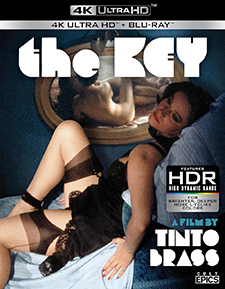
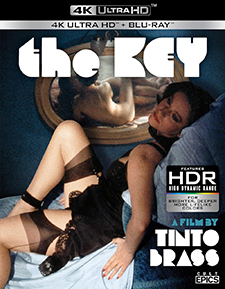
The Cult Epics 4K Ultra HD release of The Key is a 2-Disc set that’s packaged in a black Amaray alongside a 1080p Blu-ray; a 20-page insert booklet containing various photos and the essay The Body of a Generation, Stefanie Sandrellia: From Sicily to Venice by Eugenio Ercolani; a double-sided insert showcasing a still of Sandrellia on the front with the English title and the Italian theatrical poster with the Italian title on the reverse; and a slipcover featuring an alternate still of Sandrellia. Exclusive to the Cult Epics website is a Limited Edition variant limited to 500 units that features an alternate slipcover with the same still but with a blue background, and four lobby card reproductions. The following extras are included on each disc in both variants:
DISC ONE (UHD)
- Audio Commentary by Eugenio Ercolani and Marcus Stiglegger
- Tinto Brass Trailers:
- The Key English Language Trailer (HD – 3:07)
- Cheeky! (Transgressing) English Language Trailer (HD – 3:24)
- Frivolous Lola (Monella) Italian Trailer (HD – 2:17)
- All Ladies Do It English Language Trailer (HD – 3:21)
DISC TWO (BD)
- Audio Commentary by Eugenio Ercolani and Marcus Stiglegger
- Tinto’s Talisman: An Interview with Franco Branciaroli (HD – 38:55)
- Keyhole Venice (HD – 7:34)
- Sensuous Morricone (HD – 28:29)
- Score by Ennio Morricone (HD – 32:05)
- Archival Interview with Tinto Brass (SD – 16:52)
- Outtakes Venice (HD – 10:14)
- The Key Poster Gallery (HD – 33 in all – 2:45)
- Tinto Brass Photo Gallery (HD – 33 in all – 2:48)
- Tinto Brass Trailers:
- The Key English Language Trailer (HD – 3:07)
- Cheeky! (Transgressing) English Language Trailer (HD – 3:24)
- Frivolous Lola (Monella) Italian Trailer (HD – 2:17)
- All Ladies Do It English Language Trailer (HD – 3:21)
Film historians Eugenio Ercolani and Marcus Stiglegger provide audio commentary duties for this release, delving into the film’s political under and overtones, while also exploring the state of Brass’ career at this time and how important The Key is in terms of his career and where it wound up. Tinto’s Talisman interviews actor Franco Branciaroli who discusses the differences between theatre and film acting and why theatre is more truthful, being a successful thespian early on, working with Michelangelo Antonioni and Miklós Jancsó, becoming Tinto Brass’ good luck charm, being attracted to Stefania Sandrelli, shooting in Venice, Brass creating adult films for couples, his emphasis on ladies’ rear ends, how large his productions were, his respect for theatre actors, Branciaroli’s relationship with Franco Interlenghi, being comfortable with nudity, and his work in other Tinto Brass productions.
Keyhole Venice is a 2026 filming locations tour in Venice. Sensuous Morricone features an interview with music historians Pierpaolo De Sanctis and Claudio Fuiano about Ennio Morricone’s career and the score he produced for the film, following by an Isolated Score segment showcasing ten selections of Morricone’s music. Next is a 2001 interview with Tinto Brass explaining his interest in eroticism, making changes from the source novel, shooting in Venice and being inspired by it, people being appreciative of his work and offended by it, and the pros and cons of shooting The Key in English. Newly-included is a set of Outtakes featuring multiple takes of location establishments in Venice. The Key Poster Gallery also features lobby cards, while the Tinto Brass Photo Gallery contains behind-the-scenes photos from his films. Last is the film’s trailer, plus trailers for other Tinto Brass-directed films available from Cult Epics.
Despite the high quality of the bonus materials, there are several notable things missing from previous releases. The Tinto Brass Collection DVD release by Arrow Video in 2012 features a 1991 interview with Tinto Brass, while the Region 2 DVD by Raro Video in Italy features a longer interview with Brass than the one on this release. The 2023 Region B Blu-ray release by Sidonis Calysta contains an introduction by writer and film critic Francois Guerif and a set of deleted scenes taken from the Director’s Cut. Also released in 2023 on Region B Blu-ray by Wicked Vision Media is a set of German credits. The aforementioned Director’s Cut features five extra minutes of footage, though none of it has to do with the nudity or erotic content. One scene involves Nino examining a piece of artwork before having a dizzy spell, and another features Teresa buying her diary. Earlier releases also include a different poem read by Nino.
With P.O. Box Tinto Brass currently in the works, Cult Epics continues to deliver excellent releases of Brass’ catalogue, The Key among them. One of his most important and beloved features, it’s finally been given the proper UHD treatment and belongs on every Brass fan’s shelf. For them, this release is highly recommended.
- Tim Salmons
(You can follow Tim on social media at these links: Twitter, Facebook, BlueSky, and Letterboxd. And be sure to subscribe to his YouTube channel here.)