
Day of the Dead (4K UHD Review)
Director
George A. RomeroRelease Date(s)
1985 (June 16, 2026)Studio(s)
Laurel Entertainment (Shout! Studios/Scream Factory)- Film/Program Grade: B+
- Video Grade: B
- Audio Grade: B
- Extras Grade: A

Review
George A. Romero is unquestionably the godfather of the modern zombie genre, even though the creatures that he introduced with his landmark 1968 film Night of the Living Dead are technically flesh-eating ghouls, not zombies (and he never used the word “zombie” in that film in the first place). But let’s not bandy semantics; the nomenclature ended up being applied to them anyway, and it stuck so hard that it’s never going to go away. Yet however much that Romero is associated with zombies, they were never his real interest—zombies were always a means to an end, not necessarily an end unto themselves. The consistent theme running throughout his zombie films has always been the dissolution of societal norms and mankind’s inhumanity toward their fellow man. While he toyed with that theme elsewhere, especially in The Crazies (which, to be fair, was essentially a zombie story in the guise of a viral outbreak thriller), it was always the most clearly developed in his Dead films.
Night of the Living Dead laid the groundwork for it by having the zombies serve as the fuel that feeds the fire of conflict between Ben and Harry Cooper. And as the social structures that surround them start to collapse, zombies also fuel the rise of gun-toting militias so eager to exercise their right to bear arms that they can't distinguish friend from foe—especially when the target in their crosshairs happens to be a black man. (And the real genius of Night of the Living Dead is that it never once refers to the fact that Ben is black, allowing viewers to draw their own conclusions.) Dawn of the Dead developed the theme further by showcasing the continued breakdown of society, with renegade biker gangs taking full advantage of the chaos, while ordinary people are caught in the crossfire between these armed looters on the one side and flesh-eating zombies on the other (and making plenty of dubious moral choices of their own along the way). The savage critique of consumerism provided by the shopping mall setting was just the satirical icing on Romero’s already tasty cake.
All of that serves as necessary context in order to understand a curious fact that may seem surprising at first glance: despite the critical and commercial successes of both Night of the Living Dead and Dawn of the Dead, Romero stated repeatedly that his follow-up Day of the Dead was actually his own personal favorite of the original three films, and also of the franchise as a whole. Given the compromises that he had to make in order to bring this one to life (so to speak), that may seem a little odd. Yet it makes perfect sense, at least on a thematic level. But to clarify why, it’s necessary to address what went wrong (and inadvertently right) during the making of Day of the Dead.
Romero developed Day of the Dead as part of a production deal that he had with financier/producer Salah M. Hassanein, and initially at least, his reach exceeded Hassanein’s grasp. Romero’s original concept was much larger in scope than what eventually reached the screen, but Hassanein was actually fully on board with the necessary $7 million budget, although with one major condition: Romero had to deliver an R-rating, since unrated films like Dawn of the Dead were much more difficult to market and distribute. Either that, or else he had to scale everything back to fit into a much smaller budget. Romero did just that, Hassanein released Day of the Dead unrated, and the rest was history. Yet in order to make the smaller budget work, Romero had to strip down the scope of his story and confine it to a single setting, while also eliminating some of the elaborate set pieces that he had originally planned (makeup designer Tom Savini called them “Raiders of the Lost Ark with zombies.”)
Romero’s simplified story is set in an abandoned missile bunker in Florida, pitting the human survivors not just against the zombies, but also against each other (shades of the original film). On the one side, you have a group of scientists and their assistants searching for a solution to the pandemic, led by Dr. Sarah Bowman (Lori Cardille): Dr. “Frankenstein” Logan (Richard Liberty), Dr. Fisher (John Amplas), helicopter pilot Flyboy (Terry Alexander), and alcoholic radio operator Bill (Jarlath Conroy). On the other side, you have their disgruntled military support team led by Capt. Henry Rhodes (Joseph Pilato): Pvt. Steel (Gary Howard Klar), Pvt. Torrez (Taso N. Stavrakis), Pvt. Johnson (Greg Nicotero), and a dwindling group of others. Caught somewhere in the middle is Dr. Bowman’s occasional lover Pvt. Salazar (Anthony DiLeo), as well as the unforgettable face of the zombies that the scientists have been studying, Bub (Sherman Howard).
Romero’s Dead films have always been not so much about the rise of zombies as they are about the collapse of humanity, but in Day of the Dead, his focus is more narrowly on the loss of community that results from an inability to connect with each other. Rather than being physically pushed apart by the chaos outside, these characters have been pushed even closer together inside of a confined setting. Yet despite the fact that they’re literally sitting right across the table from each other, they just can’t see eye to eye. This abandoned bunker is their island, and they’re playing out Lord of the Flies in real time.
There was a taste of all that in Dawn of the Dead, but the greater scope afforded by the mall setting diffused the message somewhat, since Romero couldn’t resist throwing in his critique of consumerism at the same time. Had Day of the Dead expanded the setting further in accordance to his initial vision for the film, the core message could have become even more diluted. So, in a strange way, Salah M. Hassanein did Romero a favor by delivering an ultimatum about the budget and/or the final MPAA rating. The smaller scale of Romero’s revised script may not have been what he originally had in mind, but it actually works in the film’s favor. It emphasizes the isolation felt by the dwindling number of human survivors of this zombie apocalypse, and it intensifies the conflict between them. “Yep, son, we have met the enemy and he is us,” as Walt Kelly reminded us back in 1971, during the height of the external conflict of the Vietnam war.
Romero may not have had Pogo in mind while he was working his way through many drafts of the script for Day of the Dead, but he absorbed Kelly’s lesson anyway. “You see, Sarah, they are us, they are the extensions of us,” Dr. Logan explains when Sarah is starting to question the validity of their work. And it’s not a great leap from the inhumanity of these flesh-eating ghouls to the inhumanity that mankind displays on a daily basis. Or, as Logan tells Capt. Rhodes: “How are we going to set an example for them if we behave barbarically ourselves... Civil behavior is what distinguishes us from the lower forms. It’s what enables us to communicate. To go about things in an orderly fashion, without attacking each other like beasts in the wild. Civility must be rewarded, captain. If it isn’t rewarded, there’s no use for it.” The problem is that like far too much of humanity in general, Capt. Rhodes no longer has any use for civility, and Bub is now more human than he’ll ever be.
Is all of that a bit too on-the-nose? Perhaps, but it’s worth pointing out that Romero was hardly a subtle filmmaker, and Day of the Dead is anything but a subtle film (and for those who may think otherwise, they’ll end up choking on it long before the film is over). But it does make it easier to understand why Day of the Dead was Romero’s personal favorite. It’s the clearest expression of the themes that fascinated him ever since he made his first feature in 1968, and he never let go of those themes right up until the very end of his unfairly maligned final film Survival of the Dead in 2009. It’s just that there’s no missing his message in Day of the Dead, for good or for ill. Love it or hate it, it’s pure George A. Romero.
(Hat tip to Friend of the Bits John Schuermann for unintentionally giving me the idea for how to structure this essay.)
Cinematographer Michael Gornick shot Day of the Dead on 35mm film using Arriflex 35BL cameras with spherical lenses, framed at 1.85:1 for its theatrical release. This version is based on a 16-bit 4K scan of—well, pull up a chair and sit a spell. The original camera negative for Day of the Dead has been walkabout for some time now, and Shout’s previous Blu-ray version was based on a 2K scan of the interpositive instead. But then the IP went walkabout as well, and tracking it down took years. Yet Shout finally figured out where it trundled off to, and started preparing this version, with scanning, digital restoration work, and grading performed by Duplitech (both Dolby Vision and HDR10 are included). The results are... well, they’re complicated.
The image is quite soft all throughout the film. An IP is never going to offer the same levels of fine detail that a negative scan can provide, although it’s worth pointing out that the Christopher Nolan films that have been transferred from IPs still took sharp and detailed. Regardless, in this case, most of the softness is probably baked into the IP and can’t be helped. But unfortunately, it’s been exacerbated here thanks to the grain management tools that were used. The generational loss on an IP means that the grain is usually noticeably softer than it was on a negative, but the grain in this 4K version of Day of the Dead has been massaged to the point that it no longer looks natural. It’s likely some sort of temporal filtering, which averages pixel values over time in areas of the frame that aren’t in motion. The faint layer of grain that remains frequently looks blurry and even has blotchy patches—it just doesn’t look like IP grain should. And all the grain reduction has the unintended side effect of making the image look even softer than it would otherwise, since grain adds the perception of detail. Take an already soft IP, tamp down the grain too far, and it ends up looking even softer.
That’s unfortunate, because in all other respects, it’s a fine 4K remastering job. There are a few small scratches here and there, but no major damage of note, and while the reduced exposure latitude due to generational losses means that the blacks in the darkest scene are lacking definition, the contrast range is quite good. I don’t have any reference material to judge the accuracy of the color grading, but everything looks right here (and according to the restoration featurette on the disc, they fixed a few points where previous grades have been inaccurate). Given the source element that was available, Day of the Dead was never going to be a huge upgrade over Blu-ray, but it still looks pretty good overall. It’s just that it could have looked even better with a lighter hand at the digital toolkit.
Audio is offered in English Dolby Atmos, plus 5.1, 2.0 mono, and 2.0 stereo DTS-HD Master Audio, with optional English SDH subtitles. (There’s also an isolated music and effects track in 2.0 mono Dolby Digital.) Day of the Dead was released theatrically in mono, so all of these are remixes, but the sources vary. The most straightforward one is the 2.0 stereo track from the 1986 Japanese LaserDisc, which appears to have used the “Zombieing Sound” remix that was promised on one of the Japanese trailers. It’s the original mono mix with some very aggressive synthesized stereo spread and surround activity added to it—overly aggressive, as a matter of fact, since it ends up sounding thin and artificial. But at least it preserves all of the original dialogue and effects, because unfortunately the other tracks don’t. Instead, they all contain the same errors that have been floating around for more than two decades now.
While the VHS, LaserDisc, and initial DVD releases all contained more or less the same mono audio (the Japanese LD excepted), Anchor Bay’s 2003 Divimax Special Edition DVD added three different surround mixes: 2.0 stereo Dolby Digital, 5.1 Dolby Digital EX, and 6.1 DTS-ES. The trouble was, all three versions introduced some altered dialogue and effects at a handful of points, possibly taken from a version prepared for television. While the bulk of the profanity (including every single F-bomb) is intact, a few moments have been redubbed to something less offensive, and there are other minor changes as well. There are lists of the changes available online (DVD Savant’s 2003 review at DVDTalk has one), but here’s a more detailed breakdown with the timestamps corrected to match the UHD:
- 9:16 – Flyboy’s “it’s crazy” is redubbed by a different actor, minus the West Indies accent
- 9:36 – Flyboy’s “shit” is changed to “right”
- 58:52 – Steel’s gunshot sound effect is weirdly truncated
- 61:38 – Steel’s “it's the sp*c” still has the slur, but with a different line reading
- 71:25 – Sarah’s “Oh Jesus” is changed to “I can't look”
- 80:36 – Steel’s “Jesus” is changed to “stuck”
All of those changes are present on the Atmos, 5.1, and 2.0 mono tracks here—which means that contrary to Shout’s advertising, the 2.0 mono is not the original mono, but rather a fold-down of one of the newer mixes. The irony with that is that it still sounds better than any of the other tracks on the disc, the LD audio included, and it even sounds better than the actual original mono audio on Shout’s previous Blu-ray. That track was harsh and excessively sibilant, but all of that has been smoothed out here. The Atmos and 5.1 remixes are also relatively smooth, but they’re poorly balanced with the dialogue mixed down at far too low of a level (that’s especially true of the Atmos track). While none of the audio options are level-matched with each other (they’re not even close), even after accounting for that fact, the 2.0 mono track still sounds better balanced and more robust (it’s kind of like the difference between the early Beatles mono mixes and the afterthought stereo mixes). Unfortunately, it’s also still got the incorrect dialogue.
Do those alterations make much of a practical difference to the film? No, they don’t, and if they weren’t pointed out to you, you’d probably never notice. But here’s the thing: all of these minor changes have been well-known ever since 2003, so there really isn’t a good excuse for letting them slip through the cracks now. Both Arrow in the U.K. and Umbrella in Australia corrected the issue with their own 5.1 mixes. Frankly, it wouldn’t matter as much if the “original mono” here really was the original mono, because neither of Shout’s new Atmos or 5.1 mixes offer any real improvements. But it’s not the original mono. No, the minor alterations don’t impact the viewing experience, but yes, it’s not acceptable that Shout failed to catch them on such a highly anticipated release.
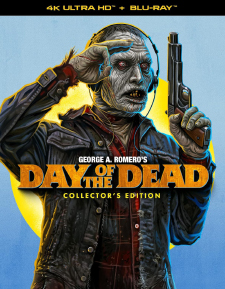
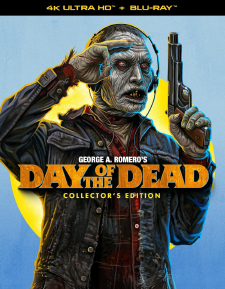
In any event, the Shout! Studios Collector’s Edition 4K Ultra HD release of Day of the Dead is a four-disc set that includes a Blu-ray with a 1080p copy of the film, a second Blu-ray with the documentary The World’s End: The Making of Day of the Dead, and a third Blu-ray with the rest of the extras. It also includes 12 lobby cards. The film discs and the extras discs are each in their own separate Amaray cases with archival artwork, and everything comes housed in a rigid slipcase with new artwork by the CRP Group. The following extras are included:
DISC ONE & TWO: UHD & BD
- Commentary by George A. Romero, Tom Savini, Cletus Anderson, and Lori Cardille
- Commentary by Daniel Kraus and Drew McWeeny
- Isolated Music & Effects
Shout has added a new commentary featuring critic Drew McWeeny and writer Daniel Kraus, author of Partially Devoured: How Night of the Living Dead Saved My Life and Changed the World. (Kraus also co-authored the 2020 novel The Living Dead along with George Romero). They describe their own first experiences with the Dead series and their feelings about Romero. They also look at the series as a whole, describing Day of the Dead as the sixth and final film in the franchise even though it was made third. They do cover some practical details about the production like the cast and the crew, and even address the 4K remastering, but they’re far more interested in the film itself and their own perspectives on it. As a result, it’s not really a scene-specific commentary, but rather a dialogue between two fans of the franchise. But they’ve got a lot to say about it, so they never run out of steam.
The archival commentary featuring Romero, Tom Savini, Lori Cardille, and production designer Cletus Anderson was originally recorded for the 2003 Divimax Special Edition DVD. Needless to say, it’s a much more practical track, offering a wealth of stories about the making of the film from conception to production. It’s still conversational, since they were all good friends, but it’s always worth sitting in on any conversation with the late great George A. Romero.
DISC THREE: BD
- The World’s End: The Making of Day of the Dead (HD – 85:26)
The World’s End was originally created for Shout’s 2013 Collector’s Edition Blu-ray. Produced and directed by Michael Flesher for his Red Shirt Pictures, it includes interview with Romero, John Harrison, Pasquale Buba, Michael Gornick, Tom Savini, Lori Cardille, Joseph Pilato, John Amplas, Gary Klar, Terry Alexander, Anthony DiLeo, Howard Sherman, and more. That’s a pretty comprehensive collection of the primary cast and crew for Day of the Dead, and since several of them are no longer with us (R.I.P, George), there will never be another documentary like it. It covers the whole production from beginning to end, from the deal with Hassanein to the theatrical and home video releases, as well as the legacy of the film. Romero doesn’t just acknowledge that Day of the Dead was his own personal favorite in the franchise, he also points out that Survival of the Dead is his other favorite, but fans hadn’t caught up to him yet on that score (and 13 years later, most of them still haven’t). The World’s End is presented here at 1.78:1 with 2.0 Dolby Digital audio.
DISC FOUR: BD
- Interview with Lori Cardille (HD – 26:32)
- Interview with Greg Nicotero (HD – 34:54)
- Interview with John Harrison (HD – 28:41)
- Interview with Suzanne Romero (HD – 25:58)
- Interview with John Amplas (HD – 8:22)
- Interview with Ernest Dickerson (HD – 15:27)
- Interview with Tina Romero (HD – 24:45)
- Monster Mania: Restoring Day of the Dead (HD – 29:21)
- Stink of the Dead (HD – 8:51)
- Underground: A Look Into the Day of the Dead Mines (HD – 7:37)
- Behind-the-Scenes Footage (Upscaled SD – 30:42)
- Wampum Mine Promotional Video (Upscaled SD – 8:12)
- Photo Galleries:
- Behind-the-Scenes (HD – 18:48, 225 in all)
- Day of the Dead Locations (HD – 4:12, 50 in all)
- Posters and Lobby Cards (HD – 9:02,108 in all)
- Miscellaneous (HD – 10:32, 125 in all)
- Theatrical Trailers (HD – 5:55, 4 in all)
- TV Spots (HD – 1:35, 3 in all)
In addition to the new commentary, Shout has also added a collection of new interviews and two new featurettes for this release. The interviews kick off with Lori Cardille, who discusses her experiences making the film, from her casting to why she eventually left the business. KNB’s Greg Nicotero explains how he first met Romero and the path that led him to working with Tom Savini on Day of the Dead. John Harrison talks about his long history with Romero, working as an assistant director, and turning to scoring. George A. Romero Foundation founder Suzanne Romero discusses the Romero archive and the work of the foundation, and also talks about her late husband’s legacy. John Amplas gives a précis of his career with Romero, and then reminisces about the rest of the cast and crew. Cinematographer Ernest Dickerson talks about shooting second unit for Day of the Dead, including his experiences with the alligator. George Romero’s and Christine Forrest’s daughter Tina Romero says that she sees her dad’s spirit in the character of Bub, and offers an affectionate personal portrait of him.
Monster Mania is a restoration featurette detailing the process of locating the interpositive, scanning it, and doing the digital restoration work on both the video and the audio. Shout Studios producer Jeff Roland is joined by Duplitech’s lead film archivist Jeff Flam, as well as by colorist Black Blasingame, restoration artist Louie Soto, and audio technician Dominic Marino. They do mention the fact that they applied grain management, especially for any dupe footage in order to help it blend with the surrounding material, and also point out the scenes that have been regraded compared to the previous Blu-ray to make them more accurate to the original intentions.
Stink of the Dead features Greg Nicotero and John Harrison discussing the very real pig intestines and other entrails that were used for some of the gore effects, and what happened when they went on break and the power was shut off at the mine location, where the stuff had been stored in a refrigerator. (Nicotero also explains where Romero got the idea for the intestine-spilling scene.)
The rest of the extras are ported over from Shout’s previous Blu-ray. Underground: A Look Into the Day of the Dead Mines is a tour of the location led by Ed Demko, with appearances by facility tech Skip Docchio. The Behind-the-Scenes Footage is a collection of home video footage of the effects work that was taken from Tom Savini’s archive. There’s no narration and it jumps around a bit, but fans of SFX makeup in general and Savini in particular will enjoy every minute of it. (At one point, an extra can be seen fanning air away from Joseph Pilato’s face, demonstrating just how bad that the Stink of the Dead really was.) The Wampum Mine Promotional Video is a commercial video advertising the facility, with a phone number and a website if you want more information. Finally, there’s an extensive collection of Photo Galleries, trailers, and TV spots.
Needless to say, for a popular George A. Romero film that’s had a tangled collection of home video rights across the globe, there are plenty of previous extras that aren’t included here. (There never will be a “definitive” release of Day of the Dead in terms of extras, so if you’re a completionist, you just have to accept double-dipping.) Anchor Bay also included the Many Days of Day of the Dead documentary; the Day of the Dead: Behind the Scenes documentary; an audio interview with Richard Liberty; a draft of the script on DVD-ROM; and a commentary by Roger Avery (which Shout did include on their previous Blu-ray, but haven’t carried it over here). Arrow added the Joe of the Dead documentary; the Travelogue of the Dead featurette; and a commentary by Greg Nicotero, Howard Berger, Everett Burrell, and Mike Deak. Umbrella added the Reflections Of The Living Dead documentary and an interview with George Romero. And all of that is just the highlights; there are plenty of other bits and bobs on those and other releases like another set of behind-the-scenes footage; a different location tour; and various other interviews.
While Day of the Dead may not have received enough love in 1985, it’s gotten plenty of love on home video over the decades since then. And, warts aside, there’s plenty of love visible in Shout’s new 4K release as well. But the warts are still there. You’ll have to judge for yourself whether or not they’ll matter to you. But I’m disappointed. This could have easily gotten an overall grade in the A range, but I’m holding off on that until we see whether or not Shout! is willing to do anything about the audio (the video probably is what it is, and your own mileage may vary on that score). If not, it’s only recommended for people who just don’t care about a few minor audio changes—which, to be fair, is probably true of most fans. But if it bothers you, you’re better off waiting to see what happens before shelling out your hard-earned money.
-Stephen Bjork
(You can follow Stephen on social media at these links: Twitter, Facebook, BlueSky, and Letterboxd).