
Talk Radio (Blu-ray Review)
Director
Oliver StoneRelease Date(s)
1988 (May 19, 2026)Studio(s)
Cineplex Odeon Films/Universal Pictures (Kino Lorber Studio Classics)- Film/Program Grade: A-
- Video Grade: B+
- Audio Grade: B+
- Extras Grade: B-

Review
“Talk radio. Free speech isn’t really free at all. It’s actually a little bit like Russian roulette. A very expensive commodity. You never know what’s gonna come up with next time you push the button.”
When Eric Bogosian met Oliver Stone, their own personal game of Russian roulette meant that sparks were going to fly, and no one knew what they were going to come up with. At that point, Stone was in something of a hiatus after Wall Street while he was waiting for Tom Cruise’s availability to open up for Born on the Fourth of July. When Wall Street producer Edward R. Pressman introduced him to Eric Bogosian’s Pulitzer Prize nominated one-act play Talk Radio, Stone was interested, though not necessarily as director. But as he worked with Bogosian to develop a screenplay, he started to take more ownership of the project. The result of their collaboration was one of the most vital and direct films that Stone has ever made, minus any needlessly distracting multimedia experimentation, absurd “counter-myths,” or pretensions of grandeur. In terms of spirit (if not in actual form), it’s more of an indirect successor to his much rawer 1985 effort Salvador—perhaps slightly less political, but no less incendiary.
Bogosian’s play took place on a single night at Cleveland radio station WTLK, where shock jock Barry Champlain has something of a meltdown on the eve of his show going national. For the film version, Bogosian and Stone moved the location to Dallas, rechristened it KGAB, and expanded things to provide a view outside the station, with flashbacks showing how Champlain got into the business in the first place. They also added additional characters like his ex-wife Ellen (Ellen Greene), his producer (and occasional girlfriend) Laura (Leslie Hope), and national program director Dietz (John Pankow). But they retained the character of the local station manager Dan, with Alec Baldwin taking over the role played by Mark Metcalf in the original off-Broadway production. Yet Bogosian himself still played Champlain, and perhaps just as importantly, the inimitable John C. McGinley also returned to play the part of Barry’s longsuffering operator Stu (the fact that McGinley was already an Oliver Stone regular was just a happy coincidence). All that, plus Michael Wincott was retained once again to play Barry’s harebrained caller Kent, and just like in the play, he also provided voices for some of the other callers.
The biggest change in the film version of Talk Radio, however, came from an external source. The play ended with Barry finding a brief moment of solace after his meltdown, leaving the station for the night as radio therapist Dr. Susan Fleming’s show begins. She mentions the fact that she just saw “a man standing on a street corner, obviously mentally disturbed” as the lights fade out and the curtain closes. Given the rampant antisemitism that Barry encounters from some of his callers, Stone had a less ambiguous fate for the shock jock in mind. A few years earlier on June 18, 1984, the equally outspoken and confrontational Jewish talk radio host Alan Berg had been assassinated by members of The Order, a white nationalist group that drew inspiration from the scabrous 1978 novel The Turner Diaries and declared war on what they called the “Zionist occupied government” of the United States. Stone drew in some elements from Berg’s tragic story, and so Barry’s cinematic fate was sealed (the film credits Stephen Singular’s 1987 biography Talked to Death: The Life and Murder of Alan Berg as one of its sources).
It’s an interesting choice, because while Barry did encounter antisemitism in the play and even encountered some veiled threats, he’s already an inherently self-destructive character who lashes out at everyone else in his life as a way of concealing his own lack of self-worth. That’s why his marriage to Ellen failed, and it’s also why he can’t maintain a consistent relationship with Laura. (Only Stu seems willing to put up with Barry’s shit over and over again.) Barry happily wears the moniker of “The Man You Love to Hate,” but in reality, he really does crave approbation. Yet he lashes out at his own audience as well, contemptuous of the fact that some of them sound just as pathetic as he feels. He even actively works to tank his show’s national syndication deal, and almost seems disappointed when he fails to do so.
In fact, Barry is so self-destructive that there’s no bear he won’t happily poke, regardless of how dangerous that it may be. That extends not just to his vaguely antisemitic callers, but to the openly white supremacist ones as well. Barry’s fatal flaw is that he fails to recognize that he shares something in common with those who genuinely hate him: self-loathing. Their justifications may be different, but they both attack other people as a way of compensating for their own feelings of inadequacy. While neither Bogosian nor Stone make that point explicitly in the film, it’s implicit in the conversations that Barry has with them:
“And what if your country is slipping away, lost? I know the argument, friend. It’s the great theory of history. I’ve heard it before. It says, when things ain’t good, instead of getting down and doing something about it, instead of changing your life, it’s a helluva lot easier to blame someone else.”
That’s the same insight that drove Harlan Ellison’s classic 1966 short story A Prayer for No One’s Enemy, which was inspired very loosely by the life and death of Daniel Burros, a high-ranking member of the American Nazi Party and a Grand Dragon of the Ku Klux Klan. Yet Burros was hiding an ironic secret, and he killed himself after it was finally revealed by The New York Times in 1965. Victor Rohrer doesn’t share the same fate in A Prayer for No One’s Enemy, but the self-loathing from his secret identity causes him to lash out just as viciously, and in the end, no less self-destructively. While Barry isn’t shy about his own identity, he still attacks everyone else in his own way:
“I mean who the hell are you anyways you... audience! You’re on me every night like a pack of wolves because you can’t stand facing what you are and what you’ve made... You’re happiest when others are in pain. That’s where I come in, isn’t it? I’m here to lead you by the hands through the dark forest of your own hatred and anger and humiliation... I come in here every night, I make my case, I make my point, I say what I believe in. I tell you what you are, I have to, I have no choice! You frighten me! I come in here every night, I tear into you, I abuse you, I insult you, you just keep coming back for more. What’s wrong with you, why do you keep calling?”
Yet for all of the abuse that Barry heaps on everyone else in his life, for all of his naked self-loathing, for all of his self-destructive behavior, there’s still an impassably wide gulf between him and the worst of the callers that keep coming back for more. For some people, mere verbal attacks like the ones that Barry engages in aren’t a strong enough way to compensate for their own feelings of inadequacy, and so the shock jock will eventually discover Ellison’s essential truth that “no one escapes, when night begins to fall.” As the years have gone by, Barry’s confrontational verbal style has become more commonplace, with major political figures openly espousing nativist rhetoric that would have been beyond the pale even for the worst of talk radio during the Eighties. The problem is, the gulf between these hateful words and those who act upon them has been shrinking steadily to the point when there’s barely any gap at all. However much that some elements of Talk Radio may have dated over the last few decades, Eric Bogosian and Oliver Stone clearly saw where things were heading. It’s just that no one heeded their warning.
Cinematographer Robert Richardson shot Talk Radio on 35mm film using Arriflex cameras with spherical lenses, framed at 1.85:1 for its theatrical release. Kino Lorber describes this version as a “new 2K restoration from an interpositive,” and it’s worth unpacking that carefully worded phrase. There’s little doubt that it’s based on a 2K scan of the IP, but while the remastering work may be new, the scan itself isn’t necessarily a recent one. The results are still a significant upgrade over the 2019 Twilight Time Blu-ray, which almost looked like an upscaled DVD master. But it lacks the levels of clarity and detail that a fresh scan could provide, even when using the IP as a source. The moderate layer of grain doesn’t always look natural—although to be fair, it doesn’t have any of the sharpening or noise reduction that plague older Universal masters, so it’s still an improvement in that regard. There’s some speckling and small blemishes visible, and at least one prominent scratch in the shot of John Pankow at 63:05. If all of that sounds like it’s damning this version of Talk Radio with faint praise, to reiterate, it is an improvement over previous versions—colors, contrast, and yes, detail, are all noticeably better. It just falls short of what could have been accomplished with a little more time, effort, and money.
Audio is offered in English 2.0 DTS-HD Master Audio, with optional English subtitles. Talk Radio was released theatrically in Dolby Stereo, and this sounds like the original theatrical audio—in fact, given that it’s a little harsh and excessively sibilant, it might be a direct port of the theatrical track with no re-eq to compensate for home viewing. Typical of Dolby Stereo mixes from that era, surround activity is mostly limited to light ambience, but it’s a dialogue-focused film anyway. Most of the stereo spread is provided by the score by Stewart Copeland, but the dominant musical association with Talk Radio will always be the Penguin Café Orchestra’s 1981 earworm Telephone and Rubber Band that plays over the closing credits (although to be fair, Nadia Tass and David Parker had already beaten Oliver Stone to the punch on that one by using it in their 1986 Australian classic Malcolm).
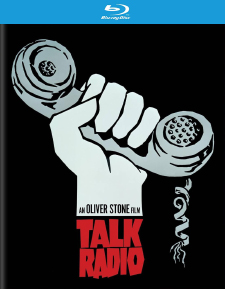
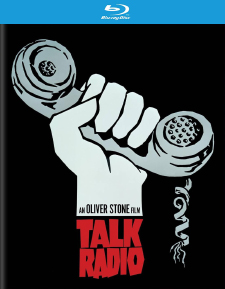
The Kino Lorber Studio Classics Blu-ray release of Talk Radio includes a slipcover that matches the theatrical poster artwork on the insert. The following extras are included:
- Commentary by Alexandra Heller-Nicholas and Josh Nelson
- The Man You Love to Hate (HD – 15:00)
- Talk Radio Trailer (HD – 2:23)
- A Kiss Before Dying Trailer (SD – 1:48)
- Dead Again Trailer (HD – 2:21)
- Runaway Train Trailer (SD – 1:58)
- Vice Squad Trailer (Upscaled SD – :57)
Kino Lorber has added a new commentary for this release featuring author Alexandra Heller-Nicholas and academic Josh Nelson, who open the commentary by discussing their own experience with radio and noting that there are some awful, awful people out there. They point out a loose connection between Bogosian’s own writing process and Australian talk radio, providing a tongue-in-cheek justification for why they’re doing the commentary. Heller-Nicholas says that Talk Radio is her favorite Oliver Stone film, so points from me on that score. Anyway, they go on to analyze the nature of personalities like Barry Champlain; contrast the small scale of the film with the grander themes it presents; and provide some of the cultural context with Reagan-era America. They also compare the film to the play and discuss some of the expanded elements such as Champlain’s wife Ellen and the details derived from Alan Berg.
The Man You Love to Hate is a new interview with Oliver Stone, who (unsurprisingly) says that he feels that the media is poison. He discusses the background of Talk Radio, from Bogosian’s one-act play to the process of expanding it for the film. He breaks downs some of the differences between the two and how Alan Berg’s life (and death) was incorporated. Stone says that he thinks that the originality of Talk Radio is its vitality, its crudeness. Misanthropic, true, but the film has a point. (Oh, and if you wait until after the closing credits, he offers an inevitable rant about Dealey Plaza and the Kennedy assassination.)
Unfortunately, the lengthier (and superior) interview with Stone from the Twilight Time Blu-ray, Filming Rage, isn’t included here, and neither is their isolated score track (or Julie Kirgo’s essay, for that matter). But Talk Radio has never gotten much love on home video, so the addition of a new commentary and a new interview is welcome here—it’s the first new extras for Talk Radio in eight years. So, we’ll take it. Kino Lorber’s Blu-ray is also a definite upgrade from the video quality on the Twilight Time disc, and while it could be better, we’ll take that as well. Talk Radio has always deserved better, and as imperfect as this release may be, it’s an essential upgrade for fans who remember that there’s more to Oliver Stone than just Platoon and JFK.
-Stephen Bjork
(You can follow Stephen on social media at these links: Twitter, Facebook, BlueSky, and Letterboxd).