
Frankenhooker (Blu-ray Review)
Director
Frank HenenlotterRelease Date(s)
1990 (December 8, 2025)Studio(s)
Shapiro-Glickenhaus Entertainment (Refuse Films)- Film/Program Grade: B+
- Video Grade: B+
- Audio Grade: B
- Extras Grade: A+
Review
In the long annals of the Motion Picture Academy of Arts and Sciences, there have been many infamous snubs when it comes to the acting categories. You don’t have to look very far to see plenty of examples, like Peter O’Toole losing for Lawrence of Arabia, Peter Sellers for Being There, and Judy Garland for A Star Is Born. In some cases, the snub was so bad that the actor or actress wasn’t even nominated in the first place, like Jeremy Irons in Dead Ringers, Gene Hackman in The Conversation, and Ruth Gordon in Harold and Maude. Yet out of all these numerous oversights during the history of the Academy Awards, there’s one outrageously glaring snub that arguably outweighs everyone else put together: Patty Mullen in Frankenhooker.
Work with me here for a minute.
Writer/director Frank Henenlotter is known for a great many things, but guiding actors to award-winning performances isn’t one of them. Grotesque humor? Sure. Cartoonish levels of gore? Uh huh, yep. General outrageousness? Oh, yah, you betcha. But when you think of Basket Case or Brain Damage, you’re usually thinking of Belial or Aylmer, not necessarily their reluctant partners Duane Bradley and Brian. Yet however charming that Belial and Aylmer may be, they’re still little more than special effects that were brought to life thanks to the hard work of Kevin Hayney, Gabe Bartalos, and others who were working behind-the-scenes. Bartalos was also responsible for the makeup effects in Frankenhooker, but actually bringing the titular (no pun intended) creation to life required the incomparable acting skills of the August 1986 Penthouse Pet of the Month and 1988 Pet of the Year, Patty Mullen. Frankenhooker is still a Frank Henenlotter film from head to toe, but Frankenhooker never would have worked without Mullen in the title role (also from head to toe). Still, it took a visionary like Henenlotter to put that kind of faith in someone who was known more for posing than acting.
William S. Burroughs was correct that John Waters is the Pope of Trash, then by the same token, Frank Henenlotter is the Archduke of the Absurd. So, it’s no surprise that Frankenhooker was born out of equal levels of absurdity: Henenlotter ad-libbed the whole story (and the title!) while making a pitch to James Glickenhaus of Shapiro-Glickenhaus Entertainment, and Glickenhaus loved the idea so much that he bought it on the spot. That put Henenlotter in a spot of his own since he didn’t actually have a script, but he hastily threw one together with the help of screenwriter Robert Martin. So, Frankenhooker was born out of the fevered recesses of Henenlotter’s brain, which is entirely appropriate, because the story idea started as a modern riff on The Brain That Wouldn’t Die. Yet by the time that Henenlotter and Martin had fleshed it out, it ended up more as an homage to classic Universal monster movies, The Bride of Frankenstein in particular. (And not a subtle one, either: listen for the church bells on the soundtrack when Frankenhooker is born, and watch for Mullen’s birdlike head movements.)
Jeffrey Franken (James Lorinz) serves as the story’s Henry Frankenstein, but he’s no Baron. Instead, he’s just a schmuck who lives with his mother (Lousie Lasser) in Ho-Ho-Kus, New Jersey. But he’s a bit of a mad scientist, which comes in handy when his girlfriend Elizabeth Shelley (Mullen) is killed in a tragic lawnmower accident (don’t ask). He decides that he can rebuild her, but there’s just one problem: most of the leftover parts are the worse for wear. He needs fresh body parts, and inspired by the way that addiction to crack cocaine has been causing the deaths of prostitutes in New York City, he invents a new “super-crack” that accelerates the process in dramatic fashion. Since he’s figures that they’re all going to die anyway, he tricks a pimp named Zorro (Joseph Gonzales) into letting him set up a party to test it out on some of Zorro’s girls, with suitably gruesome results. Yet when Jeffrey reassembles everything, the Bride of Franken doesn’t turn out quite the way that he planned. Frankenhooker also stars Charlotte Kemp, Jennifer DeLora, David Lipman, and the great Shirley Stoller.
So, yes, Frankenhooker is very much The Bride of Frankenstein, but filtered through Frank Henenlotter’s fevered imagination, which means that everything is taken to absurd extremes. Absurd gore. Absurd nudity. Absurd drug-fueled debauchery. Absurdly filthy restrooms. Absurd Morton Downey Jr. style asshole talk show hosts. Absurdly exaggerated overacting. And yet… there’s still Patty Mullen to consider. While her performance can’t exactly be called subtle, every one of her awkward body movements, every twitch, every facial reaction, and yes, every one of her line deliveries, couldn’t possibly be more perfect for a film like Frankenhooker. She understood the assignment, and then some. Sure, there’s a fair argument to be made that the film needed James Lorinz as well, but if Lorenz is the brains of Frankenhooker, then Mullen is its very heart and soul. Frank Henenlotter found his perfect muse, and so yes, Patty Mullen deserves a retroactive Best Actress award. Sure, her total screen time might put her more firmly in Best Supporting Actress territory, but if you’re going to aim high, you might as well go for all the gusto that you can get.
Also, that solves another MPAA oversight regarding Frankenhooker: Louise Lasser. She surely deserved the Oscar for Best Supporting Actress as one of the most paradigmatic representations of the maternal instinct ever put on film. She’s justifiably concerned about Jeffrey’s obsessive behavior, locked up in his room while making his mad plans for death and rebirth. When she tells him that she’s worried about him, he replies:
“Yeah... Well so am I, Ma. Something’s happening to me that I just don’t understand. I can’t think straight anymore. It’s like my reasoning is all, uh, twisted and distorted, you know? I seem to be disassociating myself from reality more and more each day. I’m anti-social. I’m becoming dangerously amoral. I—I’ve lost the ability to distinguish between right from wrong, good from bad. I’m scared, Ma. I mean, I feel like I’m—I’m plunging headfirst into some kind of black void of sheer and utter madness or something.”
That’s an ominous statement that should put a chill into the hearts of mothers everywhere, but like the very best of them, Jeffrey’s mother has the perfect maternal solution to the problem:
“You want a sandwich?”
Cinematographer Robert M. Baldwin shot Frankenhooker on 35mm using Arriflex cameras with spherical lenses, framed at 1.85:1 for its theatrical release—although most viewers ended up experiencing it open-matte at 1.33:1 on VHS. In that vein, this version has been opened up slightly to the full 1.78:1 of modern HDTVs. While Synapse has created a new 4K master for Frankenhooker, this version reuses their previous 2011 Blu-ray master. Minus the HDR grade from the 4K remaster, it’s a bit less vivid, but the candy-colored hues are still present. (The red lighting at the Huevos Grande club is a bit less intense, and the abundant purples elsewhere don’t pop quite as much.) There’s a bit more damage visible here as well, from speckling to other small blemishes. It’s certainly a more than acceptable 1080p rendition of the film, but at this point, you can do much better via 4K.
Refuse Films has included an open-matte 1.33:1 version of Frankenhooker derived from the SD master that was used for the 1998 DVD from Scimitar. Running at 82:25, it’s been upscaled here to 720p, with 2.0 stereo Dolby Digital audio. Needless to say, the video quality is a significant step down, but it’s still nice to have for archival purposes. Refuse has also included a more interesting raw workprint version that’s derived from a 1989 VHS copy (also at 1.33:1, upscaled to 720p, this time with 2.0 mono Dolby Digital audio). Running at 94:96, it’s 10 minutes longer than the regular director’s cut. Needless to say, it’s in much rougher shape, and it’s clear that the editing was far from locked down at that point—not just in terms of whole scenes or shots, but also in the way that they’re assembled. It’s still an interesting look at a work in progress.
Audio is offered in English 5.1 Dolby Digital, which was sourced from the 2011 Synapse Blu-ray; 2.0 stereo Dolby Digital, sourced from the 2006 Unearthed Films DVD; and 1.0 mono Dolby Digital, sourced from Arrow Film’s 2012 Blu-ray. (Optional English, French, Italian, and Spanish subtitles are included.) Frankenhooker was released theatrically in Dolby Stereo (hey, SGE spared no expense), and the 2.0 sounds like the original track with matrix-encoded surround channels. The 5.1 version is mostly just a discrete encoding of those original four channels, and while Synapse has remastered it recently for their 4K version, this is the older, unremastered version (and encoded in lossy Dolby Digital to boot). It’s still a slight improvement over 2.0 stereo, with better clarity and more precise steering. But both 5.1 and 2.0 are still viable options (unless, for some reason, you insist on sticking with Arrow’s mono version).
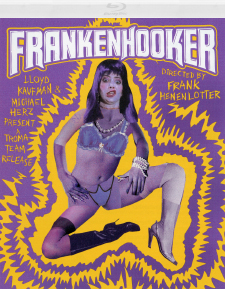
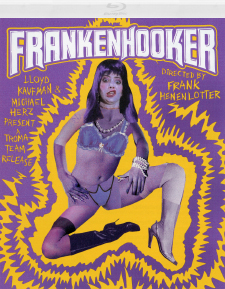
The Refuse Films Region-Free Blu-ray release of Frankenhooker is part of their Tromarchive Collection—which may raise some questions for viewers on this side of the Pond. Frankenhooker was indeed a Shapiro-Glickenhaus Entertainment production, but Troma Entertainment acquired their catalogue in 2021. Synapse still retains the rights in North America, but Frankenhooker is now officially a Troma film elsewhere. Refuse Films is handling Troma titles in the U.K., and thus, you have this Tromarchive Collection version of Frankenhooker, with all the Troma trimmings. It includes a slipcover with the familiar theatrical poster artwork, but the artwork on the insert has been thoroughly Tromafied. It also includes a four-page booklet with details about the various transfers and a reproduction of VHS box art from across the world. Despite the fact that it includes multiple versions of the film and an abundance of extras, everything is still squeezed onto a single BD-50.
The following extras are included, arranged (more or less) in reverse chronological order from when they were originally produced. Note that with the exception of the Tour of Gabe Bartolos’ Lab, which is full 1080p, they’re all encoded here at 720p, upscaled from various standard definition sources:
- 2025 Commentary by James Lorinz and Jackson Stewart
- 2012 Commentary by Frank Henenlotter and James Lorinz
- 2006 Commentary by Frank Henenlotter and Gabe Bartalos
- 2012 Your Date’s on a Plate: The Making of Frankenhooker (39:16)
- 2012 Tour of Gabe Bartalos’ SFX Lab (19:13)
- 2012 Introduction from Frank Henenlotter & James Lorinz (:20)
- 2006 A Salad Once Named Elizabeth: Patty Mullen Remembered Frankenhooker (8:53)
- 2006 A Stitch in Time: The Makeup Effects of Frankenhooker (21:00)
- 2006 Jennifer DeLora’s Frankenhooker Scrapbook (11:21)
- 2006 Turning Tricks: Jennifer DeLora Remembers Frankenhooker (19:32)
- 2000 Troma’s Edge TV Ep. 5 of 20 (24:25)
- 1998 Frankenhooker Photo Video Gallery (5:03)
- 1997 Troma’s Super Package Trailer Reel (42:54, 17 in all)
- 1996 Troma Basement Ep. 5 of 16 (7:01)
- Original Theatrical Trailer (1:32)
- Troma Trailer Tape 5 (14:16, 6 in all)
- Frank Henenlotter Trailer Tape (11:56, 6 in all)
- Henenlotter Digital Excess (110:09)
- Radiation Merch (:54)
Refuse added a new commentary for this release with James Lorinz and filmmaker Jackson Stewart, moderated by Zack Beins—although in practice, it’s an interview with Lorinz, conducted by both Stewart and Beins. Beins does his duty by trying to find ways to tie Lorinz and Frankenhooker to Troma, but mostly they just provide excuses for Lorinz to tell stories, and he’s a helluva storyteller. He explains how he was cast and relates some interesting details about the production, like how the lawnmower accident scene was actually shot at night because they ran out of time to finish it during the day (while Baldwin’s lighting covered over the differences, once you know that fact, you’ll never unsee it). Needless to say, he’s pretty tongue-in-cheek throughout the track, and he makes a few errors along the way (like stating that Frankenhooker was given an NC-17 by the MPAA when the rating hadn’t even been adopted yet), but it’s still an entertaining track.
The archival extras are organized by source, starting with the 2012 Blu-ray from Arrow Films in the U.K. There’s a commentary track with Lorinz and Frank Henenlotter, and this time, it’s Henenlotter who’s the storyteller. He dominates the majority of the track, but Lorinz does chime in with occasional contributions (including a repeat of the fact that they lost the light while shooting the opening sequence). Henenlotter discusses the conception of Frankenhooker (he never intended it to be a horror movie), ratings issues, and other issues like casting—it was his first SAG film, but none of the SAG actresses he talked to were willing to do the nudity for the prostitute party, so he had to work around the union. Henenlotter also calls the ending of the film the “feminist part of the plot”—okay, Frank. (But it is true that Jeffrey gets his just desserts.)
Your Date’s on a Plate: The Making of Frankenhooker was produced and directed by Calum Waddell, featuring interviews with Henenlotter, Lorinz, and Gabe Bartolos. Henenlotter kicks it off by saying that Frankenhooker was the most miserable film that he ever had to make, and he’s never had another experience like that before or since. He tells the story about how he invented the concept on the fly while pitching to James Glickenhaus, and explains how the actual script was developed. Lorinz discusses his own casting and the challenges of the party scene, while Bartalos naturally focuses on the effects work. Bartalos says that he had his doubts about the script, but he trusted Henenlotter and the results speak for themselves. Meanwhile, Henenlotter trusted Glickenhaus, right down to his idea for the home video promotional campaign with the “talking” VHS box (which sold like hotcakes).
In addition to a blink-and-you’ll-miss-it Introduction from Frank Henenlotter & James Lorinz, there’s also a Tour of Gabe Bartalos’ SFX Lab, where Bartolos shows off everything from his life cast area to the makeup room, the sewing and hair room, his “skull display,” storage areas, and more. There are plenty of artifacts from his career on display, including the hockey masks that he made for Friday the 13th Part VI: Jason Lives. (He also shows off one very real artifact, so be forewarned if you’re sensitive to the sight of a mummified animal.)
The next batch of archival extras were produced for the 2006 DVD from Unearthed Films, although they were also included later by both Arrow and Synapse. There’s a commentary with Henenlotter and Bartalos, and if you’re at all familiar with the two of them, you know what you’re in for: a good time. Okay, maybe they’re a matter of taste, but if you’re here for Frankenhooker, this track will be right up your alley. They discuss the very, very Henenlotter origins of the project, which came together quickly. It was a struggle to figure out how to keep Jeffrey sympathetic despite all the death and destruction. Casting James Lorinz helped, but losing the original cinematographer before a frame of film had been shot didn’t. Fortunately, Glickenhaus came to the rescue by loaning them Robert Baldwin—although Henenlotter didn’t get along with him, at least at first. On the other hand, they have nothing but praise for Lorinz, and equal amounts of praise for Patty Mullen. Bartalos says that her memorable grimace was something that she was doing in the makeup chair, and when they showed it to Henenlotter, he loved it so much he incorporated in into the film. But the most interesting thing is how much credit that they give to Glickenhaus, who was involved at every level. It’s a fun track, and easily the best of the three commentaries.
A Salad That Was Once Named Elizabeth is an interview with Patty Mullen, who talks about her experiences making Frankenhooker and yes, she also talks about her experiences as a Penthouse Pet. She discusses her favorite scenes, what it was like having to deal with the makeup, and her discomfort with shooting the sex scene with David Lipman (who she refers to as the “Miracle Whip man,” and if you don’t get that reference, Google it). She also tells a different version of the story about her funny face: she says that Henenlotter is the one who taught her how to make it.
A Stitch in Time is with Bartalos, and Bartalos being Bartalos, it’s a little different. He shot most of it on location, and not at any locations used in the film, either—you’ll have to find out for yourself exactly where he chose to go. He repeats the praise for Mullen, who he says was patient and easy to work with. He also breaks down some of the challenges that he faced on the project, including shooting makeup effects on location and trying to find a way to make the exploding hookers as unrealistic as possible in order to avoid issues with the ratings board (naturally, they had problems anyway).
Turning Tricks is with Jennifer DeLora, who played one of the hookers in the film—which she was happy to do despite the fact that she had already played a half dozen hooker roles prior to Frankenhooker. She had a blast because in terms of personality, she basically got to play herself on crack (not super-crack), and improvised some of her own dialogue. As the interview makes clear, her own real-life persona definitely shined through in the final film. She doesn’t hold back, either; while she says that Mullen was a doll, she calls James Lorinz a “diva.” She also returns to show off her polaroids from her Frankenhooker Scrapbook, with plenty of pithy comments along the way.
The rest of the archival extras come from a variety of different sources, most of them Troma-oriented rather than focused on Frankenhooker. There’s a variety of different trailer tapes and trailer reels, plus episodes from Troma’s Edge TV and Troma Basement. But there’s also a trailer reel of different Frank Henenlotter titles, a Frankenhooker photo gallery, and the oddest but most interesting of all the extras: Henenlotter Digital Excess. It’s an extended reel of otherwise random material relating to Henenlotter and Frankenhooker, including a Japanese Fantazone video promo; excerpts from Joe Bob Briggs’ Drive-In Theater; various other promos for Frankenhooker and Basket Case 3, including ones from SGE; an interview with Henenlotter from 2008 (around the time of Bad Biology); more Joe Bob Briggs; more promos, including some festival promos; and an episode of C.R.A.G.G. Drive-In Movie Radio offering an extended audio-only interview with Henenlotter.
Put all of that together, and it’s pretty much every previously available extra for Frankenhooker, and then some. Refuse Films left no stones unturned for this release. But it’s still not perfect, for the simple reason that Synapse’s 4K Ultra HD version supersedes it in terms of video and audio quality. So, what’s a self-respecting Frankenhooker fan to do? Well, I hate to be the bearer of bad news, but two words: double-dip. (Hey, I don’t make the rules, so don’t shoot the messenger.) You will want the Synapse release for its superior A/V credentials—in fact, you’ll probably never watch Frankenhooker any other way again. But if you’re a real fan, you’ll also want this Refuse Films version for its superior collection of extras. It’s not cheap for a single-disc Blu-ray set, and shipping from the U.K. can be painful, but them’s the breaks for the obsessive-compulsive collectors out there. And if you’re one of them, it’s not just recommended, but also an essential purchase. As always, know thyself.
-Stephen Bjork
(You can follow Stephen on social media at these links: Twitter, Facebook, BlueSky, and Letterboxd).