
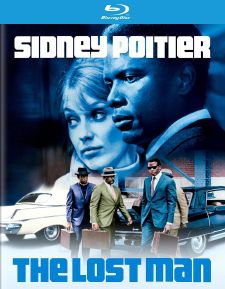
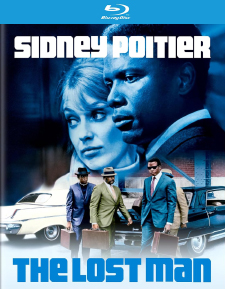
Lost Man, The (Blu-ray Review)
Director
Robert Alan AurthurRelease Date(s)
1969 (June 16, 2026)Studio(s)
Universal Pictures (Kino Lorber Studio Classics)- Film/Program Grade: C+
- Video Grade: A
- Audio Grade: A-
- Extras Grade: B

Review
Sidney Poitier had risen to the status of box office superstar by 1969 with a series of successful movies under his belt. In The Lost Man, Poitier’s gentlemanly image is given a dramatic shake-up. He’s not the patient, caring teacher of To Sir With Love nor the accommodating drifter of Lilies of the Field. This is a Poitier we’d never seen on screen before.
Jason Higgs (Poitier) is a Black militant in an unnamed organization who leads a group of Philadelphia men. He has planned a payroll robbery, with the money going toward buying food for the children of incarcerated activists. Though this idea doesn’t sit well with the others, he eventually convinces them that the organization has an obligation to look after the families of the men sent to prison for standing up for the cause.
When we first see Jason, he’s in a crisp suit and tie, sitting in the back of a car, sunglasses on, watching a protest organized by councilman Dennis Lawrence (Al Freeman, Jr.). Jason registers no emotion as the protest devolves into violence when the cops arrive. Jason is observing and thinking. If his group stages a protest at the time of the planned robbery, the attention of the police will be diverted to the protest.
Jason has planned the robbery to the smallest detail, but things go wrong when Jason he gets shot and he kills the shooter. Jason uses his street smarts to go into hiding. His group scatters. The police follow their every move.
Social worker Cathy Ellis (Joanna Shimkus), a young white woman, is sympathetic to their cause and helps Jason and his men. Cathy provides a romantic interest for Jason, even as the cops close in.
Director Robert Alan Aurthur provides a look at the anxieties of social and racial upheavals. Protests were everywhere in the late 60s, and Jason’s organization is based on a non-violent version of the Black Panthers. The world was moving more quickly than many people could accept, causing tension, suspicion, and rapid changes in society.
Though Poitier makes Jason intimidating and intelligent with a Robin Hood inclination, the actor is a poor fit for the character. Poitier had made a career of playing upstanding men with a clear-eyed sense of right and wrong. His charm and radiant smile emphasized his persona as a non-threatening man of ethics and determination. Stoic, and looking like a gangster big shot in his impeccable suit and shades, Poitier attempts to shed his typecasting. His efforts have mixed results. Sometimes he appears to be coasting. Other times, as in his scenes with Shimkus, more humanity emerges and he allows us to feel empathy for Jason.
Shimkus, like her Cathy character, is being used. Cathy’s race and social position allow her access to people and places denied to Black men. But Shamus’s primary purpose is to soften the image of Jason and show his vulnerabilities. She pops into the story whenever Cathy’s car is needed or inside information is sought. She doesn’t have a major scene until the end.
Robert Alan Aurthur seems to have put restraints on Poitier. His Jason appears more a victim of the circumstances he initiated than a true leader. Lacking foresight, knowingly breaking the law and risking lives, Jason is more interested in short-term goals than more permanent ones. Wouldn’t a bank robbery label the organization as a criminal enterprise? Isn’t he taking advantage of his charisma to get his group to follow his lead? And did he never hear about food banks and food drives to help the families? When you add up an uneasy character fit for Poitier, a troublesome script, and a diluted version of 1960s social turmoil, you can see why The Lost Man never achieved the lofty status of other Poitier films.
The Lost Man is also a lesser-known Poitier film. It didn’t fare well at the box office and had never before been released on DVD or Blu-ray, until now.
The Lost Man was shot by director of photography Gerald Perry Finnerman on 35mm film with Panavision cameras and lenses, processed by Technicolor, Hollywood, CA, and presented in the aspect ratio of 2.35:1. The Blu-ray from Kino Lorber Studio Classics is sourced from a 4K scan of the 35mm original camera negative. Clarity is generally very good, but is reduced in darker scenes. Details are mostly well-delineated, as in sweat on Jason’s face, overgrown weeds in the ghetto neighborhood, modest decor in the apartment where Jason is hiding out, and Philadelphia P.D. insignia on police cars. Color palette tends toward darker, somber hues. The vibrant green of the overgrown weeds in the alleyways of the ramshackle Black neighborhood really pops, adding brightness to an otherwise depressing environment.
The soundtrack is English 2.0 mono DTS-HD Master Audio. English SDH subtitles are available for the main feature. Dialogue is clear and distinct. Sound effects include gun shots, a physical confrontation between protesters and police, car engines, police sirens, sounds of running, and ambient street traffic. The opening credits theme has a driving energy that promises an exciting action picture. The score by Quincy Jones also shores up quiet scenes with romantic or suspenseful musical interludes.
Bonus materials on the Blu-ray release from Kino Lorber Studio Classics include the following:
- Audio Commentary by Julie Kirgo and Peter Handoff
- Theatrical Trailers:
- The Lost Man Teaser (:17)
- Lilies of the Field (3:15)
- In the Heat of the Night (2:48)
- The Wilby Conspiracy (2:16)
- Sneakers (2:54)
- Madigan (2:27)
Audio Commentary – Film historian and writer Julie Kirgo and filmmaker Peter Hankoff, both Kino Lorber regulars, share this commentary. They refer to The Lost Man as a “lost film” because it’s seldom mentioned in Sidney Poitier’s filmography and the actor plays an atypical character. There was a lot of change in America in 1969, which the film attempts to capture. Protests were happening everywhere for many different causes. Freedom of speech was more respected than today. College protests were widespread. The year also saw a clash between the old and new Hollywood. The commentators mention and discuss several films released in 1969, among them Butch Cassidy and the Sundance Kid, Midnight Cowboy, I Am Curious Yellow, Hello, Dolly, Easy Rider and True Grit. Events of the period are noted. The Black Panthers were a militant arm of Black protest. Planes were being hijacked to Cuba. The Stonewall riots marked the beginning of the Gay Pride movement. The first man set foot on the moon. The Manson murders took place. Michael Jackson made his first appearance on The Ed Sullivan Show. “It was a schizophrenic time.” The Lost Man was Hollywood’s attempt to make a film about revolution. Poitier wasn’t known for being a radical. He was at the height of his career. In 1967, he starred in three box office hits: In the Heat of the Night, To Sir With Love and Guess Who’s Coming to Dinner. Poitier is “self-created” as a shining figure. He had been criticized for taking “Uncle Tom” roles, which may explain why he agreed to do The Lost Man. The role of Jason isn’t purely heroic. If Poitier trusted someone, he would work with them again. Many actors in the film came from the theater because the stage offered greater employment opportunities for Black actors. Later, television provided increased opportunities for Black actors. Al Freeman, Jr. was in many films and was a reliable actor. He did both movies and theater. In the film, the militants’ goal is noble. The location of the Flats in Philadelphia is a tight-knit community like Harlem. The area isn’t gentrified. The era depicted had lots of change with hope for a better future. The commentators draw a parallel between Jason and Cathy and Bonnie and Clyde in terms of their complex relationship, adding that there are no really villains in the film. They conclude by referring to The Lost Man as a “thought-provoking if rather unknown film.”
The Lost Man is a half-hearted effort to capture the turmoil of the 60s. Despite some well-staged action sequences, the film has long, talky scenes that slow the narrative and kill dramatic momentum. Sidney Poitier does his best with the material but never fully convinces as a militant with a social conscience.
- Dennis Seuling