
My Neighbor Adolf (Blu-ray Review)
Director
Leon PrudovskyRelease Date(s)
2022 (April 7, 2026)Studio(s)
2-Team Productions/Film Produkcja (Cohen Media Group/Kino Lorber)- Film/Program Grade: B
- Video Grade: A
- Audio Grade: A
- Extras Grade: F

Review
Making Hitler a character in a sentimental comedy might rub many the wrong way. Yes, Mel Brooks skewered Hitler and the Nazis in The Producers, but My Neighbor Adolf is hardly that broad. Rather, it capitalizes on the idea that a Holocaust survivor is living next to “der Fuhrer” himself.
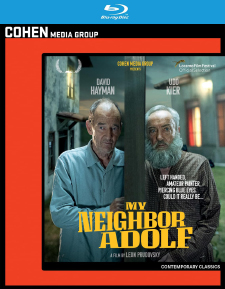
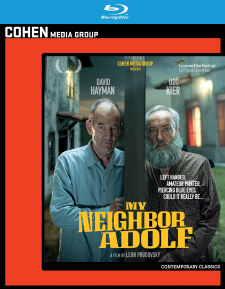
A brief prologue set in 1934 shows a large family in happy, pre-Nazi Poland. An attractive young woman takes pains caring for her rose bushes. Very quickly the scene shifts to Colombia in 1960. Marek Polsky (David Hayman), his family’s sole survivor of the Holocaust, lives alone in a house enclosed by a high fence. He’s a loner, impatient and belligerent toward the rare person he encounters. His only care seems to be for the rose bush in his yard.
Noticing activity at the house next door, Polsky sees that he’s about to have a new neighbor. His name is Hermann Herzog (Udo Kier) and he, too, is a loner. He’s heavily bearded and spends his time caring for his German shepherd, competing with himself at chess, and painting. When Herzog’s dog breaks into Polsky’s yard and relieves himself on the rose bush, an incensed Polsky rushes over to Herzog to complain. Herzog listens politely but isn’t at all apologetic.
Polsky is taken aback by Herzog’s grayish blue eyes and believes his new neighbor is Adolf Hitler. The man’s physical size, hobbies, and the face-obscuring beard further convince Polsky that Herzog is Hitler.
Their dispute is mediated by Herzog’s assistant, Frau Kaltenbrunner (Olive Silhavy), who discovers that the roses are actually on Herzog’s property. A judge rules in favor of Herzog and Polsky must accept new fencing that puts his beloved rose bush out of view.
Polsky becomes obsessed with proving that Herzog is Hitler. He purchases as many books about Hitler as he can find, along with camera equipment including a telephoto lens. He goes to the Israeli consulate but is met with skepticism by an intelligence officer (Kineret Peled). Undeterred, he resolves to unmask his neighbor as the notorious leader of the Third Reich.
Director Leon Prudovsky attempts to inject sentiment into My Neighbor Adolf. His tale becomes that of two lonely, grumpy old men finding humanity in each other and the transition is abrupt considering how agitatedly Hayman plays Polsky at first. Eventually, the two men bond and their later scenes are touching, if somewhat contrived.
Hayman captures the misanthropic Polsky. His backstory is tragic and Polsky has led a hermit-like existence, shut away from people and suspicious of whomever rings his doorbell. Kier’s Herzog is appropriately enigmatic. Director Prudovsky toys with Herzog’s true identity. Sometimes, elements point to his actually being Hitler. At other times, it’s made to seem an impossibility. This is the film’s key ingredient of suspense. Is Herzog Hitler? Just an old curmudgeon like Polsky? Or something else?
My Neighbor Adolf benefits from the two leads, who elevate the material considerably. With strong performances, they draw us in and make us care about these two men. Less-convincing performers could have turned the material into a burlesque or sentimental tear jerker. Hayman and Kier never allow this to occur. Director Prudovsky brightens the plot with humor in the characters of the intelligence officer and Frau Kaltenbrunner. The unnamed officer listens with strained tolerance and a look that says “Oh my God, another crank,” retaining her professional demeanor while impatiently puffing on a cigarette. Frau Kaltenbrunner is Herzog’s liaison with the outside world and the kind of officious individual we’ve all encountered: self-righteous, soft-spoken, slightly menacing. She’s Herzog’s assistant, peace keeper, problem resolver, and protector of his privacy, all of which drive Polsky crazy. He may rant and shout about the disputed property boundary, but she calmly tells him that the law is on Herzog’s side.
My Neighbor Adolf was captured digitally by director of photography Radek Ladczuk with Sony Venice cameras and presented in the aspect ratio of 2.39:1. Shot mostly under overcast skies, it has an air of gloom. Interiors are somber and dark. When Polsky goes into town to buy books and camera equipment, there’s a hustle and bustle of pedestrians and an appropriately expanded color palette. Details are particularly strong in close-ups of the old men’s faces, with wrinkles and facial stubble clearly delineated. An aura of mystery is created as visitors come to Herzog’s house late at night.
There are two soundtrack options: English 5.1 and 2.0 DTS-HD Master Audio. English subtitles are an option. Though most of the dialogue is in English, some characters speak German, Yiddish, or Spanish. When Polsky is researching Hitler, there are lengthy passages in which the only sounds are ambient background noises such as a dog barking, doors opening or closing, a car’s engine, or scratching noises on a fence. The decibel level rises when both men’s tempers flare.
There’s only one extra on the Blu-ray release from Cohen Media Group and Kino Lorber:
- Theatrical Trailer (2:10)
My Neighbor Adolf is engaging despite the fact that the bond forming between the main characters is unlikely after their early hostilities, particularly because the Holocaust survivor is convinced that his new neighbor is Hitler. The performances are excellent and director Prudovsky moves the narrative briskly while deftly building suspense. Polsky’s initial suspicions seem far-fetched but as he gathers information, he and we the viewers come to see numerous similarities between Hitler and the man called Herzog. Polsky’s credibility increases and the stakes rise dramatically.
- Dennis Seuling