
Man Inside, The (Blu-ray Review)
Director
John GillingRelease Date(s)
1958 (February 16, 2026)Studio(s)
Warwick Films/Columbia Pictures (Indicator/Powerhouse Films)- Film/Program Grade: B-
- Video Grade: A
- Audio Grade: A
- Extras Grade: B+

Review
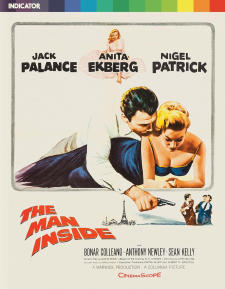
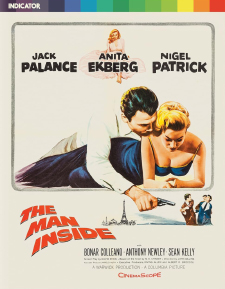
This British-made—but Hollywood-financed—crime thriller plays like a protracted episode of Secret Agent or The Saint, but with mostly real European location work, and Jack Palance, affecting an unconvincing Dallas accent, instead of Patrick McGoohan or Roger Moore in the leading role. Indeed, The Man Inside (1958) is a riot of phony accents: Swede Anita Ekberg pretending to be Austrian; Sid James pretending to be an American; American-born Bonar Colleano pretending to be German; Austrian Eric Pohlmann pretending to be Spanish, along with Englishmen Anthony Newley, Donald Pleasence, and others. Pohlmann could seemingly play any nationality, but the others often sound ridiculous.
In New York City, 30 Rockefeller Plaza, no less, jeweler’s clerk Sam Carter (Nigel Patrick) steals the famous Tyrahna Blue, a priceless diamond, killing two people in the process. The Midwest Insurance Company hires private detective Milo March (Palance) to locate him before professional thieves can get to him first. At Carter’s apartment Milo encounters blonde bombshell Trudie Hall (Ekberg, still voluptuous but undeniably packing on the pounds), but she vanishes shortly after someone blows up Milo’s car. (Why? This makes no sense, given what follows.)
He tracks Carter to Lisbon, where killers Martin Lormer (Bonar Colleano) and American Rizzio (Sean Kelly), also after the diamond, tail Milo from place to place, while in Carter’s recently-vacated hotel suite, Milo encounters Trudie again, she now claiming to be the diamond’s rightful owner, stolen from her father by Nazis during the war. In Madrid, Milo is aided by comical taxi driver Ernesto (Anthony Newley, in the Sid Melton role). Eventually both Milo and Trudi close in on Carter, he now assuming the name Carrasco, they striking up an uneasy friendship with the cautious, circumspect jewel thief and murderer. (Nigel Patrick’s subtle performance is by far the best thing about the film.) Later, in Paris, the various parties—Milo and Ernesto, Trudy, Carter, Lormer and Rizzio—converge, aboard a boat train bound for London.
Established in 1951, Albert R. Broccoli and Irving Allen’s Warwick Films had a long-term arrangement with Columbia Pictures splitting production costs 50-50, the two American-based producers moving to England, making films like The Man Inside, which typically featured one or two American name actors, but otherwise British casts and crews. They churned out competent but generally uninspired if well-made modest second features and, occasionally, nervous “A” pictures, insofar they were often in color, CinemaScope, and shot on location in Europe and Africa. Unlike contemporary Hammer, also producing features for Columbia at the time, Warwick’s output was a little tonier if not necessarily better; many of their films had budgets either side of $1 million—not expensive but not cheap, either.
All this is reflected in The Man Inside. Though most of its New York City scenes are faked with second unit and stock footage, the use of real locales in Portugal, Spain, and France is reasonably impressive (Nicholas Roeg was one of the camera operators), at a time when foreign locations were still relatively novel in Hollywood-made movies. Jack Palance is competent if a little bemused, even overwhelmed by the story, which is overly familiar yet eventful—if nothing else, its narrative certainly keeps moving forward and, at 90 minutes, isn’t overly long.
In retrospect, watching all these British actors sometimes absurdly attempting to play other nationalities damages what little credibility the film has. Warwick favorite Anthony Newley makes a less believable Spaniard than Anthony Sachs’s Manuel on Fawlty Towers, for instance. Before he became typed as a salacious Cockney in the Carry On film series, Sid James often played American characters in Anglo-American productions (as in Another Time, Another Place) and he’s okay, though Donald Pleasence is hammy as a Portuguese organ-grinder.
Sadly, this was Bonar Colleano’s last film, he wasted in a minor no-nothing part. Born in New York City to Australian circus acrobats, he moved to London when he was 12, and often cast as Americans in British films, including Powell & Pressburger’s A Matter of Life and Death. He played Stanley Kowalski opposite Vivien Leigh in the original West End production of A Streetcar Named Desire, a production directed by Laurence Olivier, and soon after had what may have been his best film role in Pool of London (1951), a real masterpiece of British cinema. Prior to the release of The Man Inside, Colleano, then 34, died after crashing his Jaguar XK140. Actor and friend Michael Balfour, also in the vehicle, survived.
Once again, The Digital Bits was sent only a check disc, with no booklet, no case, etc., just a check disc. The Region “B” encoded Blu-ray, a worldwide premiere, presents the film in its original black-and-white, 2.35:1 widescreen CinemaScope aspect ratio. Detail is strong as are blacks, and the LPCM 1.0 mono audio is more than adequate, supported by optional English subtitles.
Supplements consist of a new audio commentary by writers Barry Forshaw and Kim Newman; Slam-Bang Entertainment, an 11-minute look at Warwick Films by film historian Vic Pratt; an image gallery; and a trailer. This release is limited to 3,000 copies.
Neither bad nor particularly memorable, The Man Inside exemplifies American-British co-production work in the late-1950s, adequately done but little beyond that, except maybe for Nigel Patrick’s good performance as the cautious, cold-blooded thief. Okay for Saturday afternoon viewing on a rainy day, but far from exceptional.
- Stuart Galbraith IV