
Shawscope: Volume Two (Blu-ray Review – Part 2)
- Review Date: Oct 21, 2025
- Format: Blu-ray Disc
-


Director
VariousRelease Date(s)
Various (December 6, 2022)Studio(s)
Shaw Brothers Studio/Celestial Pictures (Arrow Video)- Film/Program Grade: See Below
- Video Grade: See Below
- Audio Grade: See Below
- Extras Grade: A+
- Overall Grade: A+


Review
THIS REVIEW CONTINUES FROM PART 1 [Click here to go back...]
From the mid-1960s and through to the early 1980s and beyond, the Hong Kong-based Shaw Brothers Studio ruled the roost when it came to martial arts cinema. Producing a number of successful films that traveled all over the world, particularly to the US, Britain, and Europe, their brand of extreme hand-to-hand combat films entertained audiences under a myriad of different titles and in various languages. Today, they’re still beloved to genre fans, particularly to those who grew up seeing these films in grindhouse cinemas or repeatedly on television.
Arrow Video presents twelve of these films, encapsulating the Shawscope: Volume Two Blu-ray boxed set, a massive and beautifully-rendered release. It’s loaded with an amazing amount of extras per film in gorgeous packaging with an accompanying booklet, making it a massive undertaking for a single review. Because of its size, I’ll be covering this release one disc at a time, updating this review of the entire set over time to go over it in better detail.
Below, you’ll find quick links that will take you to reviews of Discs 6 through 10:
(Click Below to Jump to Individual Disc/Film Reviews):
DISC SEVEN: MERCENARIES FROM HONG KONG
DISC EIGHT: MARTIAL ARTS OF SHAOLIN
DISC EIGHT: THE BARE-FOOTED KID
DISCS NINE AND TEN: SOUNDTRACKS

DISC SIX: MY YOUNG AUNTIE
My Young Auntie (aka Zhang bei, Fangs of the Tigress, and Kung Fu Concubine) was released in Hong Kong in 1981 (it was never officially released in the US, though some screenings did take place between 1981 and 1983). In the film, Cheng Dai-nan (Kara Hui) is a martial arts expert who marries a wealthy elderly man in order to keep his inheritance out of the hands of evil brother, Yu Wei (Wang Lung-wei). After his passing, she travels to meet her older nephew-in-law Yu Zheng-quan (Lau Kar-leung) and hand the deeds to the inheritance over to him. When his son Yu Tao (Hsiao Hou), who has been away at college in Hong Kong, returns to find Cheng in their home, comedy ensues through a clash of cultures. Since Cheng is a less-refined country girl, Tao attempts to introduce her to new ideals and good times, but Wei’s men are keeping a close eye on her, ready to steal the deeds that Wei believes are rightfully his.
Above all things, My Young Auntie is a reflection, and even a parody, of Cantonese cinema in the 1960s. References are abound throughout, from the obvious to the not-so-obvious. In that sense, some of it is a bit lost in translation to Western audiences, especially many years after its release. The film was also actor and director Lau Kar-leung giving Kara Hui a proper starring vehicle. She had been appearing in smaller parts in other Shaw Brothers productions, but My Young Auntie gave her the chance to allow her star to really shine, and shine it did. For her work, she took home the Best Actress prize at the Hong Kong Film Awards the following year. As for the film itself, it’s definitely outside the realm of what Shaw Brothers is known for, perhaps even more so today. Its amazing and sophisticated martial arts choreography certainly outshines its comedic elements, which can be tiring depending upon one’s personal taste. For this reviewer, the comedy and the action in My Young Auntie doesn’t blend well enough to be totally effective.
My Young Auntie was shot by director of photography Chih-Chun Ao on 35mm film with anamorphic (Shawscope) lenses, finished photochemically, and presented in the aspect ratio of 2.35:1. Arrow Video presents the film from a restoration carried out by Celestial Pictures between 2003 and 2007. The opening and closing titles have been re-created digitally. Like many of the Celestial Pictures-sourced presentations in this set, this is an uneven but still mostly pleasant presentation. Detail is often sharp and the color palette is bursting with an array of hues. As the film doesn’t share disc space with another, the bitrate tends to run higher, usually sitting between 30 and 40Mbps. Grain sometimes struggles, and while the picture does have an organic quality, it can appear too smooth at times. Blacks are a little uneven and there are occasionally light density issues, which may be difficult to spot, depending on the size of your setup. Other than some minor speckling, it’s a clean and stable presentation overall.
Audio is included in Cantonese, Mandarin, or English 1.0 DTS-HD Master Audio with optional subtitles in English for the Cantonese and Mandarin tracks and English SDH for the English track. The Cantonese track is a little too clean and lacking in natural aural personality. The Mandarin track is of similar quality, but performances are far superior on the former. The English track is the most natural, but it’s a little hot with some clipping, and obviously the least in terms of performances. All three tracks are clean with no obvious leftover age-related wear and tear.
The following extras are included:
- Select Scene Commentary by Tony Rayns (HD – 46:43)
- Lady Kung Fu: An Interview with Kara Hui (HD and Upscaled SD – 29:20)
- Cinema Hong Kong: The Beauties of the Shaw Studio (HD – 53:45)
- Alternate VHS Version (SD – 120:34)
- Alternate Opening Credits (HD – 1:19)
- Trailer Gallery:
- Hong Kong Theatrical Trailer (Cantonese) (HD – 4:19)
- Digital Reissue Trailer (HD – 1:04)
- Image Gallery (HD – 30 in all)
Film critic and historian Tony Rayns returns with another great audio commentary, which doesn’t run the entire length of the film, but instead focuses on forty-seven minutes of it. Split into two parts at the beginning and the ending of the film, he delves into its story, its star, its director, its content, the other cast members, how it connects with other Shaw Brothers productions of the era, and how it reflects both Cantonese and martial arts cinema. Lady Kung Fu features an interview with Kara Hui who discusses her career extensively. Cinema Hong Kong: The Beauties of the Shaw Studio is the third and final part of a three-part documentary featuring interviews with Run Run Shaw (via archival footage), Qiu Ping (Ping Chin), Hou Ng (Dr. Ng Ho), Wong Ain Ling, Ivy Ling Po, Cheng Pei Pei, Tanny Tien Ni, Yueh Hua, and Shaw Yin Yin (Susan Yam-Yam Shaw). The Alternate VHS Version of the film is about a minute and twenty-two seconds longer than the main feature, containing alternate opening and closing credits, and several extended moments. However, no major content is missing from the main presentation. Next is a set of Alternate Opening Credits; the Hong Kong and digital reissue trailers for the film; and an Image Gallery containing 30 images of production photos, lobby cards, posters, sales ephemera, and home video artwork. Not carried over from the 2007 Dragon Dynasty release of the film by Genius Products is an audio commentary with Elvis Mitchell and Andy Klein; interviews with Kara Hui, David Chute, and Andy Klein; and a home video trailer.
MY YOUNG AUNTIE (FILM/VIDEO/AUDIO/EXTRAS): C+/B/B/B+

DISC SEVEN: MERCENARIES FROM HONG KONG
Mercenaries From Hong Kong (Lie mo zhe, Lip mo je) was released in Hong Kong in 1982. (Though never officially released in the US, it did play a few dates in Los Angeles and Austin between 1982 and 1983.) In the film, Vietnam veteran Lo Lik (Ti Ling), now a mercenary-for-hire back home in Hong Kong, is contracted by the mysterious Ho Ying (Candice Yu) to put together a team of men to infiltrate an area of Cambodia and take out notorious Thai druglord Naiman (Phillip Ko Fei), whom she claims killed her father. Accepting the assignment, Lo Lik enlists the help of Le Tai (Lo Lieh), Yun Namsing (Michael Chan Wai-min), Curry (Wong Yue), Brand (Nat Chan Pak-cheung), and Hung Fan (Wang Lung-wei), all of whom are working day jobs and will be paid handsomely once their task is carried out. Their mission is ultimately successful and they manage to get to Naiman, but it turns out that Ho Ying has a secret agenda of her own.
Certainly one of the most breakneck paced films in the Shaw Brothers catalogue, Mercenaries From Hong Kong is a highly energetic action film that barely leaves any room to breathe, but in a vastly entertaining way. Directed by Wong Jing (billed here as Wang Tsing), who would go on to make a number of high octane action vehicles in the 1980s and 1990s, the plot of the film is nothing particularly original, often cited as having influences from First Blood and The Wild Geese, in particular. It manages to mix in some light comedy with the occasional heavy-handed melodrama, though a transphobic moment in a men’s restroom that’s played for laughs definitely doesn’t hold up. Mercenaries From Hong Kong also pre-dates the action star vehicles of Chuck Norris, Steven Seagal, and Jeff Speakman, with Ti Lung’s character kicking ass and taking names all the way up to the end. Unsophisticated narratively, Mercenaries From Hong Kong manages to bring down the house with its outstanding and over-the-top action set pieces.
Mercenaries From Hong Kong was shot by director of photography Tsao Hui-Chi on 35mm film with anamorphic (Shawscope) lenses, finished photochemically, and presented in the aspect ratio of 2.35:1. Arrow Video presents the film with a 2K scan and restoration from the original camera negative, carried out between 2021 and 2022 with the collaboration of L’Immagine Ritrovata, Hong Kong Film Archive, and Celestial Pictures. It’s a very organic-looking picture with mostly solid grain, outside of opticals which only increase the grain, and a bitrate that sits somewhere between 20 to 35Mbps for most of the running time. The color palette is rich with varying hues in and around Hong Kong, as well as the jungles and villages of Cambodia. Blacks are deep with good contrast, and outside of some minor density issues, the picture is stable and clean, free of any excessive leftover damage.
Audio is included in Cantonese, Mandarin, or English 1.0 DTS-HD Master Audio with optional subtitles in English for the Cantonese and Mandarin tracks and English SDH for the English track. The English track is the worst in terms of performances, but it offers the most definition. All three tracks feature some sort of sibilance or distortion issues, though they’re minor. The Cantonese option is the most narrow, but obviously contains the most natural performances. The Mandarin track is a little wider and runs hotter than the other two tracks. None of them have any major leftover defects, so it’s more of a preference point (I lean toward the Cantonese option).
The following extras are included:
- Martial Arts Master: An Interview with Tong Kai (HD and Upscaled SD – 28:50)
- Trailer Gallery:
- Hong Kong Theatrical Trailer (HD – 2:38)
- Digital Reissue Trailer (HD – 1:21)
- Image Gallery (HD – 27 in all)
In Martial Arts Master, Tong Kai, who was one of the martial arts instructors for the film, discusses his extensive career. Also included is the Hong Kong and digital reissue trailers for the film, and an Image Gallery containing 27 images of production photos, posters, sales ephemera, and home video artwork.
MERCENARIES FROM HONG KONG (FILM/VIDEO/AUDIO/EXTRAS): B/A-/B/C-

DISC SEVEN: THE BOXER'S OMEN
The Boxer’s Omen (aka Mó and Black Magic 4) was released in Hong Kong in 1983. It didn’t officially open in the US, but it did play a few dates the following year in Los Angeles and Miami in a pair of theaters that ran subtitled programming. A most definite left turn from the other films in these releases so far, The Boxer’s Omen is also a sequel to 1981’s Bewitched (aka Gu). In the film, Chan Hung (Phillip Ko Fei) comes to Thailand to visit his brother Chan Wing (Wang Lung-wei), a professional boxer who has been crippled by local fighter Bu Bo (Bolo Yeung). While there, he begins receiving supernatural visions that point him to a nearby temple, whereupon he’s asked to remain and develop a series of mystical abilities in order to fight evil forces for Abbot Ching Chiu (Elvis Tsui), his twin in a former life. Unknowingly losing his new powers along the way, he’s forced to confront and battle the magical powers of darkness on his own.
In the vein of an extreme horror comedy, The Boxer’s Omen is madcap lunacy from beginning to end, making little sense at any given time, but constantly upping the ante in terms of “folklore” gobbledygook, striking visuals, and outlandish set pieces. It often defies description and is unconventional in every sense of the term. It’s as if Alejandro Jodorowsky and Lucio Fulci teamed up to make a Hong Kong supernatural adventure, loaded with striking and symbolic imagery, and some truly disgusting and over-the-top sequences. It was also the penultimate film from director Kuei Chih-hung, who had made a number of films at Shaw Brothers since the early 1970s. Difficult to recommend but impossible to forget, The Boxer’s Omen is now celebrated for being one of the Shaw Brothers’ most aggressive splatter extravaganzas, but because it throws all convention so brazenly out the window, it’s impossible to assign a letter grade to. The squeamish need not apply... one’s mileage will definitely vary on this one.
The Boxer’s Omen was shot by cinematographers Li Hsin-yeh, Tsao Hui-chi, and Lin Yun-kun on 35mm film with anamorphic (Shawscope) lenses, finished photochemically, and presented in the aspect ratio of 2.35:1. Arrow Video presents the film with a 2K scan and restoration from the original camera negative, carried out between 2021 and 2022 with the collaboration of L’Immagine Ritrovata, Hong Kong Film Archive, and Celestial Pictures. It’s another organic presentation with only a minor caveat, that being that some scenes involving any nudity, which have been re-instituted using what appears to be prints to complete them. There are only a couple of these moments, but they stand out. There’s also a mild bit of damage and freezing grain between 18:06 and 18:08. Otherwise, it’s fine picture with bitrates that sit between 20 and 35Mbps. The film’s assertive lighting and design gives the color palette a wide range of hues, with some nice contrast and deep blacks. Outside of the aforementioned flaws, it’s a solid and stable picture.
Audio is included in Cantonese or Mandarin 1.0 DTS-HD Master Audio with optional English subtitles. The Cantonese track is less canned-sounding, while the Mandarin track takes the film’s surroundings into account more, giving dialogue and sound effects more obvious reverb and echo depending on the environment. The Mandarin track is also a little hotter, but both tracks are clean and free of any obvious issues. Like the previous film, it’s a preference point as to which track is more ideal for performances, but as usual, I lean towards the Cantonese option.
The following extras are included:
- Audio Commentary by Travis Crawford
- Tony Rayns on Kuei Chih-hung (HD – 21:02)
- Extended Scene (Upscaled SD – 1:57)
- Trailer Gallery:
- Hong Kong Theatrical Trailer 1 (HD – 2:47)
- Hong Kong Theatrical Trailer 2 (HD – 3:06)
- Image Gallery (HD – 30 in all)
The audio commentary features the late journalist and former film festival programmer Travis Crawford who, as a fan of the film, delves mightly into the film’s content, as well as its various collaborators. Tony Rayns also returns for another excellent discussion, this time focusing on the content and context of The Boxer’s Omen, as well as director Kuei Chih-hung. Since the film was severely edited for Mandarin-language markets and elements could not be found, the Extended Scene(s) are sourced from a Taiwanese VHS release and include an additional shot after one of the film’s sex scenes, and a text overlay that was added to the original Mandarin version, offering a moralistic warning to audiences. Also included are a pair of Hong Kong trailers for the film, and an Image Gallery containing 30 images of production photos, posters, lobby cards, and home video artwork.
THE BOXER’S OMEN (FILM/VIDEO/AUDIO/EXTRAS): N/A/B+/B-/B+

DISC EIGHT: MARTIAL ARTS OF SHAOLIN
Martial Arts of Shaolin (aka Nan bei Shao Lin, Nam bak siu lam, North and South Shaolin, Arahan, and Shaolin Temple 3: Martial Arts of Shaolin) was released in Hong Kong in 1986. Though never officially released in the US, it played in some subtitled theaters, mostly in California. Northern Shaolin monk Zhi-ming (Jet Li) and Southern Shaolin student Sima Yan (Huang Qiu-yan) are orphans who were separated after the murder of their respective families at the hands of the evil Lord He Suo (Yu Cheng-hui). Both growing up with a determination to take vengeance against He Suo, they get their chance during an open court celebration, but their plans fail and they wind up on the run from He Suo’s men. Things are complicated when Sima Yan’s friend and protector Zhao Wei (Hu Jian-qiang), who’s secretly in love with her, discovers that an ankle bracelet that Sima wears is identical to the one Zhi-ming wears, signifying that their parents meant for them to be together. Zhi-ming’s flagrant breaking of monastery rules is also called into question, but it isn’t long before Lord He Suo’s men catch up to them and Northern and Southern Shaolin factions must come together to overthrow the vicious and deadly tyrant.
Director Lau Kar-leung was late in his career when he took on Martial Arts of Shaolin, which was made in mainland China and not in the Shaw Brothers studio, and without direct studio support. It was an unhappy experience as he didn’t get along with his star Jet Li, who refused to take direction from him, and the resulting film was more or less a cover version of the 36th Chamber films. Stylistically, it’s much different than the martial arts films of the past, shot on vast locations with more camera movement (to its detriment), and a pop-infused soundtrack. The pièce de résistance winds up being the grand finale in which the Northern and Shaolin fighters come together, climaxing in a fight directly against Lord He Suo that’s actually the most engaging action set piece of the entire film. Martial Arts of Shaolin is certainly not one of Lar Kar-leung’s finest works, but there are aspects of the film worth appreciating, but you might have to dig.
Martial Arts of Shaolin was shot by director of photography Chao An-sun on 35mm film with anamorphic (Shawscope) lenses, finished photochemically, and presented in the aspect ratio of 2.35:1. Arrow Video presents the film from a restoration carried out by Celestial Pictures between 2003 and 2007. At times, it can be a very pleasant and organic image loaded with fine detail, and at other times appearing a little too scrubbed. Bitrates tend to sit between 15 and 30Mbps, but stable, and free of any overt debris. The edges of the frame are visible during the opening titles, and shadows can appear flat, but the color palette offers a nice array of hues with nice flesh tones. It’s not a perfect presentation, but a very watchable one.
Audio is included in Mandarin or Cantonese 1.0 mono DTS-HD Master Audio with optional English subtitles, or English 1.0 mono DTS-HD Master Audio with optional subtitles in English SDH. The Mandarin and Cantonese are the clear choices in terms of performance and being of similar aural quality, though the Cantonese track has a bit more push to the music. The English dub is much worse, both in terms of performance and in quality. It’s also the most distorted and the flattest of the three tracks by far. However, all three track are clean and free of any hiss-related issues or dropouts. The film was clearly shot for Mandarin-speaking audiences, so it’s the most accurate option sync-wise, but you can’t go wrong with the Cantonese track either.
The following extras are included:
- Audio Commentary by Jonathan Clements
- Tony Rayns on Martial Arts of Shaolin (HD – 29:40)
- Shaolin Stories: An Interview with Sze Yeung-ping (HD and Upscaled SD – 42:15)
- Unrestored Version (Upscaled SD – 97:32)
- Trailer Gallery:
- Hong Kong Theatrical Trailer (HD – 2:57)
- Japanese Theatrical Trailer (HD – 1:52)
- Digital Reissue Trailer (HD – 1:09)
- Shaolin Temple & Kids from Shaolin Trailers (Upscaled SD – 6:58)
- Image Gallery (HD – 45 in all)
The audio commentary is hosted by Jonathan Clements, author of A Brief History of the Martial Arts, who mightily delves into the history of the film, as well as the set design, and the many filming locations. It’s a thoroughly well-researched and fascinating discussion if you’re interested not just in the making of the film, but also the part of the world in which it was made. Tony Rayns returns once again for an extended discussion of the period in which Martial Arts of Shaolin was made and what was going on in the career of director Lau Kar-leung at that time, even reading from a vintage interview with him prior to making the film. The Unrestored Version of the film is sourced from a standard definition presentation, and according to Arrow, “it is arguably a truer representation of the film’s original cinema release.” It’s presented in Cantonese or English 1.0 Dolby Digital with optional English subtitles. In Shaolin Stories, Sze Yeung-ping, who wrote the film and was also an assistant director, is interviewed about his career. Next are the Hong Kong, Japanese, and digital reissue trailers for the film, as well as trailers for Shaolin Temple and Kids from Shaolin. Last is an Image Gallery containing 45 images of publicity photos, posters, film programs, and home video artwork.
MARTIAL ARTS OF SHAOLIN (FILM/VIDEO/AUDIO/EXTRAS): C+/B/B+/A-

DISC EIGHT: THE BARE-FOOTED KID
The Bare-Footed Kid (Chik geuk siu ji, Chi jiao xiao zi, The Barefoot Kid, and Professional Fighter) was released in Hong Kong in 1993. It was never released in the US, although it did make it to the UK, but with very few screenings. A remake of Disciples of Shaolin (1975), it tells the story of Guan Feng-yao (Aaron Kwok), a poor, barefoot young man who makes his way into the city to find Brother Duan Qing-yun (Ti Lung), a close friend of his now deceased father, asking him for work and shelter at the Four-Seasons Weave Factory. Owned by Miss Huo (Maggie Cheung), this dye and weaving factory is being harassed by the Dragon Spinners, owned by Master Hua (Paul Chin Pei), who’s pressing Miss Huo into selling her business, which she refuses to do. After Guan attempts to help by fighting them off, he’s sent packing, forcing him to fight in local martial arts tournaments overseen by Manchu Ke-hu-pu (Kenneth Tsang), who takes him under his wing due to his advanced fighting skills, as well as other secret reasons. Guan quickly learns the error of his ways, but it may be too late to stop what’s in store for Duan. Also among the cast are Chang Shao-hui, Jacklyn Wu, Yuan Ling-tao, and Huang Yi-fei.
In many ways, The Bare-Footed Kid feels like a tribute to the Shaw Brothers style of old while also pushing it forward in a more modern way, complete with intricate camera work and choreography, as well as occasional pop songs. Aaron Kwok was a popular singer in Hong Kong and though the film appears to be a dramatic acting vehicle for him, he’s more than up to the task, and Johnnie To utilizes him well. Some have said his performance is lacking in comparison to the other performers, but I ultimately found him an engaging presence. He’s definitely game for the martial arts action, as well as the dramatic content. The Bare-Footed Kid isn’t technically a Shaw Brothers film since it was released by other companies, but it nonetheless takes up the mantle dutifully, outpacing and mostly improving upon Disciples of Shaolin. At a brief 86 minutes, it doesn’t overstay its welcome. Some of the flowing camera moves are overwhelming initially, but once you get the rhythm of the film, it becomes a valuable asset to its quality.
The Bare-Footed Kid was shot by director of photography Huang Yung-heng on 35mm film with spherical lenses, finished photochemically, and presented in the aspect ratio of 1.85:1. Arrow Video presents the film from a restoration carried out by Celestial Pictures between 2003 and 2007. The opening and closing titles have been re-created digitally. This is one of the softer presentations in this release, likely due to its age, but it nonetheless carries a healthy bitrate, sitting between 20 and 30Mpbs most of the time. Decent detail is on display, though shadow detail is blacking, and nothing is all that crisp. Color and color are merely decent, but the overall appearance of the picture is clean and stable. It’s more than watchable.
Audio is included in Cantonese and Mandarin 1.0 mono DTS-HD Master Audio with optional English subtitles, or English 1.0 mono DTS-HD Master Audio with optional subtitles in English SDH. All three tracks are clean and free of any obvious issues, The Cantonese and Mandarin options exhibit similar qualities, while the English track offers slightly more fidelity. Still, in terms of performances, the original language tracks are preferable.
The following extras are included:
- Audio Commentary by Frank Djeng
- Tony Rayns on The Bare-Footed Kid (HD – 16:28)
- Alternate Opening Credits (Upscaled SD – 3:11)
- Trailer Gallery:
- Hong Kong Theatrical Trailer (HD – 3:39)
- UK VHS Promo (Upscaled SD – 2:06)
- Digital Reissue Trailer (HD – 1:12)
- Image Gallery (HD – 30 in all)
In the audio commentary, filmmaker and Hong Kong film historian Frank Djeng once again dives into a mountain of information about the film and the people behind the making of it. Tony Rayns returns for one final time to talk about the career of director Johnnie To before launching into a discussion of The Bare-Footed Kid, mentioning that Lau Kar-leung was hired to do the choreography. The Alternate Opening Credits are taken from a UK VHS source and feature the Cosmopolitan Film Productions logo, as well as the original opening and closing titles. Next are the Hong Kong and digital reissue trailers for the film, as well as a VHS promo. Last is an Image Gallery containing 30 images of publicity photos, posters, newspaper clippings, and home video artwork.
THE BARE-FOOTED KID (FILM/VIDEO/AUDIO/EXTRAS): B+/B-/B/A-

DISCS NINE AND TEN: SOUNDTRACKS
Also included are soundtrack selections for ten of the fourteen films offered in this set, totaling 71 tracks:
CD #1 (THE 36TH CHAMBER OF SHAOLIN / FIVE SUPERFIGHTERS / INVINCIBLE SHAOLIN / THE KID WITH THE GOLDEN ARM)
- David and Goliath by Derek Laren (:58)
- Light Industrial Movement by Derek Laren (2:07)
- Gold Sequence by Jack Trombey (:32)
- Scene De Desolation (Scene of Desolation) by Edward Michael (3:18)
- Le voyageur (The Traveller) by Edward Michael (2:32)
- Vision De Frayeur (Vision of Fear) by Edward Michael (3:06)
- Ciel Nocturne (Evening Sky) by Edward Michael (2:21)
- Eveil A L’aube (Dawn Awakening) by Edward Michael (2:36)
- Burlesque by Edward Michael (1:24)
- Jardin De Paradis (Garden of Paradise) by Edward Michael (2:24)
- Au Fil De L’eau (Flowing Water) by Edward Michael (2:45)
- Dynamo by Reg Tilsley (2:18)
- Tension Area by Reg Tilsley (:46)
- Payroll by Jack Trombey (2:17)
- Electro Beat 10 by Ronald Marquisee (1:01)
- Electro Beat 11 by Ronald Marquisee (:31)
- Fog Bound by Ivor Slaney (2:01)
- Despair by Paul Lewis (2:30)
- Suffragette by Paul Lewis (1:53)
- Nervestretch 1 by Paul Lewis (:38)
- Nervestretch 2 by Paul Lewis (:33)
- Forlorn by Ronald Binge (3:53)
- Full Brass Call by Spencer Nakin (:19)
- Roads and Runaways by Anthony Mawer (2:26)
- Violence by Eric Towren (3:14)
- Microscope by Pierre Arvay (1:42)
- Primum Mobile (Awakening) by Pierre Arvay (3:43)
- Secret of the Lake by Pierre Arvay (3:12)
- The Hunted Man by Pierre Arvay (2:58)
- Future of Industry 7 by Jack Trombey (2:01)
- Corn Exchange by Simon Haseley & Peter Reno (3:09)
- Dark Mystery by Paul Lewis (:53)
- Walking Into the Trap by Basil Kirchin & John Coleman (:55)
- Insert A by Basil Kirchin and John Coleman (:23)
- Insert E by Basil Kirchin and John Coleman (:14)
CD #2 (RETURN TO THE 36TH CHAMBER / MAGNIFICENT RUFFIANS / TEN TIGERS FROM KWANGTUNG / MY YOUNG AUNTIE / MERCENARIES FROM HONG KONG / DISCIPLES OF THE 36TH CHAMBER)
- Dodge City by Jack Trombey (2:07)
- Electro Beat 18 by Ronald Marquisee (:31)
- For and Against by Barry Stoller (1:00)
- Apparition of Fear by Johnny Hawksworth (:27)
- Search and Destroy by Johnny Hawksworth (1:20)
- Shadow and Substance by Johnny Hawksworth (:25)
- The Net Tightens by Johnny Hawksworth (1:42)
- Through the Forest by Johnny Hawksworth (1:40)
- Dark Mystery Section 2 by Paul Lewis (:34)
- Quick Revenge by Paul Lewis (1:02)
- Sweet Sorrow by Paul Lewis (2:48)
- Hit Link 1 by Keith Papworth (:05)
- Hit Link 3 by Keith Papworth (:06)
- Hit Link 4 by Keith Papworth (:26)
- Running Hot by Keith Papworth (2:02)
- Moving Shadows by Don Harper (1:50)
- Twisted Mind by Don Harper (1:34)
- Sinister Stranger by Don Harper (1:57)
- Rumpus by Alan Parker (3:09)
- Time Running Out by Johnny Hawksworth (:49)
- Drama Bridge by Peter Knight (:09)
- Mystery Place No. 1 by Peter Knight (2:38)
- Mystery Place No. 4 by Peter Knight (:49)
- Ferocity Fanfare by Reg Tilsley (:20)
- World in Action by Keith Papworth (3:07)
- Stalking by Peter Milray (1:13)
- Two Minutes Precisely by Derek Scott (1:59)
- Bitter Lemons by Frank Rothman (1:50)
- Face to Face by Frank Rothman (1:29)
- City to City by Frank McDonald & Chris Rae (3:08)
- Strike Squad by Frank McDonald & Chris Rae (2:48)
- Homebrew 2 by Frank McDonald & Chris Rae (:34)
- Extortion 1 by Reg Tilsley (2:30)
- Crossed Swords by Dudley Matthew (1:49)
- Impact by Adrian Ludlow (:53)
- Mob Violence by Ivor Slaney (1:09)

PACKAGING AND FINAL THOUGHTS
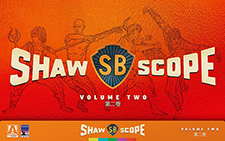
All of the discs in this set sit in a large, rectangular, multi-page booklet which contains artwork for each film and listings for each disc’s contents. Alongside it is a 58-page booklet containing various photos from each film; An Explanatory Note on Names & Languages; the essay The Legacy of the Shaw Brothers Studio by David Dresser; cast and crew information, synopses, film notes, trivia, and “Name That Tune” side panels for each film; the essays Ni Kuang and the Matter of China by Jonathan Clemens, Soundtracking the Musical Pugilistic Force by Lovely Jon, and Lar Kar-leung and Modern Mythmaking by David West; restorations information; production credits; and special thanks. All of this material is housed in a large, rectangular organge slipcase resembling the famous “Shawscope” opening logo.
Once again, Arrow Video has proven themselves to be one of the best home video companies in the business, putting together a massive boxed set that many thought would never happen, at least not in as comprehensive a way as this. Shawscope: Volume Two collects together fourteen of the finest selections of Hong Kong cinema from the Shaw Brothers studio in a way that, despite any minor nitpicks along the way, is a definitive and all-encompassing release. If you’re a fan of Asian action cinema in any capacity, this needs to be in your film library. Most highly recommended.
- Tim Salmons
(You can follow Tim on social media at these links: Twitter, Facebook, BlueSky, and Letterboxd. And be sure to subscribe to his YouTube channel here.)