
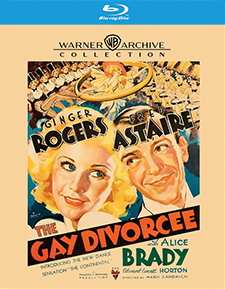
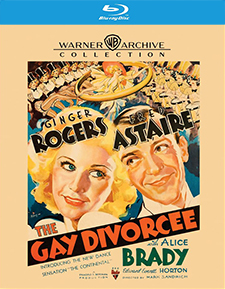
Gay Divorcee, The (Blu-ray Review)
Director
Mark SandrichRelease Date(s)
1934 (March 31, 2026)Studio(s)
RKO Radio Pictures (Warner Archive Collection)- Film/Program Grade: A
- Video Grade: A
- Audio Grade: A
- Extras Grade: B

Review
Fred Astaire and Ginger Rogers appeared for the first time on screen in Flying Down to Rio. They weren’t the stars, but their on-screen chemistry would lead to starring roles in a series of musicals for RKO. The first of these was The Gay Divorcee. The plot revolves around the machinations necessary at the time to get a divorce, especially if the other party didn’t want one.
American dancer Guy Holden (Astaire) and his friend, British lawyer Egbert Fitzgerald (Edward Everett Horton), arrive in London. While they wait on the dock for their luggage, American Mimi Glossop (Rogers) gets her dress caught in a trunk as she waits for her Aunt Hortense (Alive Brady). In a “meet-cute” scene, Guy sees Mimi’s plight and tries to assist but only succeeds in ripping her dress. He’s instantly smitten and lends her his coat, hoping to get her address and retrieve the garment in person. She refuses and has the coat returned to him instead.
Guy spends two weeks vainly searching for her all over London and finally spots her driving. A high-speed chase ends with her giving her name but not her phone number. What Guy doesn’t know is that Mimi is attempting to divorce her husband, Cyril (William Austin), with the assistance of Egbert, engaged for the purpose by Aunt Hortense. Egbert and Mimi scheme to stage a fake affair at a seaside hotel with hired “co-respondent” Rodolfo Tonetti (Erik Rhodes) to create the required grounds for divorce. When Guy inadvertently repeats a coded phrase meant to identify the fake lover, Mimi assumes he’s the professional gigolo.
Mistaken identity leads to a number of misunderstandings and embarrassing moments. As the farcical plot unfolds, plenty of songs and especially dances take the spotlight. Astaire solos on It’s Just Like Looking for a Needle in a Haystack as Guy longs to locate Mimi in a big city. Edward Everett Horton and a young Betty Grable perform the novelty number Let’s K-nock K-nees accompanied by a chorus of dancers. For some strange reason, we see Horton’s legs instead of Grable’s, which would later be insured by 20th Century-Fox for $1 million.
The best numbers, of course, belong to Astaire and Rogers. Cole Porter’s Night and Day, the only song from the original play to make it into the film, is given a lush treatment as Guy and Mimi meet in a moonlit suite overlooking the ocean. Initially, Mimi tries to get away from the man she believes is a gigolo but Guy repeatedly blocks her until all at once he sweeps her into his arms and a beautiful dance proves his infatuation with her.
The Continental, the first Academy Award-winning Best Song, is a highlight and, at 17 minutes, one of the longest musical numbers in history. Rogers sings the song, scores of dancers arrange themselves in patterns as the music continues, Astaire and Rogers clear the dance floor for their solo, more dancers converge, Rhodes sings a chorus, then Lillian Miles sings part of the song, and finally Astaire and Rogers return for the grand finale of the number. With its Busby Berkeley-esque staging, the number builds constantly, with Astaire and Rogers the centerpiece.
The two leads are fantastic on the dance floor but also have great rapport in the comedy scenes. With Rogers’ character often miffed at Astaire’s until she falls for him completely as he pursues her eagerly until she succumbs, the template was set for seven more pictures that followed.
The Astaire/Rogers films benefited from a strong supporting cast. Edward Everett Horton is a master of comic delivery with his fussbudget Egbert and Alice Brady, playing the ditzy Hortense (who can’t keep track of her numerous former husbands), adds some comic absent mindedness to this effervescent musical. Eric Blore, a regular in the Astaire/Rogers musicals, adds some whimsy as a chatty waiter. Horton, Rhodes and Blore would appear with Astaire and Rogers again the following year in Top Hat.
The Gay Divorcee was shot by director of photography David Abel on 35mm black & white film with spherical lenses and presented in the aspect ratio of 1.37:1. The Blu-ray from the Warner Archive Collection is from a restoration sourced from a 4K scan of the original nitrate camera negative. The quality is exceptional. The clarity of the image is excellent, with Van Nest Polglase’s art direction and Walter Plunkett’s costumes beautifully showcased. Details such as the fabrics in Ginger Rogers’ gowns, decor in the lavish seaside hotel, and hand puppets manipulated in a choral number are well delineated. Rear projection is used to show the ocean in the background as Astaire and Rogers dance to Night and Day. Rear projection is also used in some of the shots of Mimi in her car. The Continental production number is shot from an assortment of angles ranging from very low to high angle to better showcase the patterns formed by the many dancers. When Astaire and Rogers dance, they’re filmed with minimum cutting and no intrusive close-ups so that the beauty of their movements can be appreciated. This was an ultimatum Astaire made to his directors—“Either I dance, or the camera dances.”
The soundtrack is English 2.0 mono DTS-HD Master Audio. English SDH subtitles are an option. Dialogue is sharp and the musical numbers sound particularly good considering the age of the film. The sound of steps and taps were post-recorded to match filmed images. Musical numbers are placed at regular intervals, allowing for plot developments and comic repartee between Edward Everett Horton and Alice Brady. Arrangements for the romantic numbers capture the attraction between Guy and Mimi and reflect Mimi’s uncertainty about her feelings for Guy.
Bonus materials on the Blu-ray release from the Warner Archive Collection include the following:
- Art Trouble (20:50)
- Masks and Memories (32:14)
- I Like Mountain Music (7:01)
- Shake Your Powder Puff (6:20)
- Radio Promotional Trailer (13:45)
- Screen Guild Playhouse (27:58)
- Theatrical Trailer (1:18)
Art Trouble – In this 1934 Vitaphone short featuring Shemp Howard, two wealthy brothers don’t want to go to a Paris art school and hire a couple of amateur house painters to go in their place. In Paris, a French chanteuse flirts with them and they watch an Apache dance. A slapstick version follows, with Shemp having his clothes ripped off. This short was the first, uncredited, screen appearance of James Stewart.
Masks and Memories – Lillian Roth stars in this two-reel 1934 Vitaphone musical short. Three young people on the eve of Mardi Gras try to coax their reclusive, nostalgic uncle out of his self-imposed, time-locked isolation and into the festivities of the 20th century.
I Like Mountain Music – This 1933 Merrie Melodies black & white cartoon directed by Rudolf Isling is set in a closed drugstore at night. The characters on magazine covers come to life. Cowboys in a Western magazine sing and play the title song as the characters from all the other magazines join the festivities. Crooks from a crime magazine try to rob the till but are thwarted by Sherlock Holmes, King Kong, and other magazine characters.
Shake Your Powder Puff – Directed by Friz Freleng this 1934 Merrie Melodies black & white cartoon features a group of farm animals who attend the Powderpuff Review in a barn with numerous attractions, including a lion conductor and three rabbit girl singers. A dog heckler causes problems, leading to mayhem as he attempts to ruin the performance.
Radio Promotional Trailer – An announcer gives a bit of the plot of The Gay Divorcee. Musical excepts from the film include It’s Just Like Looking for a Needle in a Haystack (Fred Astaire), Let’s K-Nock K-nees (Edward Everett Horton, Betty Grable), and The Continental (Ginger Rogers). The announcer concludes his pitch by awkwardly declaring the film is “one you should not permit yourself to miss.”
Screen Guild Playhouse – This radio adaptation of the film The Gay Divorcee was originally broadcast on March 6, 1944. It stars Frank Sinatra as Guy Holden, Gloria De Haven as Mimi, Edward Everett Horton as Egbert, and Spring Byington as Hortense.
The Gay Divorcee is an impressive showcase for Fred Astaire and Ginger Rogers. Their undeniable chemistry, both on and off the dance floor, creates a magical Depression-era fantasy with its elegant settings, Rogers’ breathtaking dresses, and an obstacle-filled romance that ultimately works out. The Gay Divorcee is a beautifully filmed musical with dazzling choreography. It highlights Astaire and Rogers’ proficiency at making romantic intimacy a part of dance on film.
- Dennis Seuling