
Remo Williams: The Adventure Begins (4K UHD Review)
Director
Guy HamiltonRelease Date(s)
1985 (April 14, 2026)Studio(s)
Dick Clark Productions/Orion Pictures (Kino Lorber Studio Classics)- Film/Program Grade: B-
- Video Grade: B+
- Audio Grade: B-
- Extras Grade: B

Review
It’s not often that a director is given the opportunity to establish a franchise that doesn’t just stand the test of time, but also has enormous multigenerational cultural impact. It’s even less often that the same director is given the opportunity to do the same thing twice, and vanishingly rare that it actually works. Such is the case with Guy Hamilton, who was arguably responsible for turning the James Bond franchise into a global phenomenon. Sure, Terence Young actually directed the first two films, and he ended up shaping the cinematic conception of the character even more than Ian Fleming did. But it was Hamilton who really established the familiar Bond formula with Goldfinger, enough so that when Young returned afterward to direct Thunderball, that film followed in the Goldfinger template, not in the ones from Dr. No or From Russia with Love.
So, it’s not particularly surprising that Hamilton was given the chance to establish another franchise in 1984, and this time, he got there first. Unfortunately, he would also end up being the last one out the door, at least as far as the cinema goes, since the optimistically titled Remo Williams: The Adventure Begins failed to find an audience. But to be fair, there was little chance that it ever would have. Ian Fleming’s novels had been bestsellers, so James Bond was already a familiar character prior to the release of Dr. No in 1962—and the superspy got a major pop culture boost when President John F. Kennedy told Life magazine in 1961 that From Russia with Love was one his 10 favorite books. In comparison, while Warren Murphy and Richard Sapir’s Destroyer series had already churned out nearly 60 books by 1984 (it’s up over 150 as of this writing), it had much narrower appeal that was limited to niche audiences. When mainstream moviegoers saw the title Remo Williams, their reaction was always going to be, “Who?” To paraphrase one of the film’s characters, adapting The Destroyer was the 11th Commandment in action: “Thou shalt not get away with it.”
Still, that didn’t stop executive producers Mel Bergman and Dick Clark (yes, that Dick Clark) from giving it a college try, with Guy Hamilton at the helm and The Spy Who Loved Me screenwriter Christopher Wood penning the adaptation, borrowing elements from multiple Destroyer novels in order to create a new origin story. When New York City cop Sam Makin (Fred Ward) is killed in action, it turns out that his death was faked by a secret government organization, CURE, who did it to recruit him against his will. Rechristened Remo Williams and given plastic surgery to hide his old identity (though it wasn’t very good surgery, since he looks the same), his handlers Harold W. Smith (Wilford Brimley) and “Mac” McCleary (J.A. Preston) set up him with Chiun (Joel Grey), an elderly Korean master of Sinanju who trains Remo how to dodge bullets and kill using only his bare hands. But ready or not, he’s soon sent out to investigate corrupt arms dealer George Grove (Charles Cioffi), and his adventures will take him from the top of the Statue of Liberty to the heart of a U.S. Army base. Remo Williams: The Adventure Begins also stars Kate Mulgrew, George Coe, and Patrick Kilpatrick (watch for William Hickey, John Polito, and Reginald VelJohnson in cameo roles).
Fred Ward was pretty much no one’s idea of a leading man, but his gruff, affable charm works well enough for the cinematic conception of the character. While his tough guy physicality was quite real, there’s always been an everyman quality to Ward that helps to keep Remo Williams grounded even when it takes some major flights of fancy. The books were pure pulp fiction, with an openly tongue-in-cheek quality, and Hamilton tried to translate that to the screen, not always successfully. Remo Williams veers back and forth between the serious and the silly, and it never quite manages to find the right balance between the two. So, with an unfamiliar character, a less familiar leading man, and an uneven tone, Remo Williams was doomed from the start, and it was never going to succeed in launching a new franchise to rival the venerable James Bond. All that doesn’t mean it’s a bad film; far from it. It’s just that the problematic elements that prevented it from cleaning up at the box office predestined it to become a cult movie instead. And that, finally, leads us back to Chiun.
So, about Chiun... sorry, but there’s no way to discuss Remo Williams without addressing the 800lb gorilla in the room in the form of the 97lb (soaking wet) Joel Grey wearing a metric ton of “yellowface” makeup. And before anyone tries to object that hey, it’s not fair to judge problematic elements in older films by our modern standards, this was 1984, not 1894. Yes, people did know better in 1984 (trust me, I was there). This was the same year that The Karate Kid managed to cast the Japanese-American Noriyuki "Pat" Morita as, you know, a Japanese-American character. Morita was hardly the only Asian actor working in (or out of) Hollywood at the time, either. And yet producer Larry Spiegel still had the balls to tell the Chicago Tribune that “we assumed, of course, that we would be using an oriental actor. We couldn’t find one and then I thought of Grey.” They obviously didn’t look very hard (hell, Morita might have been available, although casting a Japanese-American actor as a Korean character would have been problematic in its own way). The simple fact of the matter is that they cast Grey because they wanted to cast Grey.
And that leads to another complication when trying to assess the problematic nature of Joel Grey playing Chiun: it’s Joel Grey. Culturally insensitive or not, he’s unforgettable in the role. Never before has a piece of casting been so dubious and so delightful, in roughly equal measures—and arguably never since, either. It’s easy to condemn the casting of Mickey Rooney as Mr. Yunioshi in Breakfast at Tiffany’s since he was so supremely awful in the role, but it’s a little trickier with Grey as Chiun. Yes, his casting never should have happened, but he’s the main reason why Remo Williams remains a cult favorite more than forty years down the road. He even managed to get a nomination for Best Supporting Actor at the Golden Globes (although the Academy wisely decided not to touch him with a 10-foot pole). All of the most quotable lines in the film come from Chiun, and fans keep quoting him to this very day.
So, Joel Grey’s performance as Chiun is the most dated element in the film, but it’s also the main reason why Remo Williams has had such longevity as a cult movie. Like many things in life, it’s not quite a black-and-white issue—like the actor who played him, Chiun occupies an uncomfortable grey area. He never should have happened, and yet in his own way, he’s incredible.
No! He is better than that.
Cinematographer Andrew Laszlo shot Remo Williams: The Adventure Begins on 35mm film using spherical lenses, framed at 1.85:1 for its theatrical release. This version is based on 4K scans of the original camera negative, digitally remastered and grade for High Dynamic Range in Dolby Vision and HDR10. Well, most of it was scanned from the negative, anyway: there are shots throughout the film that appear to have been scanned from dupe elements instead. That’s obvious during any optically printed sequences like the opening titles, but there are other random shots sprinkled here and there with fine black scratches and/or speckling, while the negative footage has white blemishes instead. To be perfectly clear, any such damage marks are minimal and only visible if you go looking for them, but the difference definitely points to different source elements.
Otherwise, detail levels, colors, and contrast are all generally good, but there are some elevated black levels during the opening scenes that fortunately improve as the film goes along. The only other minor quibble is a less than perfect encode that results in a few swirling patterns in the grain field, especially against bright backgrounds like the sky. But they’re not particularly bothersome in motion. Yet while it may not be a perfect 4K presentation of Remo Williams, it’s still a big step up from Blu-ray, and well worth the upgrade.
Audio is offered in English 2.0 and 5.1 DTS-HD Master Audio, with optional English subtitles. Remo Williams was released in Dolby Stereo, and while the 5.1 track seems to mostly be a discrete encoding of the original four matrix-encoded channels, it definitely has some bass sweetening added for the LFE track. It’s immediately noticeable with the synthesized kick drum in Craig Safan’s opening title theme, and it really stands out during the bombardment in the film’s climax. Overall, the 5.1 is preferable due to deeper bass and better channel separation, but both tracks do suffer from having the top end rolled off, and they sometimes sound a little muffled.
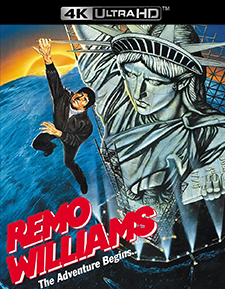
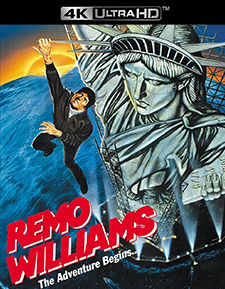
The Kino Lorber 4K Ultra HD release of Remo Williams: The Adventure Begins is a two-disc set that includes a Blu-ray with a 1080p copy of the film, as well as a slipcover that duplicates the theatrical poster artwork on the insert. The following extras are included:
DISC ONE: UHD
- Commentary by Larry Spiegel and Judy Goldstein
- Commentary by Brandon Streussnig
DISC TWO: BD
- Commentary by Larry Spiegel and Judy Goldstein
- Commentary by Brandon Streussnig
- Lessons in Popcorn Villainy (HD – 25:09)
- Created, The Destroyer (HD – 17:09)
- Unarmed and Dangerous (HD – 21:51)
- Secrets of Sinanju (HD – 8:46)
- Balance of Power (HD – 15:05)
- Assassin’s Tune (HD – 13:46)
- Radio Spot (HD – :31)
- Remo Williams Trailer (SD – 2:18)
- UFOria Trailer (HD – :57)
- The Final Option Trailer (SD – 1:47)
- The Phantom Trailer (SD – 1:23)
- Hudson Hawk Trailer (HD – 2:05)
Kino Lorber has added two new extras for this 4K release. The first is a commentary with film journalist Brandon Streussnig, who calls Remo Williams one of the most ill-advised and ill-fated attempts at a star making franchise, in all of its racist glory. That sets the tone for the entire commentary, with him opening up by praising Fred Ward as an actor but saying that he was completely miscast in the film, and then Streussnig lights into Guy Hamilton for his “leaden” direction. Maybe he has more positive things to say as the commentary goes on, but that’s the point at which I shut it off. Commentaries certainly don’t have to be hagiographies, but no one who shells out the money for physical media wants to hear about how terrible that their taste is.
On the upside, Kino also added a new interview with Patrick Kilpatrick, who says that he was happy as a clam to do Remo Williams, and has nothing but praise for Hamilton, Fred Ward, and the rest of the cast. (He’s okay with Joel Grey playing Chiun, too.) He feels that the best movies lead you to your better angels, and everyone involved with Remo Williams led him to his.
The rest of the extras are archival, starting with a commentary featuring producers Larry Spiegel and Judy Goldstein that was recorded for the 2014 Region B Blu-ray from Arrow in the U.K. (It’s also been included on various releases in the U.S.) They cover the making of the film from the writing to the casting and the direction, and tell plenty of stories about the globe-trotting production (a substantial amount of it was shot in Mexico). And yes, they address the casting of Joel Grey, too, or perhaps it would be more accurate to say that they defend it.
The rest of the extras were originally produced by Ballyhoo Motion Pictures for the 2016 Blu-ray from Twilight Time. Created, The Destroyer focuses on the book series, with Devin Murphy (son of Warren) and film historian Chris Poggiali discussing the nature of the series and which parts of it were utilized in Remo Williams (as well as which ones weren’t). Unarmed and Dangerous is an interview with Spiegel and Goldstein, who offer another recap of how the project was put together and more stories about making the film. Secrets of Shinaju is an interview with Joel Grey, who gives his thoughts about the role and having to work under piles of makeup. Balance of Power brings in production designer Jackson De Govia to address the challenges of blocking out what they could shoot on the real Statue of Liberty and what had to be shot on the mockup that they built in Mexico. He also covers the rest of the locations and his frustration with having to do things on the cheap. Finally, Assassin’s Tune is an interview with Craig Safan, who says that the trick with Remo Williams was to satisfy the Eighties requirement of a John Williams-style orchestral score while still doing something different. He ended up mixing research on Korean music and instrumentation with synthesizer work.
The most significant omissions here are the rest of the extras from Arrow’s 2014 Blu-ray, which included different interviews with Grey and Safan, as well as an interview with makeup effects artist Carl Fullerton. It also included the documentary Remo, Rambo, Reagan and Reds: The Eighties Action Movie Explosion. (Both the Arrow and Twilight Time discs also included an isolated music and effects track.) But this is certainly the broadest collection of extras to date, and while the 4K upgrade isn’t perfect, it’s still an upgrade over the old Blu-ray versions. If you’re a Remo Williams fan, you’re definitely going to want to add this set to your collection.
- Stephen Bjork
(You can follow Stephen on social media at these links: Twitter, Facebook, BlueSky, and Letterboxd).