
Peking Opera Blues (4K UHD Review)
Director
Tsui HarkRelease Date(s)
1986 (February 25, 2026)Studio(s)
Cinema City/Golden Princess Film Production (Imprint Asia/Via Vision Entertainment)- Film/Program Grade: B+
- Video Grade: A-
- Audio Grade: B+
- Extras Grade: A

Review
[Editor’s Note: This a Region-Free Australian 4K Ultra HD import.]
Tsui Hark’s Peking Opera Blues (aka Do ma daan) opens with a credit sequence that features male Peking Opera performers in full costume and elaborate makeup. They’re looking directly into the camera as they show off their regalia, and one of them launches into a robust belly laugh as the title song starts to play:
“Raise your head to look
Seize this moment to enjoy a laugh
Look around this world
It’s a drama playing out
I struggle to choose which path to go”
The struggle to decide which path to take can be read on multiple levels in Peking Opera Blues. It’s set in 1913, two years after the 1911 Democratic revolution had ended the final imperial dynasty. Rival groups that had been united in opposition to the Qing dynasty were now vying for dominance in the post-revolutionary environment—and the dynasty itself wasn’t quite willing to give up yet, either. While the film doesn’t address any of that directly, it’s still important background to understand the actions taken by some of the characters. Yet while the political stakes in Peking Opera Blues are undeniable, the film is far more interested in the personal stakes for its three lead characters, each of whom is seizing the moment in order to make revolutionary personal and social changes.
It’s significant that Peking Opera Blues opens with a group of male performers, because just like with Elizabethan theatre, most of the roles in Chinese opera were played by men—the female roles included. Bai Niu (Sally Yeh) is an aspiring performer who chafes against these kinds of arbitrary restrictions, much to the consternation of her father Mr. Wong (Wu Ma), who happens to own the troupe in which she wants to perform. Meanwhile, Tsao Wan (Brigitte Lin) is the daughter of General Tsao (Kenneth Tsang). He’s been amassing wealth in order to help restore the Qing dynasty, but unbeknownst to him, she’s secretly working for the revolutionary forces. Equally significantly, she prefers androgynous garb, wearing male clothing with her hair cut short. The odd woman out in this trio is Cherie Chung (Sheung Hung), an itinerant musician whose primary desire is making money by any means necessary. The only revolution that interests her is survival.
Raymond Tso’s script for Peking Opera Blues wastes little time setting these three women on a collision course with each other. In the early stages, the story is somewhat farcical, almost feeling like A Funny Thing Happened on the Way to the Peking Opera in terms of the way that absurdity is piled on top of absurdity. (Seize these moments to enjoy a laugh.) There are plenty of elaborate twists and turns, but all of the plot dynamics exist to bring the women closer together, reluctantly at first, but they increasingly start to rely on each other. As that happens, Tso and Hark start to raise the stakes for them, and their personal revolutions inevitably become more political.
That’s because Peking Opera Blues uses its political machinations in order to explore gender roles and gender identity, flipping the script not just on Chinese opera but on Hong Kong cinema in general. Bai Niu doesn’t accept the fact that she’s not allowed to perform in a male dominated milieu, and she’s doggedly determined to make her own way regardless of any opposition that she faces—her own father included. Tsao Wan isn’t willing to accept subservient female roles in general, both socially and stylistically. Bai Niu wants to be able to play a woman on stage, where women are usually played by men in female garb, while Tsao Wan doesn’t want to settle for the traditional female roles that society has tried to impose on her, and so she dresses in male garb instead. Even Cherie Chung isn’t willing to accept being treated as little more than a courtesan, so she’s willing to risk everything in order to make her own way in the world.
Despite the historical setting, in many ways, Peking Opera Blues can be read as one of the “women with guns” films that rose to prominence in Hong Kong cinema during the latter half of the Eighties. The action in the film relies more on wuxia acrobatics than on gunplay, but these are still women who are choosing which path to take in a world where the patriarchy is trying to restrict their opportunities. And, they kick ass when necessary. Yet the historical setting is important, because as all three women go their own separate ways after the finale, a title card appears to remind viewers that five months later, parliament was dissolved and Yuan Shikai declared himself to be the new emperor, starting the revolution all over again.
For Bai Niu, Tsao Wan, Cherie Chung, and many, many more women and men alike, the struggle will continue.
Cinematographer Hang-Sang Poon shot Peking Opera Blues on 35m film using spherical lenses, framed at 1.85:1 for its theatrical release. This version uses the same 4K master from the Shout! Studios UHD, which was based on a 4K scan of the original camera negative, cleaned up and graded for High Dynamic Range in Dolby Vision and HDR10. The optically printed opening credit sequence was derived from dupe elements and displays the expected softness, but once they’re over... well, the image does tighten up, but only incrementally. That’s because Poon employed diffusion throughout the film, using filters at a minimum and possibly even silks in a few shots, in order to achieve a hazy, period look. Everything does look as crisp and clear as it can, but it’s important to adjust your expectations with the understanding of what Poon and Hark intended. Regardless, it’s still sharp enough that the matte paintings now stand out more than they ever have before. Yet the biggest beneficiary to the 4K treatment is probably the grain structure, which is genuinely tight and refined.
The HDR grade offers benefits as well, though perhaps not in the way that you might expect. Peking Opera Blues is a colorful film in terms of the wildly variegated tones on display in any given scene, especially those that take place within the opera house, but befitting the intentionally hazy look, those colors aren’t necessarily vivid. It’s the breadth of the colors that have been brought out thanks to the Wide Color Gamut that’s the real selling point here. Nothing has been dialed up or oversaturated, but the shading is rich and well-defined. Look no further than the rose-pink face paint on the performers, which isn’t really monochromatic, but rather contains some subtle variations within those pinks, all of which stands out more in HDR than it does in SDR. Peking Opera Blues may not be the most dazzling 4K presentation, but it seems to be an accurate one, and that’s what counts.
Audio is offered in Cantonese 2.0 mono LPCM and 7.1 DTS-HD Master Audio; Mandarin 5.1 DTS-HD Master Audio; and English 2.0 mono LPCM, all with optional English subtitles. The 7.1 and 5.1 mixes are new wrinkles here, and the 7.1 track in particular sounds quite good. It’s fully immersive, with better dynamics, and the score is given significantly more breathing room. However, it does add new sound effects into the mix, which creates a bit of a quandary. As much as I prefer the music in 7.1, I still lean toward the original Cantonese mono track overall because of the altered effects, but your own mileage may vary. The mono version has deficiencies of its own since it’s mixed with typical Hong Kong cinema dynamics, which is to say, none whatsoever. It’s loud and compressed throughout, enough so that there’s some audible distortion. The dubbed dialogue (regardless of language) is forward in the mix and doesn’t integrate well into the soundstage, but once again, that’s typical of Hong Kong films from the era. Try both and judge for yourself.
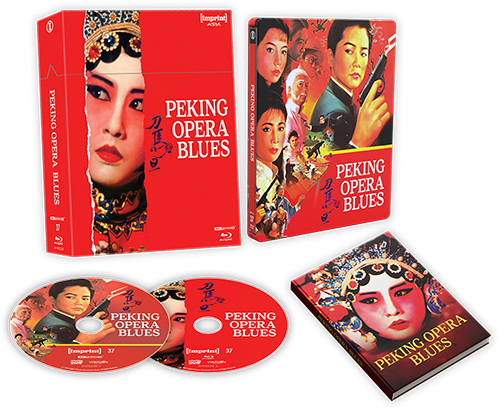
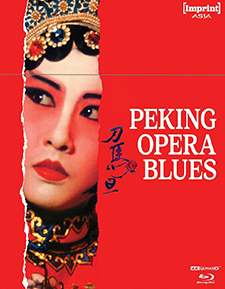
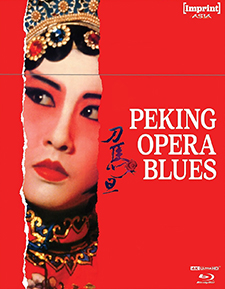
Via Vision’s Region-Free Limited Edition Steelbook 4K Ultra HD release of Peking Opera Blues is #37 in their Imprint Asia line, and it’s limited to 1,500 units. It’s a two-disc set that includes a Blu-ray with a 1080p copy of the film, as well as a 60-page hardbound booklet featuring essays by Darren Wheeling and Wayne Wong. Everything comes housed in one of Imprint’s rigid Hardboxes that opens up at the top. The following extras are included:
DISC ONE: UHD
- Commentary by James Mudge
- Theatrical Trailer (HD – 2:27)
DISC TWO: BD
- Commentary by James Mudge
- An Opus for Peking: Starring in a Tsui Hark Classic (HD – 21:58)
- An Operatic Achievement (HD – 11:11)
- Hong Kong Confidential (HD – 14:22)
- Peking Provocations: The Cinema of Tsui Hark (HD – 25:02)
- Peking History Blues: The Setting and Time of a Tsui Hark Masterpiece (HD – 23:42)
- Interview with Sally Yeh (Upscaled SD – 7:44)
- Interview with James Wong (Upscaled SD – 8:08)
- Interviews with Tsui Hark (Upscaled SD & HD – 36:08)
- Portrait of Brigitte Lin Ching Hsia (Upscaled SD – 84:43)
- A Fan’s Collection – Episode 2: Peking Opera Blues (HD – 21:58)
- Image Gallery (HD, 154 in all)
- Theatrical Trailer (HD – 2:27)
Imprint has ported over all of the Shout! Studios extras, starting with a commentary featuring James Mudge, head writer for the easternKicks website, who enthusiastically delves into Peking Opera Blues and the state of Hong Kong cinema at the time it was produced. He covers the careers of Tsui Hark and all the lead actors, as well as many of the supporting actors, and also explores the film thematically, tonally, and stylistically. In fact, there aren’t many stones that he leaves unturned, since Mudge is perfectly capable of giving Frank Djeng a run for his money in terms of talking nonstop without ever taking a breath. It’s not really a scene-specific track since Mudge free associates and follows his muse wherever it may lead him, only occasionally taking the time to discuss what’s happening onscreen. It’s still an entertaining track that’s packed with information.
The rest of the Shout! extras consist of interviews. The first two interviews are with participants on the making of Peking Opera Blues, while the remainder are analytical. An Opus for Peking is with Mark Cheng, who breaks down his career and his involvement with Peking Opera Blues—which was a little more complicated than it may seem on the surface. An Operatic Achievement is with cinematographer Ray Wong Chi-Wai, he served as a focus puller on Peking Opera Blues. He was a fan of Tsui Hark before he became involved with the film, so it was a great experience for him.
Hong Kong Confidential is with Grady Hendrix, co-author of These Fists Break Bricks. He provides an overview of where Peking Opera Blues fits into Hark’s career, and also explores the way that it inverted the gender dynamics in Hong Kong comedies and Peking Opera. Peking Provocations is with David West, author of Chasing Dragons: An Introduction To The Martial Arts Film. He also discusses where Peking Opera Blues fits into Hark’s filmography, but he goes into even greater depth regarding the way that it explores gender dynamics. He breaks down all three lead characters, especially Tsao Wan, who he considers the female equivalent of a knight errant, defining the film’s main themes of chivalry, righteousness, and patriotism. Finally, Peking History Blues is with Dr. Lars Laamann, author and associate professor at SOAS University in London. He goes deep background, detailing the chaotic development of factions in China after the 1911 revolution, providing details about the time period and how they relate to the story in Peking Opera Blues. In addition, he spends some time delving into exactly what the film’s original title Do ma daan means to the narrative.
Along with the trailer and the Image Gallery, that’s everything that Shout! Studios had to offer, but Imprint isn’t done there. They’ve also included two archival interviews that were originally offered on the Hong Kong DVD from Joy Sales. The first is with Sally Yeh, who gives her thoughts about her character and the making of Peking Opera Blues. The second is with James Wong, who says that he likes Yeh’s sense of rhythm, but it also means that acting opposite her is more work. He spends more time talking about her than he does about his own performance, but he does offer a tidbit or two in that regard.
Yet that’s still not all. Imprint has added interviews with Tsui Hark from two different sources. The first (and oldest) was recorded for Tohokushinsha Home Video, possibly for their 1990 LaserDisc version of Peking Opera Blues (although I can’t confirm that fact). The second was recorded in 2014 for a WE Talk Special for the Sinovision network, with Livia Areas-Holmblad serving as host. Considering that there may be as much as 25 years between the two interviews, they provide an interesting way to bracket Hark’s thoughts about Peking Opera Blues closer to when he made it and then much later down the road.
Portrait of Brigitte Ling Shing Hsia is a television documentary that was produced by ATV (Asia Television Limited) in 1991. While it obviously only covers everything that she had done up until that point, if you have any real interest in Brigitte Lin, this is all Brigitte, all the time. It’s not so much a documentary as it is a hagiography, made with Lin’s full participation, showing her, well, going everywhere and doing everything. That includes having a lengthy conversation about herself with Tsui Hark, so it’s relevant to this release.
Finally, A Fan’s Collection – Episode 2: Peking Opera Blues is an odd addition to this release, since it was created by Darren Wheeling for the bootleg release of Peking Opera Blues from Hong Kong Rescue. (Unsurprisingly, the HKR website is now defunct, although Wheeling still maintains his own website to blog about Hong Kong Cinema.) It’s a short video of Wheeling showing off his collection of memorabilia for Peking Opera Blues, and there’s some genuinely interesting stuff in it.
That’s pretty much everything, and then some. Arrow’s 4K release in the U.K also offers all of the Shout! Studios extras, and they added back the two interviews from the Joy Sales DVD as well, but they’re missing all the rest—and they don’t offer the 7.1 and 5.1 mixes, either. Combined with Imprint’s Steelbook packaging and the Hardbox, that makes this the definitive 4K Ultra HD release of Peking Opera Blues to date. No, it’s not cheap to import, but if you love Peking Opera Blues, this is hands-down your best option.
-Stephen Bjork
(You can follow Stephen on social media at these links: Twitter, Facebook, BlueSky, and Letterboxd).