
All the President's Men (Steelbook) (4K UHD Review)
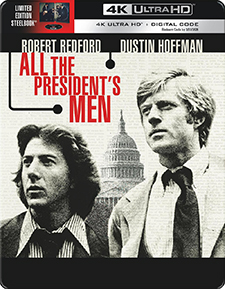
Director
Alan J. PakulaRelease Date(s)
1976 (February 17, 2026)Studio(s)
Wildwood Enterprises/Warner Bros. (Warner Bros. Discovery Home Entertainment)- Film/Program Grade: A+
- Video Grade: A
- Audio Grade: B+
- Extras Grade: C+

Review
On June 17, 1972, a seemingly minor incident occurred that ended up having major consequences. Bernard Baker, James McCord, Virgilio Gonzalez, Eugenio Martinez, and Frank Sturgis all broke into the offices of the Democratic National Committee, which were located at the Watergate complex in Washington, D.C. It actually wasn’t their first or even second attempted break-in at the DNC, but this time they were caught red-handed. They were carrying lockpicks, 35mm cameras, listening devices, a shortwave radio, tear gas guns, and $2,300 in cash (with sequential serial numbers). The lockpicks, cameras, and wiretaps may have been their intended tools, but it was the money that left a trail behind them that would eventually lead to the White House.
Washington Post reporters Bob Woodward and Carl Bernstein stayed hot on that trail even while other papers lost interest in the story, and they later published the full results of their investigation in their 1974 book All the President’s Men. Those results should have changed the course of American history forever, but the reality is that any changes that took place were transient at best. President Richard M. Nixon did resign on August 9, 1974, and his Vice President Gerald R. Ford was sworn in as the 38th President of the United States on that same day. Yet there’s a footnote to that temporary upheaval that lessened its long-term impact, but hold that thought for a moment.
Historical changes or not, the Watergate scandal and Nixon’s resignation did have an enormous cultural impact at the time, so it’s not surprising that Woodward and Bernstein’s book drew the attention of Hollywood—or to be more precise, it drew the attention of Hollywood royalty in the form of Robert Redford, who ended up producing the film. He brought in William Goldman to translate Woodward and Bernstein’s nonfiction account into a workable cinematic narrative, and just as importantly, he hired Alan J. Pakula to direct. Pakula had already demonstrated his gift for crafting extraordinarily effective conspiracy thrillers on both Klute and The Parallax View, and All the President’s Men would end up becoming the third part of a trifecta that helped define the nature of Seventies paranoia.
Redford had originally intended to hire unknowns to play the leads, but as the costs of the production mounted (Warner Bros. had to shell out $450,000 for the screen rights alone), it was clear that the film would need some marquee names above the title. So, he decided to play Woodward while bringing in Dustin Hoffman to personify Bernstein—and that was just for starters. Jason Robards delivered a powerhouse performance as Ben Bradlee (he would go on to win the Academy Award for Best Supporting Actor), with Jack Warden and Martin Balsam on hand to play editors Harry M. Rosenfeld and Howard Simons. Hal Holbrook lurked in the shadows as Deep Throat, and the rest of the cast was filled out by the likes of Jane Alexander, Stephen Collins, Ned Beatty, Polly Holliday, Meredith Baxter, Lindsay Crouse, Robert Walden, James Karen, F. Murray Abraham, and an uncredited John Randolph as the voice of John Mitchell. (Watch for Watergate security guard Frank Willis playing himself as the one who calls the police after discovering that the locks had been jimmied.)
While Redford, Pakula, and the rest of the amazing cast are all responsible for making All the President’s Men work as well as it does, William Goldman was arguably the keystone that held everything else together. (He also ended up taking home an Oscar for his work.) If it’s axiomatic that movies about writers rarely spend much time showing actual writing, it’s equally true that movies about reporters tend to lose sight of actual reportage in favor of the melodrama and/or comedy. That’s not the case with All the President’s Men, which goes to great pains to show Woodward and Bernstein pounding the pavement while interviewing people, getting doors slammed in their faces, taking notes, revising those notes, digging through libraries and phone books, writing, rewriting, and rewriting again. The sound of typewriters and teletypes are as much a part of the soundtrack for All the President’s Men as is the memorably ominous score by David Shire. Goldman showed as much interest in all of the nuts and bolts of reporting as he did in the details about the Watergate investigation, and that’s one of the main reasons why the film is so effective. It takes a great writer to understand what reporters and writers really do.
Yet while All the President’s Men does offer one of the most accurate portrayals of old-school journalism, it’s still fair to question some parts of Woodward and Bernstein’s account. Any story about an actual conspiracy invites conspiracy theories of its own, and Watergate has had its fair share of them over the years, like Len Colodny and Robert Gettlin’s Silent Coup: The Removal of a President. Yet even setting those conspiracy theories aside, some parts of the “official” story have never quite added up. Woodward and Bernstein have always sworn that Deep Throat was a single individual, not a composite figure, but even after the 2005 revelation that Deputy FBI Director Mark Felt was their primary source, it’s still arguable that some of the revelations that they attributed to him came from other sources that were on even deeper background. The wounds that were caused by the Watergate break-in and its coverup run deep, although time has healed some of those wounds in ways that haven’t been healthy for the American body politic. And that finally leads us back to where we started.
On September 8, 1974, newly inaugurated President Gerald R. Ford pardoned former President Richard M. Nixon, just one month after having told the American people that “our long national nightmare is over.” Yet the reality was that the nightmare was just beginning. Ford ended up ushering in the era of a lack of any real accountability for the executive branch, and it continues to this very day. Cover-ups, abuse of the pardon power, bribery, illegal arms sales, lying under oath before Congress, torture, warrant-less wiretapping, extrajudicial assassination of U.S. citizens, violations of the Emoluments Clause(s)—no U.S. President has ever been impeached and removed from office for any kind of high crimes or misdemeanors like these, nor have they been prosecuted for any federal crimes, either. (And thanks to the 2024 Roberts Court decision in Trump v. United States, none of them ever will.)
Just as problematically, the kind of adversarial investigative journalism practiced by Bob Woodward, Carl Bernstein, and the Washington Post is a thing of the past. The Post is little more than a hollow shell of its former self, and journalism has been replaced by stenography, with most reporters dutifully sharing whatever a politician says without pushing back on demonstrable falsehoods—all in the name of a thoroughly misguided conception of “objectivity.” And with the rise of alternative media and A.I. manipulation, it’s easier than ever to push those kinds of falsehoods, with few of the American people having the means (or the energy) to sort fact from fiction.
That’s all part of the thorny legacy of All the President’s Men. It’s unquestionably one of the greatest films of the Seventies, a cracking paranoia thriller that manages to make interviewing reluctant subjects and taking detailed notes seem absolutely riveting. On the other hand, it was all for nothing, wasn’t it? Nixon resigned, but in the long run, nothing else changed. The legacy of All the President’s Men may go on, but the lessons of Watergate have been forgotten, and far too few people are interested in following the money anymore. That makes All the President’s Men as much of a historical artifact as it is a historical document. Yet, paradoxically, it’s still a great film. Like many other things in life, it’s complicated.
Legendary cinematographer Gordon Willis shot All the President’s Men on 35mm film using Panavision Panaflex cameras with spherical lenses, framed at 1.85:1 for its theatrical release. There’s no information available regarding this new 4K master, but it appears to have been scanned from the original camera negative, and it’s graded for High Dynamic Range in both Dolby Vision and HDR10. (We’ve reached out to Warner Bros. and will update this if they provide more details.) Like most things shot by Willis, All the President’s Men is somewhat challenging material to reproduce faithfully on disc. In this case, he shot everything on 100T Eastman 5254 stock, with roughly 90% of the film force-developed one stop. It’s always been a grainy film, and that grain is resolved nicely here (it’s been encoded at a healthy bitrate onto a BD-100, so that certainly helps). Yet despite the omnipresent grain, the image is still clear enough to make out all of the names on Kay Eddy’s list of CRP employees, and even some of the previously murky-looking titles on the spines of books in Ben Bradlee’s office. All the President’s Men is never going to be the sharpest and most detailed of 4K presentations—Ben-Hur, this ain’t—but it still looks lovely in 4K.
Further complicating the accurate reproduction of Willis’ cinematography is that he chose to light the entire massive Washington Post set with unfiltered fluorescent lighting, which can lead to inaccurate (and sometimes variable) color reproduction. He retained that distinctive florescent look, but had the excessive greens dialed out in post. Yet the massive translights that provided the backdrops seen through the windows were lit via regular tungsten bulbs, which created mismatch issues. He ended up using cyan filters on those lights to get them to match the cool florescent lighting as closely as possible. All of that has created grading problems on past releases of All the President’s Men, but the good news here is that the grading finally looks accurate throughout. Previous versions pushed up the magenta in order to give everything more of that artificially “balanced” home video look, but this time, the vagaries of the lighting have been reproduced more faithfully. There’s little to complain about here—All the President’s Men looks fantastic in 4K. It’s not necessarily demo material, but it looks like film and that’s what counts.
Primary audio is offered in English 2.0 mono DTS-HD Master Audio. All the President’s Men is a dialogue-driven film, and the dialogue here offers all the clarity that the original recordings could muster (well, Dustin Hoffman is always gonna Dustin Hoffman, so he has his muddier moments, but he’s still clear enough). There’s a fair quantity of ADR in the film that stands out since it doesn’t integrate as well into the soundstage, but that’s the nature of the mix. David Shire was one of the Patron Poets of Seventies paranoia thrillers, and while his score might have benefited from a stereo remix (assuming that it was even recorded in stereo in the first place), it sounds just fine in mono, with plenty of depth (if not any width). Additional audio options include French, German, Spanish (Spain), and Spanish (Latin America) 1.0 mono Dolby Digital. Subtitle options include English SDH, French, German SDH, Spanish (Spain), Dutch, Chinese, Spanish (Latin America), Danish, Finnish, Norwegian, and Swedish.
(As an aside, All The President’s Men initially received an R rating from the MPAA, which was knocked down to a PG on appeal due to the historical nature of the material. While there’s absolutely no sex or violence, it does contain 11 uses of the word “fuck,” which remains a record for a PG or PG-13 rated film, and they’re all pretty much crystal-clear in lossless mono.)
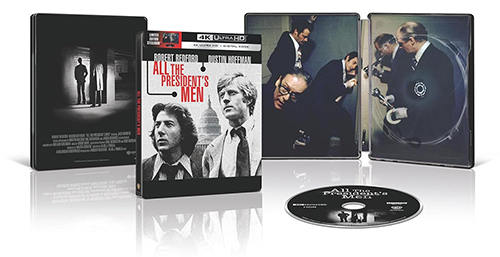
The Warner Bros. 4K Ultra HD Steelbook release of All the President’s Men is UHD only—there’s no Blu-ray included in the package, although there is a Digital code on a paper insert tucked inside, and there’s a J-card slipcover as well. (Warner Bros. is also offering a standard version in an Amaray case, albeit with different artwork.) The following extras are included:
- All the President’s Men: The Film and Its Influence (HD – 7:55)
- Woodward and Bernstein: A Journalism Masterclass (HD – 7:36)
- Woodward and Bernstein: Lighting the Fire (Upscaled SD – 17:53)
- Telling the Truth about Lies (Upscaled SD – 28:21)
- Out of the Shadows: The Man Who Was Deep Throat (Upscaled SD – 16:21)
- Jason Robards on Dinah! (Upscaled SD – 7:09)
Warner Bros. has added two new extras for this release, All the President’s Men: The Film and Its Influence and Woodward and Bernstein: A Journalism Masterclass, both of them featuring Jake Tapper and Dana Bush from CNN. The Film and Its Influence deals mostly with the making of the film while A Journalism Masterclass focuses on the nature of Woodward and Bernstein’s reporting, but in practice, they could have easily been combined into a single featurette. Still, Tapper and Bush both know Woodward and Bernstein, so they do have some insights to offer (however brief).
Lighting the Fire, Telling the Truth about Lies, and Out of the Shadows were all part of the “Behind the Story” section of the previous Warner Bros. DVD and Blu-ray releases of All the President’s Men (although they’re in a different order here). Appropriately enough, they’re all narrated by Hal Holbrook. Lighting the Fire explores the practice of investigative journalism and how it’s changed since Watergate. It includes interviews with Bob Woodward, Carl Bernstein, Ben Bradlee, Oliver Stone, Walter Cronkite, Linda Ellerbee, and many more. Telling the Truth about Lies is about the making of the film, featuring interviews with Woodward, Bernstein, Robert Redford, Dustin Hoffman, Jane Alexander, William Goldman, and Gordon Willis. Out of the Shadows is about Mark Felt coming out as Deep Throat in 2005, and it offers interviews with Woodward, Bernstein, Bradlee, Goldman, former Watergate prosecutor Richard Ben-Veniste, and more. (Take it at face value or with a few grains of salt, as you prefer.)
Finally, Jason Robards on Dinah! is a brief appearance by the actor on Dinah Shore’s daytime talk show in 1975. But there are a few things missing here from previous releases: the commentary by Robert Redford; the vintage featurette Pressure and the Press: The Making of All the President’s Men; the theatrical trailer; and the 2013 feature-length documentary All the President’s Men Revisited. The latter may have been dropped since Warner Bros. decided to issue this remaster on UHD only (it was included on a separate Blu-ray in the 2013 2-Disc Collector’s Edition), but the omission of the other items is a bit baffling. But that does seem to be the modus operandi of Warner Bros. right now: randomly dropping special features for no apparent reason. So as is often the case, you may want to hang onto the older discs for the missing extras. But you will want to double dip to grab this 4K version—it’s that much of an upgrade. It’s highly, highly recommended for any and all serious film fans.
-Stephen Bjork
(You can follow Stephen on social media at these links: Twitter, Facebook, BlueSky, and Letterboxd).