
Spawn (4K UHD Review)
Director
Mark A.Z. DippéRelease Date(s)
1997 (October 7, 2025)Studio(s)
New Line Cinema (Arrow Video)- Film/Program Grade: C
- Video Grade: A-
- Audio Grade: A+
- Extras Grade: A-

Review
Spawn was released in a dismal 1997 summer movie season when most of the more successful and hard-hitting films had already been released in the previous couple of months... that is until Titanic came along in December and reigned supreme. Nevertheless, Spawn was a financial success, but it was panned critically and has since garnered a reputation for being a poor representation of its source material. In truth, it’s fairly accurate to the original Image Comics books, but was watered down to satisfy a PG-13 rating. Even in its unrated Director’s Cut form, it still doesn’t push the envelope quite like it does on the page. Most point to 1998’s Blade for being one of the first mainstream superhero successes with a black actor as the lead, but Spawn beat it to theaters by a full year. It’s just unfortunate that the quality swung in the opposite direction.
Al Simmons (Michael Jai White) is a CIA operative working for a corrupt government agent, Jason Wynn (Martin Sheen). When Simmons begins to have moral dilemmas about their work, Wynn has him killed by another operative, Jessica Priest (Melinda Clarke), and is subsequently burned alive. Simmons goes to Hell where he’s summoned by Malebolgia, one of the Lords of Hell, and given the opportunity to see his wife Wanda (Theresa Randle) again if he agrees to lead Hell’s army to the gates of Heaven and conquer it. Simmons agrees and returns to Earth five years later as a Hellspawn, initially weak but slowly gaining the supernatural powers bestowed upon him. His guide is a disgusting clown-like man called Violator (John Leguizamo), a demon in disguise who oversees Simmons’ progress while carrying an agenda of his own. Under the direction of Malebolgia, Violator has convinced Wynn, now a weapons dealer, to have a device surgically implanted inside himself that will trigger the biological weapon Heat 16 if he dies. Violator tries to cajole Simmons into killing Wynn for revenge in order to secretly initiate Armageddon, but Simmons is preoccupied by the fact that Wanda is now married to his best friend Terry (D.B. Sweeney), who’s investigating Wynn. Soon Simmons meets Cagliostro (Nicol Williamson), a former Hellspawn who’s attempting to sway Simmons from following through on Malebolgia’s and Violator’s plans. Newly-dubbed Spawn, he must now choose between revenge and redemption.
Spawn seemed like one of the coolest and freshest ideas for a superhero in the 1990s. There were comic books, trading cards, video games, and other merchandise spinning off from it. It was all but inevitable that it would get the big screen treatment eventually, and New Line Cinema seemed like the perfect fit. Unfortunately, the film version had already been outclassed by the HBO animated series three months prior. It was down and dirty, extremely vulgar, and not at all PG-13 friendly, but also delved into the characters much deeper than a 96-minute film ever could. In other words, it was a better representation of the source material, and for those who had seen it and appreciated it (myself among them), the film version felt more like an afterthought.
There are many issues with Spawn as a character and his subsequent big screen debut, none of which had nothing to do with Michael Jai White. He deserved a better film than what was released, and while it certainly has some creative and visual moments, it’s highly inconsistent and even illogical at times. Violator’s plan set off Heat 16 due to Wynn’s death seems more convoluted than it really needs to be, especially when he could just kill Wynn himself and not even need Spawn to do it. It’s also hard to be on the side of someone who’s painted as a hero who’s spent much of his life killing people, innocent or otherwise. In the comics, Spawn is meant to be an antihero, whereas the film tries to make him more of a relatable character, which misses the point. It doesn’t help that the dialogue is mainly driven by exposition, especially from Violator. John Leguizamo totally commits in ways that few actors would pre-motion capture, but he’s unfortunately just set loose to do and say whatever he feels like, and you want nothing more than for him to shut up. That’s definitely a trait of his character, but it feels like overload.
The other drawback is the quality of the computer-generated imagery. With a heavy visual effects background, first-time director Mark A.Z. Dippé fills the film to the brim with it, even when it comes to transitions, which are typically optically-produced, even in 1997. Spawn himself tends to walk around not in his full form, and his make-up plus the bending and bulky suit that he’s wearing are chintzy. When he’s in his full costume sans cape, he looks pretty good, but when the gargantuanly oversized and tattered CGI cape gets involved, things get more overtly unreal. There are many other places where the CGI doesn’t hold up, which is partially just a reflection of the time it was made, but even in 1997, the Hell sequences with the entirely CGI-rendered Malebolgia (laughably sporting Dr. Claw’s voice via Frank Welker) didn’t look good even then. All of it could be forgiven if the film was engaging enough with great performances, but it falls short.
The sour truth about 1997’s Spawn is that it ventures head-long into mediocre territory. It’s not awful, but it’s not entertaining enough to even pass for decent. Regardless of any critique, it did well upon its release, but never received the sequel treatment, not even in the straight-to-video category. It did, however, sport one of the more memorable 1990s soundtracks. A combination of hard rock, nu metal, techno, and industrial, it featured artists like Metallica, Marilyn Manson, Butthole Surfers, Korn, Henry Rollins, and Incubus mixed with Orbital, The Crystal Method, The Prodigy, Sneaker Pimps, The Dust Brothers, and DJ Spooky. Like the soundtrack, the Spawn film has its fans who still appreciate it, but it doesn’t hold up that well over time.
Spawn was shot by cinematographer Guillermo Navarro on 35mm film (Eastman EXR 50D 5245, Kodak Vision 500T 5279, and 250D 5297) with Moviecam Compact and VistaVision cameras (for visual effects) and Zeiss Super Speed lenses. Everything was finished photochemically and presented in the aspect ratio of 1.85:1. Arrow Video presents the film on Ultra HD for the first time with new 4K 16-Bit restorations of the Director’s Cut and Theatrical Cut from the original camera negative, which has been graded for High Dynamic Range in HDR10 and Dolby Vision, and presented on separate triple-layered BD-100 discs. Outside of the ever-changing digital opticals and computer-generated moments, Spawn has a fine grain structure with a healthy bitrate sitting mostly between 80 and 100Mbps. Textures are generally excellent on costumes and environments, but the CGI doesn’t blend. Little can be done about that since those were the effects achieved at the time, so we’ll move on from that obvious caveat. The HDR grades deepen the blacks and improve the contrast, while giving the film’s limited color palette, which is dominated by oranges, greens, and blacks, more to work with visually. The image is stable and clean, as well, allowing the film to look better than it ever has on home video.
Audio options include English 5.1 DTS-HD Master Audio and 2.0 LPCM with optional subtitles in English SDH. It’s a very active and immersive experience, with the 5.1 option, likely stemmed from the original theatrical soundtrack, having the most punch and strongest placement. Dialogue is mostly up front and great directionality allows from some nice sweeping and panning, especially when some of the confrontations with Violator occur. There’s also plenty of low end response, which thoroughly aids Graeme Revell’s score and the aforementioned music selection.
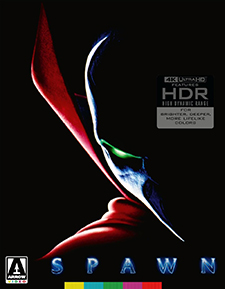
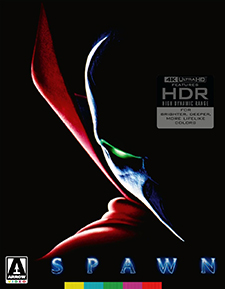
The 2-Disc Arrow Video 4K Ultra HD release of Spawn sits in a clear Amaray case with a double-sided poster and insert featuring the original theatrical artwork on the front and the home video artwork on the reverse. Also included is a 24-page insert booklet containing cast and crew information, the essay Spawn’s Long Hard Road [Out] of Comic Book Movie Hell by John Torrani, restoration information, production credits, and special thanks. Everything is housed in a slipcover with the original theatrical artwork. Extras are included with the Director’s Cut only:
- Audio Commentary with Dave Baxter
- Audio Commentary with Todd McFarlane, Mark A.Z. Dippé, Clint Goldman, and Steve Williams
- Hell’s Perfect Son: Michael Jai White Finds His Inner Demon (HD – 16:20)
- Spawn Support: Melinda Clarke and D.B. Sweeney on Spawn (HD – 16:48)
- The Devil’s in the Details: The Special Effects of Spawn (HD – 20:14)
- The Devil’s Music: The Making of the Spawn Soundtrack (HD – 10:24)
- Order Out of Chaos: Editor Michael Knue on Spawn (HD – 16:42)
- Todd McFarlane: Chapter & Verse (SD – 19:37)
- The Making of Spawn (SD – 21:58)
- Todd McFarlane’s Spawn: The Animated Movie Preview (SD – 1:44)
- Theatrical Trailer (HD – 1:47)
- Scene to Storyboard Comparisons:
- Clown to Violator (HD – 9 in all – :28)
- Violator to Clown (HD – 4 in all – :10)
- Cape (HD – 5 in all – :28)
- Mask (HD – 6 in all – :11)
- Violator from Bookcase (HD – 4 in all – :11)
- Original Todd McFarlane Sketches (HD – 3 in all)
- Spawn Concept/Sketch Gallery:
- Spawn (HD – 41 in all)
- Clown and Violator (HD – 18 in all)
- Malebolgia (HD – 2 in all)
- Jessica Priest (HD – 15 in all)
- Costume Design (HD – 32 in all)
The new audio commentary features comic book expert, podcast host, and obvious Todd McFarlane fan Dave Baxter. His track is more of a free-flowing conversation about the history of the Spawn comic book and how it made its way to the big screen, but it’s more of a reactionary track as he’s clearly a fan of the film. Recorded by and introduced by Mark Rance, the second audio commentary features Todd McFarlane, director Mark A.Z. Dippé, producer Clint Goldman, and second unit director and production visual effects supervisor Steve Williams. It was recorded in 1998 for the LaserDisc rlease and subsequent New Line Platinum Series DVD release, and is more of an old-school audio commentary that’s been pieced together from different recordings with Mark Rance identifying who’s speaking. It’s a fun and informative track.
Next is a series of new interviews. Hell’s Perfect Son features Michael Jai White discussing how he landed the lead role after losing out the Jax role in Mortal Kombat, the hardships of being in make-up on the set, working with his fellow actors, and his disappointment with the final product. In Spawn Support, actors Melinda Clarke and D.B. Sweeney talk about where their careers were at when they landed their roles, working with director Mark A.Z. Dippé, and their overall experiences on the film. The Devil’s in the Details interviews animatronic creature and special makeup effects artists Howard Berger and Greg Nicotero who comment on the creation of the film’s effects, dealing with problems on the set, the integration of real world effects and CGI, and the legacy of their work. The Devil’s Music features an interview with music supervisor Happy Walters in which he delves into several songs from the film’s soundtrack and how the whole thing came together. Order Out of Chaos interviews editor Michael Knue about the tumultuous editing schedule on the film, even cutting in effects shots at the last minute while in the final stages.
Todd McFarlane: Chapter & Verse is a vintage interview with creator Todd McFarlane who analyzes the final film versus the comic book, as well as the animated adaptation. The Making of Spawn is an archival Sci-Fi Channel behind-the-scenes special hosted by Michael Jai White and featuring interviews with Martin Sheen, Todd McFarlane, Theresa Randle, Mark A.Z. Dippé, John Leguizamo, Steve Williams, and digital artists Steve Lui and Habib Zargapour. Next is a preview of HBO’s Todd McFarlane’s Spawn: The Animated Movie on VHS. Last is the theatrical trailer, a set of Scene to Storyboard Comparisons, a series of Original Todd McFarlane Sketches, and a Spawn Concept/Sketch Gallery.
Not included from the DVD release are text-based cast biographies and production notes, and absent from the Warner Bros. Blu-ray are the music videos Trip Like I Do by Filter & The Crystal Method, and Long Hard Road Out of Hell by Marilyn Manson & Sneaker Pimps.
Spawn is certainly not a film that I would have expected to have such lavish 4K treatment. Since the franchise is being dipped back into for re-distribution, I for one would enjoy, at the very least, a Blu-ray collection of the HBO animated series; containing the original broadcast versions and the re-edited movie versions, plus all of the previous DVD and LaserDisc extras. Let’s hope that Arrow’s release of the film version of Spawn could lead to just such a release. As for fans of the film itself, they’ll be very pleased with its treatment on UHD.
- Tim Salmons
(You can follow Tim on social media at these links: Twitter, Facebook, BlueSky, and Letterboxd. And be sure to subscribe to his YouTube channel here.)