
Monty Python’s Life of Brian (Blu-ray Review)
Director
Terry JonesRelease Date(s)
1979 (April 14, 2026)Studio(s)
HandMade Films/Python (Monty) Pictures (The Criterion Collection – Spine #61)- Film/Program Grade: B+
- Video Grade: A
- Audio Grade: A
- Extras Grade: A-

Review
Controversy wasn’t new when Monty Python’s Life of Brian hit theater screens in 1979. No previous film had dared to poke fun at organized religion with such irreverence. Though Christ appears in the film and treated with respect, it’s the dogma, the demagogues, and the rules that came in his wake that are the targets of the film’s comic skewering.
In the prologue, a beautiful silhouetted image depicts three wise men bearing gifts and following a star to a stable where they claim the son of God has been born. Within the manger, however, is an ordinary baby called Brian. Realizing that they’ve come to the wrong address, the wise men snatch their gold, frankincense, and myrrh and head next door, where a true miracle is occurring.
Next, Terry Gilliam’s animated credits are accompanied by Brian Song, a James Bond-style theme performed by British singer Sonia Jones channeling Shirley Bassey. After the credits, we are now in Judea, A.D. 33, where the adult Brian Cohen of Nazareth (Graham Chapman) attempts to listen to Jesus as he preaches his Sermon on the Mount. A spirited argument between onlookers prevents him from hearing Christ’s words but it doesn’t really matter, since he’s more interested in watching a stoning with his mother (Terry Jones).
Thus begins the Pythons’ lampooning of practically anything and everything associated with the period. Blasphemy, lepers, women’s rights, mortal combat at the Coliseum, rebellious factions, politics, vandalism, contempt for the Romans, haggling, speech impediments, and even crucifixion do not escape their brand of parody with a strong helping of silliness.
Jones and Chapman along with fellow Pythons John Cleese, Terry Gilliam, Michael Palin, and Eric Idle play multiple roles with the distinctive surrealistic zaniness reminiscent of their TV classic, Monty Python’s Flying Circus. Like the show, the film is composed of a number of skits, and the character of Brian ties them together. He’s sort of the Zelig of Biblical times, showing up at significant moments in history.
Jones does double duty as director and actor. As director, he gives the foolishness a sense of epic grandeur in the manner of big-budget Hollywood Biblical movies. Gilliam, doubling as production designer, infuses a richness into the film with authentic-looking locations filmed in Tunisia.
Life of Brian is notable for its density and variety of gags. There are witty exchanges between characters, a generous helping of slapstick and clever wordplay. In the title role of Brian, the Jewish-Roman doofus regularly mistaken for the Messiah, Chapman does his best to anchor the film. It meanders nevertheless and some sequences run too long. Though only 94 minutes, the film runs out of steam about two thirds in.
A highlight is Eric Idle crooning his self-written jaunty tune Always Look on the Bright Side of Life at a strikingly inapt moment in comical contrast to a particularly dark event. So, yes, there’s irreverence, but aimed at institutions, traditions, and human quirks. These do not escape the Pythons’ pointed barbs. The daffiness of their TV work is somewhat subdued in Life of Brian, but still looks at serious things through a lens of absurdity.
Life of Brian was shot by director of photography Peter Biziou on 35mm film with Arriflex 35 BL cameras with spherical lenses, processed by Bucks Laboratories, London, UK, and presented in the aspect ratio of 1.85:1. According to information in the enclosed booklet this release, which was supervised by Terry Gilliam, this is a new 4K restoration created from the 35mm original camera negative and a 35mm interpositive. Clarity and contrast are excellent. The prologue looks like that of a Biblical epic. Gilliam’s production design enhances the production tremendously, with Tunisian locations standing in for ancient Judea. Narrow alleyways, desert vistas, and buildings that pass for those of ancient times add significant visual appeal. A judicious use of extras adds to the “big movie” feel. The ludicrous conceit of having men play women is a trademark of the Pythons and it’s very much on view here. Leftover costumes and sets from a previous Biblical film offer additional eye appeal. Wigs, false beards, and make-up give many characters a comical appearance. Gilliam’s animated title sequence sets the stage for the outlandish comedy to follow.
Audio is included in English 2.0 and 5.1 DTS-HD Master Audio with optional subtitles in English SDH. The original 2.0 surround soundtrack was remastered from the 35mm 3-track magnetic track and a 1/4-inch magnetic track. Dialogue is clear and distinct. The actors adopt a number of funny voices, especially when men are playing women, which enhances the comedy element of several scenes, particularly the one of the wise men visiting the next-door neighbor of the real Messiah. Exaggerated sound effects to amp up jokes are kept to a minimum. Crowds of extras shout, moan, chant, and create ambient noise as required by the scene. Sonia Jones belts out the Goldfinger-inspired Brian Song, which features glorious trumpets and soaring strings. Eric Idle provides a bit of ironic optimism when he sings Always Look on the Bright Side of Life despite his character’s precarious situation.
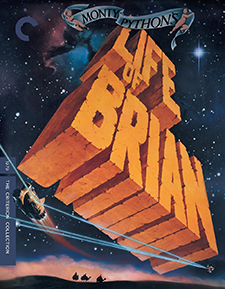
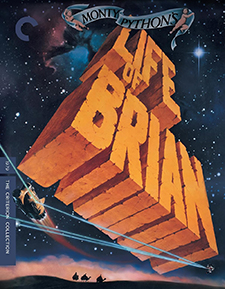
The 2-Disc Blu-ray release of Monty Python’s Life of Brian sits in a clear Amaray case with an insert featuring artwork based upon Terry Gilliam’s British theatrical poster and an accordion-style booklet that contains cast and crew information, the essay The Wrong Messiah by Bilge Ebiri, 6 color photos from the film, information about the restoration, production credits, acknowledgments, and special thanks. The following extras are included on each disc:
DISC ONE (FILM)
- Commentaries:
- Terry Gilliam, Eric Idle, and Terry Jones
- John Cleese and Michael Palin
DISC TWO (EXTRAS)
- The Story of Brian (SD – 59:51)
- The Pythons (SD – 49:54)
- Michael Palin’s Super 8 Film:
- Teaser (HD – 1:08)
- Film (HD – 13:51)
- Screenplay Read-Through (SD – 110:48)
- Deleted Scenes w/Optional Commentary by Terry Jones, Terry Gilliam, and Eric Idle:
- Sheep (SD – 4:28)
- Pilate’s Wife (SD – 1:51)
- Otto (SD – 4:21)
- The Sign That Is the Sign (SD – 1:10)
- Souvenir Salesman (SD – :32)
- Radio Ads:
- Mrs. Cleese (HD – :50)
- Mrs. Gilliam (HD – :37)
- Mrs. Idle (HD – :37)
- Michael Palin’s Dentist (HD – :50)
- Animated Stills Gallery (SD – 15 in all – 1:50)
- Trailer (SD – 2:48)
Audio Commentary #1 – Terry Gilliam, Eric Idle, and Terry Jones share this commentary. They speak about the animated title sequence, which was inspired by relics of the Italian Renaissance. Surrealistic, the animation foreshadows the content of the film. In the Sermon on the Mount sequence, extras had to be placed carefully to suggest that the crowd listening to Jesus was much larger. Many extras are from among the locals. A long tracking shot was filmed by the director of photography hand holding the camera and walking backwards. Graham Chapman played the lead because he was a proficient actor. Old granaries in Tunisia were opened to stand in for the manger. Costumes and locations used by director Franco Zeffirelli for Jesus of Nazareth were repurposed for Life of Brian. The more real the surroundings, the funnier the film became. In the stoning scene, men playing women are playing women disguised as men. The film is anti-organized religion. Working with a limited budget led to cleverness. Though there are skits, there’s a through-line of narrative. The Pythons went to Barbados for two weeks so they could give their full attention to writing the script. Getting away provided them with an uninterrupted block of time. A day-for-night scene works only if you don’t show the sky. In one day-for-night scene the sky is visible but the comedy worked, so it was left in. The Python approach is to create a structured world so that audiences can identify comic references and silliness. Though many skits have an improvisational feel, everything is written, rewritten, rehearsed, re-rehearsed. Performances “come together in the playing.” Some good shots had to be eliminated or trimmed in order to maintain dramatic flow. Many buildings in the film already existed. A few additions gave them a period feel.
Audio Commentary #2 – John Cleese and Michael Palin share this commentary. They believe the film is strong because of Terry Gilliam’s production design. He emphasized how smelly and dirty these places were. Space travel was very big in film at the time. The outer space episode served as a strange interval, surrealistic and hilarious. The prophets are un-charismatic, yet they have crowds of listeners. Cleese believes Chapman should have amped up his performance a notch during the haggling scene because it doesn’t adequately convey Brian’s panic at being pursued by the Romans and forced to bargain with an insistent street merchant. To write comedy, you have to be invested in making scenes as outrageously comic as possible. The characters in the film are consumed by beliefs that make them act ridiculously. Cleese and Palin say it’s a mystery why certain bits are found funny by audiences. Often, practitioners of religion regard religion differently from its creators. Cleese gives a shout-out to Terry Jones’ ability to direct and also play a big part. The film is about people mindlessly following authority. There’s a lot of posturing and people feeling they’re doing God a favor. The shoot was pleasurable. Much of the movie was filmed outdoors, the atmosphere was relaxed and at night the cast could get a great meal at a Tunisian restaurant.
The Story of Brian – In this film from 2007, it’s mentioned that Life of Brian delighted many and upset others. By 1976, the Pythons were big stars. Monty Python and the Holy Grail (1975), their first feature, had been a success. No one had ever treated religion as comedy. All of the Pythons had received some form of religious upbringing and become disillusioned by it. At the time, there was a British movement against blasphemous literature and the original backer got nervous after the script was presented and pulled out. Eric Idle went to New York and Los Angeles to seek financing but no one wanted to touch the project. So Idle approached his friend, George Harrison, who agreed to put up $4 million. Terry Jones was the best comedy director. Gilliam was best at art direction. The religious community began a war on Life of Brian. There were protests and newspaper editorials lambasting the film and it was banned in several UK cities even though those who banned it hadn’t seen it.
The Pythons – Shot on location in Tunisia during the filming of Life of Brian, this featurette contains behind-the-scenes footage. The film was produced for the tenth anniversary of Monty Python. Each of the Pythons offers his insight on the phenomenon and the longevity of the comedy troupe.
Michael Palin’s Super 8 Film – Michael Palin narrates these color home movies shot in Barbados, where the Pythons worked on the screenplay for Life of Brian, and in Tunisia, where the film was shot.
Screenplay Read-Through – In this audio recording, the Pythons read through an early draft of the screenplay for Life of Brian. Storyboards and script pages accompany the reading.
Deleted Scenes – The following scenes are shown: Sheep (with Eric Idle and Terry Jones); Pilate’s Wife (with Eric Idle and Terry Jones); Otto (with Terry Gilliam and Eric Idle); The Sign That Is the Sign (with Terry Jones); and Souvenir Salesman (with Eric Idle).
Radio Ads – These radio ads, produced for the original UK release of Life of Brian, feature three “mums” and “Michael Palin’s dentist” promoting the film.
Animated Stills Gallery – In slideshow format, a series of fifteen black & white photos show behind-the-scenes moments in the production of Life of Brian.
Life of Brian is a showcase for the versatility of the Pythons as both writers and performers. Unafraid—in fact eager—to take on multiple roles, they make each one distinctive and funny in different ways. The writing is intelligent and their willingness to delve into previously taboo territory is risky but mostly riotous. The test of time has rendered Life of Brian a classic, though it doesn’t have quite the satiric punch it did nearly fifty years ago. Even though some of the skits overstay their welcome, there are enough laughs here to make this a must for fans of absurdist comedy.
- Dennis Seuling