
Man Who Came to Dinner, The (Blu-ray Review)
Director
William KeighleyRelease Date(s)
1941 (March 31, 2026)Studio(s)
Warner Bros. Pictures (Warner Archive Collection)- Film/Program Grade: A
- Video Grade: A
- Audio Grade: A
- Extras Grade: B+

Review
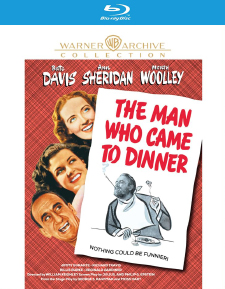
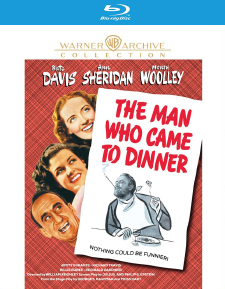
Making light of thinly disguised, larger-than-life celebrities, The Man Who Came to Dinner was a hit on Broadway in 1939. Two years later, Warner Bros. assembled an all-star cast for its screen adaptation of the George S. Kaufman and Moss Hart screwball comedy.
Renowned author and radio host Sheridan Whiteside (Monty Woolley) is on a lecture tour that brings him to Mesalia, Ohio, where the prominent Stanley family has invited him to dinner. Climbing the entry steps of the family home, he slips on some ice and takes a bad fall. Local physician Dr. Bradley (George Barbier) declares that he must remain where he is and be confined to a wheelchair until his injuries heal. Fuming, Whiteside proceeds to take over the house as Mr. and Mrs. Stanley (Grant Mitchell, Billie Burke) look on in exasperation.
Sharp-tongued, with a generous helping of venom, Whiteside commandeers the main rooms and orders the Stanleys to stay out. He’s surrounded by those who cater to his every whim, including his longtime loyal secretary, Maggie Cutler (Bette Davis) and his intimidated nurse, Miss Preen (Mary Wickes). The Stanleys’ butler, John (Edwin Stanley) and cook, Sarah (Betty Roadmnan) are excited about having a celebrity in their midst and happy to see to his every wish. Though Whiteside is dismissive of Mr. and Mrs. Stanley, he forms a bond with their grown children, June (Elisabeth Fraser) and Richard (Russell Arms). Mr. Stanley wants his home back but Whiteside threatens to sue him for negligence if he doesn’t go along with his demands.
Whiteside directs a steady stream of insults, cruel putdowns, and displays of contempt at his bullied hosts while abusing their forced hospitality. He calls his famous friends from all over the world and runs up an enormous long-distance phone bill for the Stanleys. He entertains guests including a group of convicts, glamorous stage actress Lorraine Sheldon (Ann Sheridan), zany movie star Banjo (Jimmy Durante), and multi-talented sophisticate Beverly Carlton (Reginald Gardiner). Non-stop incoming get-well phone calls and scores of gifts arrive, including an octopus and a quartet of penguins sent by Admiral Byrd from the South Pole.
The Stanleys’ curmudgeony guest from Hell meddles in the lives of everyone in the household. He advises June that it’s perfectly fine to marry the union organizer in the factory owned by her father and encourages Richard to use his talent as a photographer to set out on his own. When Maggie falls in love with town newspaper reporter Bert Jefferson (Richard Travis), Whiteside concocts an elaborate plan to break up the romance so she won’t marry and quit and thereby upset his routine.
The film’s primary set is the Stanley parlor and library, reflecting its stage origin. Several brief scenes take the action outdoors to an ice-skating rink, a train station, and a Florida hotel where Lorraine Sheldon lounges by the pool. The action is fast and often frenetic, with Whiteside the center of mayhem he himself causes.
Woolley created the role of Whiteside on Broadway and beautifully captures the egocentric man of the world who believes everyone should kowtow to his wishes and whose rudeness is as natural to him as common decency is to others. With his imperious pronouncements, Woolley engages us with Whiteside’s outlandish behavior and unapologetic chutzpah.
Bette Davis is top billed but is more part of an ensemble than star. Woolley clearly dominates, though Davis has some good scenes as the efficient, sophisticated, sharp-tongued secretary. The Man Who Came to Dinner is one of her few comedy pictures.
Mary Wickes, who also recreates her role from the stage production, is wonderful as Miss Preen, the butt of Whiteside’s constant insults. A professional, Wickes’ Miss Preen swallows her pride and does her best to care for the irascible patient who usually chases her out of the room.
Ann Sheridan nails the role of glamorous, imperious, scheming Lorraine Sheldon, whose attempts to snag a wealthy English lord fit nicely into Whiteside’s own machinations. Known for her passion for men and for a good play, she’s adept at managing one to get the other.
Jimmy Durante’s Banjo enters like a hurricane, doing schticks to amuse Whiteside, playing the piano and singing a silly song, swiping a sandwich from the cook, and joining Whiteside in an elaborate scheme. Durante is over the top, but is right at home in the madness and chaos.
Reginald Gardiner is devilishly urbane in the small role of Beverly Carlton, a Noel Coward-inspired bon vivant and wit who plays a part in an audacious trick contrived by Whiteside.
Kaufman and Hart based Sheridan Whiteside on Algonquin Round Table member Alexander Woolcott, drama critic, occasional actor and playwright, and prominent radio personality. Woolcott wrote for The New York Times, The New York Herald and The New Yorker. Known for his acerbic wit, he was widely quoted. Kaufman said the idea for The Man Who Came to Dinner occurred to him when Woolcott was his less-than-pleasant weekend guest and Kaufman thought how awful it would be if he had to put up with him for a prolonged visit. Woolcott was delighted by The Man Who Came to Dinner and was asked to star as Sheridan Whiteside for the play’s 1939 Broadway debut but declined because of his busy radio and lecture schedule. Once the play became a huge hit, Woolcott’s appetite for the spotlight prevailed and he eventually played the lead role for the West Coast touring company in 1940.
The Man Who Came to Dinner was shot by director of photography Tony Gaudio on 35mm black & white film with spherical lenses and presented in the aspect ratio of 1.37:1. The Blu-ray for the Warner Archive Collection is sourced from a 4K scan of the original nitrate camera negative. Clarity is pristine, with deep velvety blacks in a pleasing grayscale. The interior of the Stanley home is a sound stage set, as is an ice skating sequence. Details such as the pattern in Whiteside’s dressing gown, Maggie’s cluttered work table, Lorraine Sheldon’s elegant attire, including hats, and a mysterious photo given to Whiteside, are well delineated. Director William Keighley’s staging is fast-paced, with characters making entrances and exits at breakneck speed, a hallmark of classic farce.
The soundtrack is English 2.0 mono DTS-HD Master Audio. English SDH subtitles are an option for the main feature. Dialogue is clear and precise, much of it delivered rapidly. Dialogue and background effects are nicely balanced with dialogue dominant throughout. Jimmy Durante sings Did You Ever Have the Feeling That You Wanted to Go? (Still Have the Feeling That You Wanted to Stay). Friedrich Hollaender’s score is light, in keeping with the tone of the film, and never gets in the way of the witty repartee, exasperated outbursts, and madcap zaniness.
Bonus materials on the Blu-ray release from the Warner Archive Collection include the following:
- The Man Who Came to Dinner: Inside a Classic Comedy (11:47)
- Glen Gray and His Casa Loma Orchestra (8:53)
- The Wabbit Who Came to Supper (8:09)
- Hotpoint Holiday Hour (59:40)
- Lux Radio Theater (59:50)
- Theatrical Trailer (3:14)
The Man Who Came to Dinner: Inside a Classic Comedy – Jeanine Basinger, film professor at Wesleyan University, film critic Paul Clinton, and USC film professor Dr. Drew Casper discuss The Man Who Came to Dinner. The character of Sheridan Whiteside is based on Alexander Woolcott, a “larger than life person.” Woolcott set himself as the standard by which others things are measured. No one in the original Broadway cast was famous. In the film adaptation, several established stars were cast. Maggie is a buffer between Whiteside and the Stanley family. Mary Wickes, repeating her Broadway role, made her screen debut with this film. Mr. Stanley is the clueless husband. The film is a “chaotic mix” based on real people. Lorraine Sheldon is a composite of Tallulah Bankhead and Gertrude Lawrence. Reginald Gardiner channels Noel Coward. Banjo is based on Harpo Marx. The commentators mention that some references in the film may be lost on modern viewers. They note that you pick up things on multiple viewings because the film is so dense with dialogue, action, and comedy. It’s fast and furious but finely tuned so that multiple plots come together seamlessly.
Glen Gray and His Casa Loma Orchestra – In this 1942 black & white short directed by Jean Negulesco, the orchestra plays four songs: Hep and Happy, Purple Moonlight, Broom Street, and Darktown Strutters Ball. Jitterbug dancers Dean Collins and Jewel McGowan are featured. Mirrors create multiple images of the musicians and exaggerated shadows of the players add visual flair. At one point, the slide of a trombone seems to nearly touch the camera lens.
The Wabbit Who Came to Supper – In this 1942 Technicolor Merrie Melodies cartoon directed by Friz Freleng, Elmer Fudd inherits $3 million from his Uncle Louie, but it comes with a provision. Elmer must never harm any animals, especially rabbits. Bugs Bunny happily discovers this, moves into Elmer’s home, and begins to relentlessly torment him.
Hotpoint Holiday Hour – Originally aired on December 25, 1949, this adaptation of The Man Who Came to Dinner is introduced by John Garfield and stars Jack Benny, Rosalind Russell, Gene Kelly, Gregory Peck, Charles Boyer, and Dorothy McGuire. The program is narrated by Henry Fonda and directed by Mel Ferrer.
Lux Radio Theater – This second radio adaptation of The Man Who Came to Dinner, starring Clifton Webb and Lucille Ball, was first broadcast on March 27, 1950. It’s introduced by William Keighley, who directed the film.
The Man Who Came to Dinner works beautifully on screen because of its faithful adaptation by Julius and Philip Epstein. Monty Woolley as the often-antagonizing Sheridan Whiteside is outstanding, engaging us with his wit, outlandish behavior, his superiority, and his ability to steamroll over people’s feelings and throw a monkey wrench into their lives. Woolley allows us to see Whiteside’s well-hidden humanity in a few scenes, convincing us that a heart beats below the gruff, cantankerous exterior. A first-class supporting cast allow for plenty of comic interaction and complex situations. The talent and craftsmanship of both writers and actors and director William Keighley’s ability to make everything move like a fine-tuned engine add up to one of the best adaptations of a Broadway comedy ever brought to the screen.
- Dennis Seuling