
Cecil B. Demented (Blu-ray Review)
Director
John WatersRelease Date(s)
2000 (November 5, 2025)Studio(s)
Polar Entertainment/Le Studio Canal+ (Umbrella Entertainment)- Film/Program Grade: B
- Video Grade: A-
- Audio Grade: A
- Extras Grade: B+
Review
[Editor’s Note: This a Region-Free Australian Blu-ray import.]
While the anarchists of John Waters’ Pink Flamingos from 1972 battled for the title of filthiest people in the world, his anarchic, over-the-top filmmaking snobs in Cecil B. Demented from 2000 waged war on the film industry itself, taking it entirely by force... that is, within the Baltimore city limits. In many ways, Cecil B. Demented hearkens back to the days of both Multiple Maniacs and Pink Flamingos. In fact, it feels almost like a spiritual successor of sorts (especially since the Flamingos Forever sequel ended up never being made), and being that it’s John Waters’ next-to-last film (to date, that is) because of how he was feeling about the motion picture industry as a whole at the time, that seems entirely appropriate.
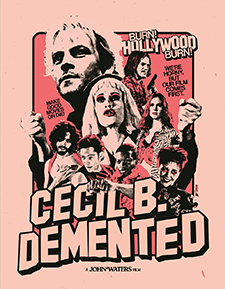
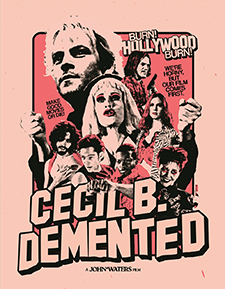
Baltimore is holding the premiere of the latest mainstream extravaganza starring the world-famous Honey Whitlock (Melanie Griffith), a demanding, self-centered diva concerned only for herself. Before the screening of her new film can begin, employees of the theater pull out their weapons and kidnap Honey at gunpoint, transporting her to a secret location. Her captors turn out to be the “Sprocket Holes,” led by Cecil B. Demented (Stephen Dorff), a maniacal local filmmaker obsessed with “Sinema” and giving the finger to Hollywood. This misfit crew includes Cherish (Alicia Witt), Lyle (Adrian Grenier), Lewis (Larry Gilliard Jr.), Raven (Maggie Gyllenhaal), Rodney (Jack Noseworthy), Petie (Mike Shannon), Fidget (Eric M. Barry), Chardonnay (Zenzele Uzoma), Pam (Erika), and Dinah (Harriet Dodge), all of whom will do whatever Cecil asks. Resistant at first, Honey is eventually brainwashed and becomes a part of the cult, dead set on helping them finish their film while avoiding the authorities and gaining an underground following. The rest of the cast includes Mink Stole, Ricki Lake, Kevin Nealon, Eric Roberts, and Roseanne Barr.
The film industry never really understood John Waters, or even tried to. The only time they gave him more attention was when he would make more so-called “mainstream” efforts like Hairspray, Cry-Baby, and Serial Mom. All are great films, but complete left turns in comparison to his earlier works. He and David Lynch were often compared to each other for their esoteric and abstract approaches, but whereas Lynch was a little more mannered and digestible, Waters was often the outlaw, and he wouldn’t have had it any other way. He tended to make films on his own terms, that is until it became far more difficult to do so in the independent realm. As such, nobody knew what to do with him, but in an environment where directors like Lars von Trier, Harmony Korine, and Gaspar Noé prospered and were given pedestals, John Waters was shown the public toilet.
Which brings us to Cecil B. Demented, partially inspired by the kidnapping of Patricia Hearst by the Symbionese Liberation Army and the events that followed. What’s even wilder is that she appears in the film, and according to Waters, was completely fine with it all. Seeing Honey Whitlock not only quickly succumb to the same brand of Stockholm Syndrome and realizing that the Sprocket Holes are sworn to celibacy until completion, which leads to an all-out sex frenzy in the final minutes, is a thing of pure madness. Cecil and his crew are willing to do absolutely anything to shoot their movie in and around Baltimore, committing multiple crimes in the process, and you actually kind of want them to succeed. Their outlandish behavior and the film’s tone doesn’t quite reach the same levels of provocative as Waters’ earlier projects, but the underground filmmaking spirit is still there and right in your face the whole time, albeit it through a bombastically zealous lens. The only downside is that the film’s ending leaves a little to be desired. In truth, it’s hard to imagine any ending being satisfactory, but seeing Honey Whitlock light her hair on fire in a very poor optical effect with the events that follow isn’t quite as effective or as interesting as what’s come before. It’s almost akin to the ending of Monty Python and the Holy Grail, which felt even more like a vat of cold water being dumped on its audience.
Nevertheless, Cecil B. Demented is John Waters poking a bit of fun at himself and pretentious low budget filmmaking. He claims that none of it was really about being angry at the studio system, but seeing as how he just walked away from making movies after being exasperated by what he had to go through to make them, it’s difficult not to read that into it. Even if that’s not the case, Cecil B. Demented is an unruly and darkly comic romp that will never stand shoulder to shoulder with films like 8½ or even Ed Wood in terms of movies about filmmaking, but that would be perfectly fine with Cecil. He’d prefer to be compared to Herschell Gordon Lewis instead.
Cecil B. Demented was shot cinematographer Robert Stevens on 35mm film with Panavision Panaflex cameras and spherical lenses, finished photochemically, and presented theatrically in the aspect ratio of 1.77:1. Umbrella Entertainment debuts the film on Blu-ray for the first time worldwide, encoded to a dual-layered BD-50 disc. This is an older master prepared by StudioCanal, but it’s a very good one with excellent compression and a bitrate that sits in the range of 25 to 35Mbps. It’s fairly sharp with loads of detail and decent contrast. Saturation offers a nice variety of hues, especially in the Sprocket Holes’ studio, but it’s a very natural palette that never appears unnatural or blown out. Blacks are fairly deep and the image is stable with only some speckling here and there. A 4K upgrade would definitely improve overall clarity and depth in the image, but this is a fine high definition master, and the only one available as of this writing.
Audio options include English 5.1 DTS-HD Master Audio and 2.0 LPCM, with optional subtitles in English SDH. The film was released in cinemas in Dolby Digital, so these two tracks offer a fine approximation of that experience. The 5.1 obviously has a little more room to move around in, giving music and sound effects some space in the surrounds, as well as some nice bass response. Dialogue is clear and discernible on both tracks, giving two great options to choose from.

The Limited Edition Blu-ray release of Cecil B. Demented from Umbrella Entertainment sits in a clear Amaray case with a double-sided poster with artwork by Johny “Visibly Wasted” Bekavac on either side, a double-sided inner sleeve featuring the US theatrical artwork on both sides, one with the mandatory Australian Classification Board ratings label and the other without, and a slipcover with one of the Bekavac artworks. Alongside it are 8 artcards and the 48-page booklet Cecil B. Demented: Essays and Art. It contains the essays Stephen Dorff vs Stardom: The Long, Strange Trip of a Mainstream Rebel by Guy Davis and City of Screens: The History of Baltimore’s Movie Houses by Justin Beahm, The Art of Revolution: Cecil B. Demented Posters & Promotional Materials From Around the World, and a page of special thanks. Everything is housed in a rigid slipcase with one of the Bekavac artworks. This is a numbered release available exclusively through Umbrella’s webstore, though they’re also offering a standard option minus the booklet, poster, and rigid slipcase. The following extras are included:
- Audio Commentary with John Waters
- Kicking Against the Pricks: John Waters on Cecil B. Demented (HD – 21:28)
- Re-Framing Fame: Melanie Griffith on Cecil B. Demented (HD – 7:53)
- Lobster Man from Mars: Production Designer Vincent Peranio on Cecil B. Demented (HD – 11:21)
- A Life in Dreamland: Mink Stole on Cecil B. Demented (HD – 14:50)
- Trailer (SD – 2:30)
The audio commentary with John Waters dates back to 2001 for the Artisan Home Entertainment DVD release. If you have any familiarity with John Waters and his speaking style, you know what you’re in for here. It’s an excellent track as he mixes his own humor with stories from the set, his appreciation for the cast and crew, any number of tangents about filmmaking, his own personal beliefs, taking drugs, and everything in between. He’s a magnetic personality and his conversations are always worth your time.
Next are a series of interviews produced by Justin Beahm’s Reverend Entertainment. Kicking Against the Pricks features an interview with John Waters, who discusses his earliest days as a filmmaker, getting the deal for Cecil B. Demented, promoting his films prior to distribution, shooting in Baltimore and being supported locally, the various local movie theaters, his similarities to Cecil and the way he made films when he was young, working with actors, putting Patricia Hearst in the film, the politics of Roseanne Barr, drive-in theaters, what a tough shoot the film was, the release of the film, and its longevity versus its lack of success. Re-Framing Fame talks to Melanie Griffith via audio only about the state of her career at the time she agreed to do the film, meeting John Waters on the set of Something Wild, Hollywood bullshit and how she was feeling at the time which infected her performance, her memories of the cast and crew, and the message of the film as she sees it. Lobster Man from Mars speaks to production designer Vincent Peranio about meeting the Dreamlanders and working with them on Multiple Maniacs for the first time, seeing John Waters films and realizing they were outlaw filmmakers, designing the Sprocket Holes’ studio, working in various theaters in Baltimore, living and working in Baltimore, and John Waters’ influence on the film industry. A Life in Dreamland interviews Mink Stole who talks about meeting John Waters at a young age and working with him, changing her name, remembering her dialogue and her Dreamlanders working environment, the Sprocket Holes being nothing like the Dreamlanders, portraying Sylvia Mallory, being among a professional and warm troupe of people, having a familial working environment, and gradually adapting to newer technologies. Last is the film’s trailer.
Items not included from DVD releases around the world include the Comedy Central Canned Ham: Cecil B. Demented Behind-the-Scenes Special, a set of production notes, an additional trailer, and a TV spot from the Region 1 Artisan Entertainment release; a set of cast and crew interviews from the Region-Free AV Channel release in Australia; the documentary Divine Trash, an interview with John Waters, and a set of TV spots from the Region 2 Universal Pictures release in France; an isolated score track from the Region 2 Warner Home Video release in Italy; and a set of soundbite interviews from the Region 2 Momentum Pictures release in the UK.
Some may view Cecil B. Demented as somewhat toothless in today’s climate when anything and everything has been parodied to death, but with terrificly unhinged performances, a stellar cast, and a little inside baseball on the film business, it’s still a fun one to pop in. Umbrella Entertainment offers a fine package with a nice Blu-ray presentation and extras. In other words...
Demented forever.
- Tim Salmons
(You can follow Tim on social media at these links: Twitter, Facebook, BlueSky, and Letterboxd. And be sure to subscribe to his YouTube channel here.)