
Blood of Revenge (Blu-ray Review)
Director
Tai KatôRelease Date(s)
1965 (January 27, 2026)Studio(s)
Toei Co., Ltd. (Radiance Films)- Film/Program Grade: B+
- Video Grade: A-
- Audio Grade: A
- Extras Grade: B+

Review
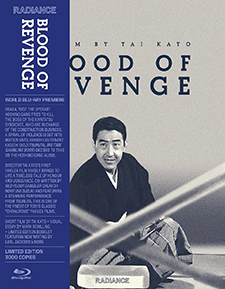
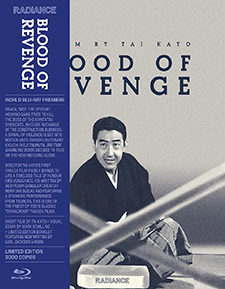
Despite its bland, inapt English title, Blood of Revenge (Meiji kyokyakuden – sandaime shumei, or “Legends of the Meiji Era – Third-Generation Succession,” 1965) is an above-average yakuza melodrama-thriller, specifically a ninkyo eiga, the subgenre that preceded the more explicit “actual record films” (jitsuroku eiga) such as Kinji Fukasaku’s Battles Without Honor and Humanity film series. The more traditional ninkyo eiga stressed conflicts between loyalty and honor with personal feelings. Blood of Revenge, with its well-worn genre tropes, breaks little new ground, but is generally subtler and more character-driven than most. This one works from an overworked yakuza movie premise: when the leader of a gang is assassinated, conflict arises over his heir-apparent son, hotheaded and immature, versus the obvious choice, the methodical and longtime trusted lieutenant who, alas, is not a blood relative.
Set in Osaka in 1907, the film revolves around the Kiyatatsu syndicate, operating a lumber business that has expanded into selling concrete and other construction materials, and whose leader, Emoto (Kanjuro Arashi) is stabbed in the opening scene. A rival gang, led by Gunjuro Hoshino (Minoru Oki), is behind the assassination attempt. As the elderly Emoto’s condition turns grave, he realizes his impetuous son, Haruo (Masahiko Tsugawa), is ill-suited to take over, urging instead for longtime right-hand man Asajiro Kikuchi (Koji Tsuruta) to succeed him.
Elsewhere, Hatsue (Junko Fuji), a prostitute whose regular client is the abusive Tatsuzo Karasawa (Toru Abe), Hoshino’s own right-hand man, begs a leave of absence from the brothel to visit her dying father, but her Mama-san refuses. Kikuchi comes to her rescue, buying her for three days leave because he remembers of the pain of being in prison, unable to see his own dying father. Kikuchi and Hatsue become lovers, but breezy yakuza Senkichi (Hiromi Fujiyama) has to step in when an enraged Karasawa threatens the lovers.
Directed by genre master Tai Katô, Blood of Revenge is slightly above average for its type insofar as the main characters are a little richer with just a bit more depth than usual. Women in these films are tend to be either victims or, especially if middle-aged, scheming shrews, and while Junko Fuji’s Hatsue clearly falls in the former category, there’s a wisp of Mizoguchi-esque empathy, rather than the usual Toei company manner of both pitying such women while simultaneously exploiting them (being raped, beaten, appearing semi-nude, etc.) Koji Tsuruta was good at playing such conflicted yakuza characters, setting the mold followed later by the likes of Ken Takakura and Bunta Sugawara. And Toru Abe, as always, makes a ruthless, slimy heavy, truly a man you love to hate.
Hoshino’s grand scheme to bring about the fall of the Kiyatatsu syndicate by forcing them to go legit, to surrender their yakuza ties, is rather unusual, and it’s interesting to see yakuza so directly linked with the construction industry, a link still very much in force when the film was made. Typically, such films focused on other yakuza proclivities like illegal gambling and drug trafficking, and the conflicts arising from this blurring of criminal and legitimate elements is refreshing.
Otherwise, it’s business as usual. Virtually all Japanese studio films of the 1950s and ’60s were well crafted, with especially imaginative cinematography (here by Motoya Washio, whose diverse credits include Hibari is Fashion Crazy, The Magic Serpent, and Sex and Fury) editing, and musical scoring. Toei was busy enough at this time to lavishly appoint its backlot and studio exteriors, allowing for much colorful period atmosphere.
Radiance Films’ Region A/B Blu-ray of Blood of Revenge presents the color film in its original 2.35:1 Toeiscope aspect ratio, using a digital file provided by the Japanese company. The video transfer falls a little short of greatness, but then again Katô seems to favor a lot of shallow-focus photography, so it’s inherently a little less crisp than other color-’scope Japanese productions of the mid-’60s. The uncompressed PCM audio (2.0 mono) is good for what it is, and the optional English subtitles are excellent.
The extras are limited but imaginatively conceived. Lice Are Scary is a 14-minute propaganda/educational film Katô directed in 1943. Like many wartime films, it doesn’t exactly survive in pristine condition, but is highly amusing. Japanese film critic-historian Mark Schilling hosts a new, 15-minute visual essay on actress Junko Fuji, and an excellent booklet includes essays by Earl Jackson and Yoji Ishizuka.
Not really a classic of the genre but well-made and certainly above average, Blood of Revenge is highly recommended to Japanese film fans.
- Stuart Galbraith IV