
Somewhere in Time (4K UHD Review)

Director
Jeannot SzwarcRelease Date(s)
1980 (March 10, 2026)Studio(s)
Rastar/Universal Pictures (Kino Lorber Studio Classics)- Film/Program Grade: B
- Video Grade: A-
- Audio Grade: B
- Extras Grade: B-

Review
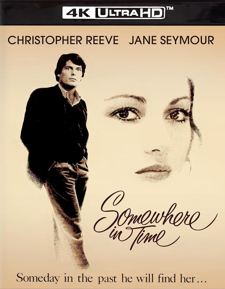
Based on the 1975 science fiction novel Bid Time Return by Richard Matheson (I Am Legend, The Omega Man, What Dreams May Come), director Jeannot Szwarc’s Somewhere in Time is an unlikely period drama and romantic fantasy featuring Christopher Reeve in his first big screen role after playing the Man of Steel in Richard Donner’s Superman, as well as the lovely Jane Seymour (Live and Let Die, Battlestar Galactica), and screen legend Christopher Plummer (The Sound of Music, Star Trek VI: The Undiscovered Country).
The film opens as an up-and-coming writer and theater student, Richard Collier (Reeve), is celebrating his first stage success at its opening night after-party. The mood in the room is buoyant, as cast, crew, and at least one agent feel the play could be destined for Broadway. It’s at this moment that an old woman who was in the audience for the performance approaches Richard, hands him an antique pocket watch, and says only “Come back to me,” before departing, leaving everyone in the room stunned.
Eight years later, Richard’s now a successful playwright living in Chicago, but he’s having writer’s block as he tries to complete his latest work. To clear his head, he decides to take a road trip and finds his way to the Grand Hotel on Mackinac Island in Michigan. After taking a room, Richard is exploring the grounds when he hears music and finds himself drawn to a old portrait of a beautiful woman on the wall—the famed theater actress Elise McKenna (Seymour), who starred in a play at the resort in 1912.
Haunted by the image, Richard conducts some research and finds a magazine photo of the elderly Elise—who it turns out is the same woman that gave him the pocket watch. Tracking down her address, he speaks to the woman who cared for Elise in her final years and is shown a music box that plays the song Richard heard at the hotel, a bit of Rachmaninoff’s Rhapsody on a Theme of Paganini. He also learns Elise was fond of a book on time travel by his old college professor, Dr. Gerard Finney, who believes such a thing might actually be possible through a kind of self-hypnosis. So Richard becomes obsessed with fulfilling what turns out to have been the final words of the woman he now loves: “Come back to me.”
Somewhere in Time was only a modest success when it was first released into theaters, and its critical reviews were terrible. Universal was more focused on promoting The Blues Brothers at the time, so the film essentially came and went. But audiences—particularly younger TV viewers who’d come to admire Reeve for his role in Superman—soon discovered the film on pay cable channels like HBO, where it aired often and to high demand, and they readily embraced its romantic premise. So within a few years, Somewhere in Time had become an unlikely cult classic. Both Reeve and Seymour give sincere performances (made all the more compelling by Seymour’s 2018 revelation that the pair fell in love for real while filming), and Plummer is in fine form as the young Elise’s overly protective manager. If you look closely in the film’s opening scene, you might also spot a young William H. Macy (Fargo) in a very early screen appearance. (George Wendt of Cheers fame was also to have appeared in this scene, but his footage was cut from the final film.)
Somewhere in Time was shot by cinematographer Isidore Mankofsky (The Muppet Movie, The Jazz Singer) on 35 mm film (specifically Eastman 100T 5247) using Panaflex cameras with Panavision spherical lenses. It was finished in a traditional analog photochemical process and released into theaters at the 1.85:1 aspect ratio. For its debut on Ultra HD, Kino Lorber Studio Classics has taken advantage of a new 4K scan of the original camera negative, completed a modest digital clean up, and graded the image for high dynamic range (compatible with both Dolby Vision and HDR10). The result has been encoded for release on a 100 GB disc, with data rates averaging 80 Mbps.
The overall image quality is very good, with lovely fine detail and light to light-medium organic grain, save for optically-printed titles and transitions (which exhibit the usual generation loss of clarity and much coarser grain). A bit of lens netting is frequently employed to lend the image a romantic softness, as is theatrical smoke. Colors are natural and well saturated at all times—particularly skin tones—with a strong and intentional warm cast overall. The contrast is very good, with deep yet detailed blacks, only a bit of crush in darker scenes, as well as naturally bold highlights. Exterior scenes are particularly luminous in appearance. You’ll notice the occasional speck of dust here and there, but on the whole this is a lovely 4K image for a classic catalog title of this vintage. It’s also a significant improvement over Universal’s original 2014 Blu-ray release in terms of color accuracy, detail, and encoding.
Primary English audio is available here in the original 2.0 mono in DTS-HD Master Audio format. The dialogue is clean and readily discernible at all times. The sonic quality is fine overall. Though the mono track doesn’t suffer from any distracting age-related issues, it’s not going to dazzle you either. But it’s more than adequate for the job at hand, and the John Barry score—which became a best seller in the U.S. (ultimately achieving Platinum album status) thanks to the film’s popularity on premium cable—sounds lovely. Optional English subtitles are available.
The Kino Lorber Studio Classics Ultra HD release is a 2-disc set that includes the film in 4K on UHD and 1080p HD on Blu-ray, both remastered. Both discs include the following special features:
- Audio Commentary by Jeannot Szwarc
- Audio Commentary by Tim Lucas
- Audio Commentary by Julie Kirgo and Peter Hankoff
To this, the Blu-ray adds the following:
- Back to Somewhere in Time (SD – 63:42)
- Inside INSITE: The Somewhere in Time Fan Club (SD – 3:23)
- Theatrical Trailer (HD – 2:11)
- Additional Trailers (see below)
The director’s commentary and video features were produced for the film’s original DVD release. Szwarc—whose other work includes Jaws 2, Supergirl, and Santa Claus: The Movie—talks about the film’s origins and shares anecdotes about its production. Back to Somewhere in Time is an hour-long retrospective documentary produced by longtime Steven Spielberg collaborator Laurent Bouzereau. It features interviews with Matheson (who adapted his own novel into a screenplay here), producer Stephen Simon, Szwarc, and all three of the lead cast members—including Seymour, Plummer, and Reeve (who was by then in a wheelchair). Actors Teresa Wright (Elise’s caregiver) and Bill Erwin (who plays Arthur) also appear. The other featurette is brief and focuses on INSITE, aka the International Network of Somewhere In Time Enthusiasts, featuring founder Bill Shepard.
New for this 4K and Blu-ray edition are a pair of additional commentaries, one by film critic Tim Lucas and another film historian Julie Kirgo and documentary filmmaker Peter Hankoff. The former features Lucas essentially reading his own essay to “guide the viewer through a closer reading” of the film. It includes abundant trivia and other details. The latter track offers Kirgo and Hankoff having a more casual and enthusiastic conversation about the film. The theatrical trailer is also here and it’s been upgraded to HD. There are also additional trailers for Daisy Miller (1974), The Other Side of the Mountain (1975), The Other Side of the Mountain: Part II (1978), The Greek Tycoon (1978), Moment by Moment (1978), The Seduction of Joe Tynan (1979), and The Aviator (1985). Missing from the original DVD is a gallery of production photos.
Somewhere in Time’s plot is contrived to be sure, its story is slow to develop, and the straightforward direction isn’t likely to have cinephile appeal. But the performances here are excellent and the film’s simple charms are impossible to deny. It’s also true that Somewhere in Time is itself not unlike a time capsule—one that serves to cement Reeve, Seymour, and Plummer in the mind’s eye, each of them in their prime. And that is not so trivial a thing. KLSC’s 4K release is definitely recommended for fans of the film.
- Bill Hunt
(You can follow Bill on social media on X, BlueSky, and Facebook, and also here on Patreon)