
Night World (Blu-ray Review)
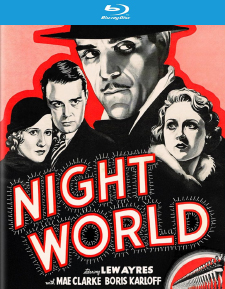
Director
Hobart HenleyRelease Date(s)
1932 (May 19, 2026)Studio(s)
Universal Pictures (Kino Lorber Studio Classics)- Film/Program Grade: A-
- Video Grade: A-
- Audio Grade: A-
- Extras Grade: B


Review
This one’s a real corker. One presumes Night World (1932) got greenlit for Blu-ray release because of the built-in audience for one of its stars, Boris Karloff, and because it’s a pre-Code title, that term being a selling point for collectors, but the picture turns out to be a cracklin’ little B-picture. It’s exceptionally well-made on a modest budget and, at just 58 minutes, never wears out its welcome.
Though originally released theatrically just four weeks after MGM’s all-star Grand Hotel, one suspects the hype surrounding that production inspired this. Grand Hotel is an ensemble film set at a ritzy Berlin hotel, while Night World is an ensemble film set at a ritzy Manhattan nightclub in the middle of winter. At Happy’s Nightclub, owner “Happy” MacDonald (Karloff) is unhappily married to shrewish Jill (Dorothy Reiver), who’s having an affair with choreographer Klauss (Russell Hopton). Chorus girl Ruth Taylor (Mae Clarke) takes pity on despondent drunk Michael Rand (top-billed Lew Ayres), whose mother (Hedda Hopper) was recently acquitted for murdering his father. Doorman Tim Washington (Clarence Muse) keeps trying, unsuccessfully, to leave work to be near his wife, she undergoing surgery. Tinhorn tough guy Ed Powell (George Raft) is trying to get Ruth into his bed, and annoyed that her affections are gravitating toward Michael.
The picture gets off to a great pre-Code start, with a dazzling montage of showgirls dressing, prostitutes plying their trade, and snowy Times Square abuzz with speakeasies, unfaithful husbands and wives carrying on, etc.
I had never heard of actor-turned-director Hobart Henley, whose career was largely confined to the silent era; Night World was his penultimate work as director, yet his direction positively dazzles. Just a few years before, early talkies were mostly profoundly static, the sauna-like camera all but bolted to the soundstage floor. But here Henley, working with cinematographer Merritt B. Gerstad, employ shots almost constantly on the move, the camera following characters as they weave their way through the bustling nightclub, sometimes trading off mid-shot with another character, or even following them from one interior set to an adjacent one without a cut. It’s like a prehistoric version of GoodFellas. Henley keeps even ordinary conversations interesting with camera movement and interesting angles, avoiding the kind of standard coverage (establishing shot, two-shot, reaction shots, etc.) one associates with ordinary movies.
The performances are also superior. The biggest revelation is Mae Clarke, who never made much of impression even in Frankenstein or The Public Enemy, her signature film roles, but who here is very naturalistic and appealing. (I was also struck by her strong resemblance and even acting style to Helen Mirren.) She and Lew Ayres make an appealing couple. George Raft is less stiff than usual, while Karloff seems to be enjoying playing an atypical part, literally grinning from ear-to-ear as “Happy” for nearly the entire film. (One doubts the role was written with Karloff in mind.) Clarence Muse is saddled with a somewhat racially stereotyped part, but Muse, an underrated actor, habitually rose above such parts, bringing to them a grounded humanity far more dignified than most such “colored” characters at that time. Night World does, however, feature an outrageous (and notably explicit) gay stereotype (fussing over his eyebrows in a mirror, trying to pick-up a male nightclubber, etc.) leaving no doubt about that character’s sexual orientation.
The film is also noteworthy for the early choreography by Busby Berkeley. Though modest compared to his later work for Warner Bros. and MGM, signature Berkeley shots (geometric patterns shot from above, tracking shots beneath the spread legs of the chorus girls, etc.) are all present and reflect the pre-Code raciness.
In a way, what most impresses about Night World is the way everything coalesces, its disparate components, all above average in and of themselves, so smoothly integrate with one another and result in a highly entertaining little movie.
Kino’s Blu-ray, licensed from Universal, offers a 2K scan “of the 35mm finegrain,” though to my eyes it looks like a composite of a finegrain with other scattered film elements. The image is commendable for such an obscure, 90-plus year-old movie. Some scenes of this black-and-white, 1.37:1 standard frame production look very good, others slightly less so, but even on a big screen the images impress throughout, even though damage (mostly of a chemical nature) are visible here and there. The DTS-HD Master Audio (2.0 mono) is also good, and optional English subtitles are provided. The disc is Region “A” encoded.
Extras are limited to two audio commentary tracks, both above average, the first by film historian Jeremy Arnold, the other by critic Tim Lucas and jazz broadcaster Joe Busam.
I was expecting something mildly interesting for its cast, not a superlative pre-Code B-movie in which many good components work together resulting in a very fun viewing experience. Highly recommended.
- Stuart Galbraith IV