
Night in the Life of Jimmy Reardon, A (Blu-ray Review)
Director
William RichertRelease Date(s)
1988 (March 10, 2026)Studio(s)
Island Pictures/20th Century Fox (Kino Lorber Studio Classics)- Film/Program Grade: B-
- Video Grade: A
- Audio Grade: A
- Extras Grade: B

Review
Teen-oriented films abounded in the 1980s, from full-out laugh fests like Fast Times at Ridgemont High to coming-of-age dramas like Pretty in Pink, troubled young people dramas (Bad Boys), and explorations of teenage angst (The Breakfast Club). In A Night in the Life of Jimmy Reardon, a 17-year-old grapples with an uncertain future.
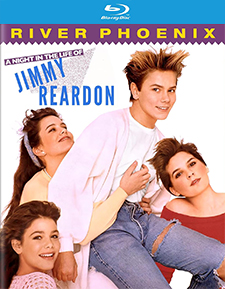
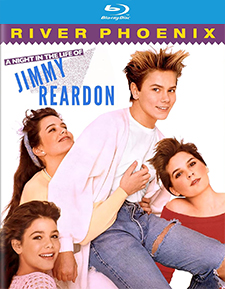
Based on the novel Aren’t You Even Gonna Kiss Me Goodbye?, the film takes place in Chicago in 1962. Jimmy Reardon (River Phoenix) is desperate to come up with the money he needs to get to Hawaii where his country club girlfriend Lisa (Meredith Salinger) will be attending college. Jimmy fancies himself a poet and has some talent. He’s also an operator. With his girl frustrating him by refusing to go to the next step sexually, Jimmy spends afternoons roleplaying sexual games with his best friend’s girl, Denise (Ione Skye). When his mother’s friend Joyce (Ann Magnuson) attempts to seduce him, Jimmy doesn’t exactly resist. There’s also tension at home. His father (Paul Koslo) wants Jimmy to go to the same business college he attended, while Jimmy’s heart is set on heading to Hawaii.
Jimmy isn’t very admirable. He uses his good looks and intelligence to get what he wants and he resents his far more affluent friends, often taking them for granted or, in the case of best pal Fred (Matthew Perry in his film debut), betraying them. He’s torn between heeding the advice of his parents, advice that would put him on a road to a profession and independence, and pursuing an ill-thought-out plan to follow his girl to Hawaii.
This was River Phoenix’s first above-the-title starring role. Prior to Jimmy Reardon, he had made only three films. The studio attempted to capitalize on his rising popularity by marketing the film as a teen sex comedy, though in actuality, it’s more a character study. Yes, there are R-rated sex scenes, but the heart of the story is Jimmy’s struggle to find out what he really wants in life. This makes the character identifiable to young viewers.
Phoenix, with a pompadour worthy of its own credit, conveys both sensuality and innocence, depending on the scene. With his piercing blue eyes and self assurance, his manner is just shy of a swagger. Though many of Jimmy’s actions are reprehensible, Phoenix draws us in so that his character never repulses us. Though he can play hedonistic carefreeness to a T, Phoenix also radiates vulnerability.
The women and girls in Jimmy’s life represent different appeals. Lisa is a nice girl from a good, affluent family. Denise fulfills his sexual desire. Joyce represents danger and adventure. His mother (Jane Hallaren) counsels him with good advice in a gentle, yet firm manner. We get the fullest understanding of Joyce. A lengthy scene between Jimmy and Joyce is filled with sexual tension as they engage in conversation, both knowing what will be inevitable. Lisa isn’t developed adequately, so her emotional confrontation with Jimmy doesn’t resonate the way it should. Denise is portrayed, literally, as Jimmy’s plaything.
In the fairly small role of Fred, Matthew Perry, who would go on to play Chandler Bing for ten seasons on Friends, already shows his proficiency in comic timing. As Jimmy’s sidekick, he’s loyal, trusting, and sort of dorky, making him an endearing contrast to Jimmy.
Jimmy’s dad is all threats and bluster until late in the film when he displays some humanity and bonds with Jimmy under peculiar circumstances. Koslo’s expressions speak volumes when his character interacts with Jimmy. You can read on his face exactly what he’s thinking.
In a small role, Marji Banks steals her scene as the elderly mother of the photographer Jimmy briefly works for. With heavy blue eye shadow, a hairstyle a la Ann Miller’s circa 1965 and a manner reminiscent of Gloria Swanson’s in Sunset Boulevard, she’s hilarious, particularly in her clipped exchanges with her quietly ill-tempered maid, Alice (E.J. Murray). Ms. Banks enlivens the picture with her portrayal of an eccentric biddy who loves pumping Jimmy for gossip.
River Phoenix deserved a better script. The film relies on a titillation factor that quickly pales. Phoenix is very good in his first starring role but he can’t shore up a flimsy script. The film is somewhat of a letdown.
A Night in the Life of Jimmy Reardon was shot by director of photography John J. Connor on 35mm film with Panavision Panaflex cameras and lenses, processed by Astro Color Lab, Chicago, and presented in the aspect ratio of 1.85:1. Clarity on the Blu-ray is sharp. Details, such as strands of hair in River Phoenix’s high pompadour, patterns in dresses and Jimmy’s clothes, decor in Jimmy’s home, a fancy red Corvette sports car, and landscaping around Lisa’s home are well delineated. There are no visual imperfections such as scratches, emulsion clouding, or impacted dirt specks to impair enjoyment.
The soundtrack is English 2.0 DTS-HD Master Audio. English SDH subtitles are an available option. Dialogue is clear and distinct. Period songs include Chances Are by Johnny Mathis, He’s So Fine by The Chiffons, Shop Around (Smokey Robinson & The Miracles), I’m a Man (Bo Diddley), and Theme from A Summer Place (Percy Faith and His Orchestra). Bill Conti composed the score for the film’s U.S. theatrical release. An original score was composed by Elmer Bernstein for the non-U.S. version of the film.
Bonus materials on the Blu-ray release from Kino Lorber Studio Classics include the following:
- Audio Commentary by Paul Anthony Nelson and Perri Cummings
- Trailers:
- A Night in the Life of Jimmy Reardon (1:33)
- Sneakers (2:54)
- The Wild Life (2:00)
- Gotcha! (1:35)
- The Secret of My Success (2:09)
- The Allnighter (1:07)
- Secret Admirer (1:33)
- Winter Kills (3:20)
Audio Commentary – Film historians Paul Anthony Nelson and Perri Cummings share this commentary. A Night in the Life of Jimmy Reardon is an adaptation of the 1968 semi-autobiographical novel by William Reichert. The film boasts a strong cast. Reichert originally recorded the voiceover, but the studio felt his voice sounded like an old man’s. The No Exit coffee house shown in the film was a real place in Chicago. It closed in 2000 but was revived briefly around the time the film was released. Reichert was proud to say he discovered Matthew Perry. Perry never had opportunities in film “up to his talent.” His flair for comedy was already evident. The actors are age-appropriate to the characters they play. Phoenix had been in an after-school special and several guest roles in TV series. Perry had been in two series that failed prior to Friends. Paul Koslo had an extensive career in television. The antagonism between Jimmy and his father is stronger in the book. The father has built up years of resentment. Jimmy has to “endure poverty” while all his friends are more affluent. The decor in Jimmy’s room suggests his tie between childhood and adult responsibility. Films in the 1980s often referenced the 50s but were more cynical. A comic set piece is Jimmy working in the photographer’s studio and making a complete mess. The commentators speak about numerous production issues on the William Reichert-directed Winter Kills, including the financiers being “a wee bit dodgy” when it came to coming up with funds to pay cast and crew. Reichert was able to attract major stars with a $6 1/2-million budget. Nelson and Cummings refer to Winter Kills, made during the Reagan Era when family values were emphasized, as “the most cursed movie of all time.” Films of the 1980s explored social disparity. The final scene at the country club heightens the disconnect. The final image of A Night in the Life of Jimmy Reardan metaphorically shows that “the train of life is going on.”
A Night in the Life of Jimmy Reardon gets mired in too many sub-plots. Performances are uniformly above average, with Phoenix, Perry, and Magnuson standing out along with Marji Banks’ scene-stealing old lady. Production design doesn’t adequately suggest the time period. Women’s hairdos are very much 80s styles and Phoenix and Perry never use slang expressions of the period. There was an obvious attempt to have it two ways—set it in an earlier period but make it relatable to audiences of the 1980s. It isn’t long before the film loses its way to the point that Jimmy’s problems cease to engage us.
- Dennis Seuling