
Let’s Spend the Night Together (Blu-ray Review)
Director
Hal AshbyRelease Date(s)
1983 (January 27, 2026)Studio(s)
Northstar Media/Raindrop/Weintraub Entertainment Group (Kino Lorber Studio Classics)- Film/Program Grade: B
- Video Grade: A-
- Audio Grade: A-
- Extras Grade: C+

Review
During their 1981 American tour, The Rolling Stones decided that the time was ripe for a big screen concert film since they were in top form and back on top of the charts with the release of Tattoo You. Drawing huge crowds to sold out shows from one coast to the other, they put up the money to professionally film three of their concerts: November 5th and 6th at the Brendan Byrne Arena in East Rutherford, New Jersey, and December 13th at the Sun Devil Stadium in Tempe, Arizona. Under the direction of Hal Ashby (Harold and Maude, Shampoo, Being There), over 200,000 feet of film was shot for Let’s Spend the Night Together, which rolled into US theaters in February of 1983 in standard 35mm, as well as 70mm with a six track Dolby stereo soundtrack.
Mick Jagger had been a fan of and was friendly with Hal Ashby during the 1970s, wanting to work with him on a project for many years. Apparently when he spoke to him about the idea of making a concert film during their current tour, Ashby suggested himself to direct. A dynamite set list, Ashby’s and uncredited co-director Pablo Ferro’s (along with cinematographers Caleb Deschanel and Gerald Feil) expansive stadium shots and compositions, and massively receptive audiences combined to make for a fun show, as well as a fine snapshot (albeit a little trimmed down) of a Stones show in 1981. Speaking of the set list, here’s what Let’s Spend the Night Together has to offer:
Under My Thumb
Let’s Spend the Night Together
Shattered
Neighbours
Black Limousine
Just My Imagination (Running Away with Me)
Twenty Flight Rock
Let Me Go
Time Is on My Side
Beast of Burden
Waiting on a Friend
Going to a Go-Go
You Can’t Always Get What You Want
Little T&A
Tumbling Dice
She’s So Cold
All Down the Line
Hang Fire
Miss You
Let It Bleed
Start Me Up
Honky Tonk Women
Brown Sugar
Jumpin’ Jack Flash
(I Can’t Get No) Satisfaction
Mostly focused on their more recent catalogue, Let’s Spend the Night Together is also an encapsulation of the Stones’ then 20-year career, even offering some vintage footage of past concerts and early television appearances during a terrific run-through of Time Is on My Side. It also highlights just how far they had come as they were now playing giant arenas, including outdoor stadiums with Jagger strutting around in compression leggings and football pads. Thankfully, the focus is on the band as a whole and not just Jagger, giving Keith Richards, Ron Wood, Bill Wyman, and Charlie Watts plenty of time in the spotlight, as well. We’re also treated to musical guests Ernie Watts and Bobby Keys on saxophone, and Ian Stewart and Ian McLagen on piano and keyboards.
The first half of the film is mostly dedicated to the Tempe show, switching gears and heading to East Rutherford, set to a respectable rendition of the Smokey Robinson and the Miracles’ hit Going to a Go-Go during a stage construction time-lapse. The Stones tear through several numbers before we switch back and forth between Tempe and East Rutherford for the final four songs: Honky Tonk Women, Brown Sugar, Jumpin’ Jack Flash, and (I Can’t Get No) Satisfaction. As the credits roll and the fireworks explode above the Sun Devil Stadium, we hear the familiar notes of Jimi Hendrix’s blistering version of the Star Spangled Banner from Woodstock.
As much fun as Let’s Spend the Night Together can be, there are some rough spots. It’s not the most appealing-looking rendition of the Stones, but the film itself can get a little messy in certain areas, specifically when the editor (Lisa Day) decides that the concerts are becoming boring, and starts changing things up with footage from other places. The most egregious example of this is during Time Is on My Side when some disturbing newsreel footage of war atrocities is laid over it. Whether the filmmakers were try to make a counterpoint about what was going on in the world at the time when The Rolling Stones were enjoying their success, or they just wanted something vulgar to throw water on audience, is unclear. Nevertheless, it’s poor form and doesn’t belong in the picture. We’re here to enjoy a show, not to see people get beheaded.
The other rub is a missing performance. Originally titled Time Is on Our Side, and released as Rocks Off in Europe, an alternative version of the film surfaced there with the additional number When the Whip Comes Down. Sadly, that version seems to be lost to history, at least for the time being. It’s an odd cut to make since the rest of that tour’s set list is otherwise represented almost in full, though there are some cuts in the final closing numbers. Other than those drawbacks, Let’s Spend the Night Together is still an enjoyable evening with one of the world’s greatest rock and roll bands, and one that long-time fans were, and still are, appreciative of.
Cinematographers Caleb Deschanel and Gerald Feil shot Let’s Spend the Night Together on 35mm film with Panavision Panaflex cameras and Panavision lenses. The results were finished photochemically and presented theatrically in the aspect ratio of 1.85:1 and 2.20:1, the latter for 70mm screenings. Kino Lorber Studio Classics debuts the film on Blu-ray for the first time in the United States from a new HD master, taken from a 4K scan of the original camera negative by StudioCanal, and encoded to a dual-layered BD-50 disc. It’s a gorgeous presentation of a film that’s never really looked all that good on home video, but the closer to the original negative it’s gotten, the better that it has appeared. And that’s certainly the case here. Even in high definition (as opposed to UHD), the film looks miles better than it has in the past. Detail has been boosted tremendously, especially in backgrounds and the darker sections of the film, chiefly the indoor Brendan Byrne Arena. You can see audience members much clearer, bathed in color from the stage show. The bitrate sits almost exclusively between 35 and 40Mbps, but compression never really suffers. Grain is prominent, though it’s much tighter and more refined in 4K, and the palette offers a lovely variety of hues. The Stones’ stage design is loaded with color, as are the thousands of audience members. Blacks are super deep with excellent contrast, and outside of stray speckling here or there, the image is very clean and stable throughout.
Audio is included in English 5.1 and 2.0 DTS-HD Master Audio with optional subtitles in English SDH. The film was released in six track stereo, which appears to be represented here well enough. The stereo track has a little more obvious staging in the left and right speakers, while the 5.1 seems slightly tighter by comparison. Both tracks dutifully represent the Stones’ music, pumping more life into it than previous presentations that seemed a little anemic. There’s some decent low end and good spread for the instruments, though the pianos tend get the short end of the shrift sonically. Nevertheless, these are both rock solid tracks.
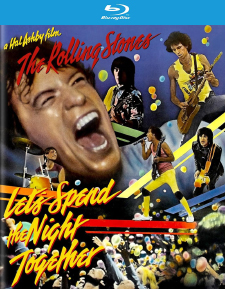
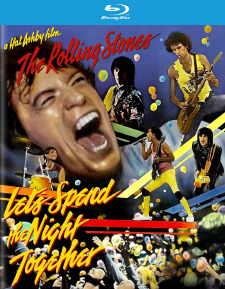
The Kino Lorber Studio Classics Blu-ray of Let’s Spend the Night Together sits in a blue Amaray case with the original theatrical poster artwork featured on the insert and the slipcover. The following extras are included:
- Audio Commentary by Justin Sosa
- Audio Commentary by Bryan Reesman and Max Evry
- Theatrical Trailer (SD – 2:30)
The first audio commentary features Justin Sosa, host of the Hang Fire: A Rolling Stones Podcast, while the second features entertainment journalists and authors Bryan Reesman and Max Evry. While each track manages to cram in as much information about the film’s production, release, and everyone involved with it as possible, each has its own sets pros and cons. Sosa’s track frequently dips in and out of the film’s audio, which is highly distracting, while the Reesman and Evry track is packed full of information to the point of bloat. In truth, there’s not tons you can really say about this film without resorting to reading biographies of the band members and the filmmakers, but both commentaries mostly steer clear of that and actually provide some illuminating material about its creation. The only other extra is the original theatrical trailer.
Rolling Stones concert films are a dime a dozen nowadays, especially since so much vintage material has been released in recent years, but when Let’s Spend the Night Together was originally released, that wasn’t the case. It’s still a great set of performances from a band during one of the most transitional phases of their career while still managing to achieve success. Kino’s Blu-ray, as well as their 4K release, are enjoyable reminders of that.
- Tim Salmons
(You can follow Tim on social media at these links: Twitter, Facebook, BlueSky, and Letterboxd. And be sure to subscribe to his YouTube channel here.)