
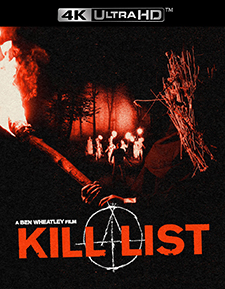
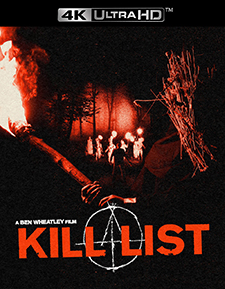
Kill List (4K UHD Review)
Director
Ben WheatleyRelease Date(s)
2011 (December 9, 2025)Studio(s)
Protagonist Pictures (Severin Films)- Film/Program Grade: B+
- Video Grade: A-
- Audio Grade: B+
- Extras Grade: A-

Review
Ben Wheatley has long been fascinated by the intersection between domesticity and the human proclivity toward violence, and not in the conventional sense of the term “domestic violence,” either. Instead, his thematic approach is more akin to David Lynch’s in Blue Velvet, where seemingly tranquil suburban surfaces can disguise the real heart of darkness that drives the worst in human behavior. His debut feature Down Terrace was the story of two ex-cons trying to balance their attempts to put a family life back together with their desire for revenge against whoever had betrayed them. Sightseers involved a seemingly ordinary couple taking a vacation by caravan that goes dreadfully, horribly, violently awry. In between those two efforts, Wheatley directed his breakthrough feature Kill List, a film that—well, like Fight Club, the first rule of Kill List is that you shouldn’t talk about Kill List, at least not in too much detail. It’s as if David Lynch’s opening sequence for Blue Velvet had zoomed into the suburban lawn only to find something far more chthonic underneath than mere ants. Kill List blends (and bends) genres, but it’s best appreciated on a first viewing if you only know the superficial one.
That genre, of course, would be the British crime film. While Wheatley has little in common stylistically with Guy Ritchie, the basic story that he concocted (along with his wife Amy Jump) mines similar territory to Richie’s milieu, albeit with a slightly more politicized twist. Jay (Neil Maskell) is a hitman who is struggling with PTSD after a disastrous mission in Kyiv. He takes many of his issues out on his wife Shel (Myanna Buring) while trying not to take them out on his son Sam (Harry Simpson). When his partner Gal (Michael Smiley) comes over to their house for a dinner party, bringing along his new girlfriend Fiona (Emma Fryer), he also brings a new job offer. The potential client (Struan Rodger, looking remarkably like a shaggy-haired Joe Biden) wants to hire them to kill three different targets: a priest (Gareth Tunley), an archivist (Mark Kempner), and an MP (James Nickerson). They accept the assignment, but as they start working their way down the list, Jay becomes increasingly disturbed, and their client isn’t about to let them off the hook, either. It seems that these hitmen have been chosen for a Becoming of a radically different sort.
That’s the basic story outline for Kill List, but it’s absolutely not what Kill List is about. Unfortunately, the first rule of Fight Club kicks in at this point, which makes it difficult to go much further. Granted, Kill List has been out for a decade and a half now, and it’s been much discussed, so people who haven’t yet seen the film still may be fully aware of its secrets. Yet for the benefit of those who aren’t, it’s still best to let them experience Kill List as cold as possible in order to be as baffled as anyone who first saw it back in 2011. Suffice it to say that while the crime milieu may recall Guy Ritchie, Wheatley’s real antecedent was another British director who made an iconic film about a man who takes an assignment only to discover that there were more things in heaven and on earth than were dreamt of in his philosophy (or actually less things, in that particular case). Kill List may start out as standard British crime fare, but as the plot unravels (and Jay’s mind along with it), it reveals itself to be something else entirely.
Yet regardless of genre(s), Kill List still revels in Wheatley’s fascination with showing the conflict between domestic tranquility and anthropogenic reality. Human nature has an inevitable impact on the environments that surround us, even the suburban environment of hearth and home. The fact that Jay is a professional hitman results in inevitable conflict with the norms of domesticity, but while the priest, the librarian, and the MP all seem like equally normal components of suburban life, they’re hiding dark secrets of their own. Even Jay’s wife Shel is a former soldier who is more than capable of taking care of herself, so when Jay and Gal’s deteriorating assignment results in the fight coming to Jay’s homestead, she’s locked and loaded for bear. Yet she hasn’t understood the real nature of the threat anymore than Jay has. She may not have been a victim of domestic violence, but violence is coming for her domestic tranquility anyway, and from an unexpected source, too. Her laugh when she finally understands what has happened is a grim acknowledgment of the irony of it all. The monsters in David Croneberg’s Shivers may have come from within, but in Kill List, the real monsters are inside of us all.
Cinematographer Laurie Rose captured Kill List digitally using Red One cameras, but there’s no other information available about lenses, formats, or capture resolutions. It was likely captured at higher resolutions with post-production work completed as a 2K Digital Intermediate (framed at 2.39:1). The lack of information extends to this 4K version, which is presumably an upscale of the original 2K DI, graded here for High Dynamic Range in HDR10 only. But even if it was a 2K DI, it’s always a mistake to dismiss a 4K upscale performed at the uncompressed source rather than from compressed 1080p at the user’s end, especially where higher capture resolutions are involved. In this case, it’s not a dramatic improvement over Blu-ray, at least in terms of fine detail, but everything still looks sharper and crisper than it did previously. The black levels are decent, although the image does tend to get a bit muddy in the darkest shots, but that’s simply how they were shot. (Note that a few of those sequences suffer from some noise or another kind of interference pattern, but again, that’s inherent to the original cinematography.) Kill List isn’t exactly a bright or colorful film, but the rich warmth of the nighttime domestic interiors and the sickly greens at a few other key locations have all been reproduced accurately. It’s an incremental improvement over Blu-ray, not a dramatic one, but the improvements are indeed there.
Audio is offered in English 5.1 and 2.0 DTS-HD Master Audio, with optional English SDH subtitles. Kill List was released theatrically in 5.1, so that’s the best choice here. It’s still a relatively restrained mix, front and center focused, but there are still some subtle ambient effects in the surround channels. Sound designer Martin Pavey was more interested in directing the audience’s attention wherever he wanted it to go, utilizing a fair quantity of silence to contrast with the occasional percussive stinger to keep everyone on their toes. The score by Jim Williams is also quite effective in creating an ominous mood for the film.
Severin’s Limited Edition 4K Ultra HD release of Kill List is a two-disc set that includes a Blu-ray with a 1080p copy of the film, as well as a slipcover that was designed by Matt Needle. The following extras are included:
DISC ONE: UHD
- Commentary by Ben Wheatley and Mike Hewitt
- Commentary by Ben Wheatley and Amy Jump
- Commentary by Neil Maskell, MyAnna Buring, and Michael Smiley
- Trailer (HD – 1:50)
DISC TWO: BD
- Commentary by Ben Wheatley and Mike Hewitt
- Commentary by Ben Wheatley and Amy Jump
- Commentary by Neil Maskell, MyAnna Buring, and Michael Smiley
- The Hitmen Return (HD – 28:57)
- The Gift of Sound and Vision (HD – 15:30)
- Unsettling Soundcapes (HD – 12:27)
- Cunning Stunts in the Editing Room (HD – 17:18)
- Archival Making-of Featurette (HD – 7:40)
- Archival Interviews (Upscaled SD – 25:33)
- Assault on Sun Hill (Upscaled SD – 4:20)
- Trailer (HD – 1:50)
Severin has added one new commentary and four new interviews for this release. The commentary pairs Ben Wheatley with Severin’s Mike Hewitt, and they discuss the inspirations for the film and its production, from the writing and design process (including the infamous logo) to casting, locations, editing, and more. While they do address what’s happening onscreen, it’s really more of a freewheeling conversation between the two of them, with Wheatley responding to questions from Hewitt (and Hewitt offering some thoughts of his own). There’s some inevitable overlap here with the archival commentaries, but it’s still a good addition to the Kill List supplemental canon.
The Hitmen Return is an interview with Neil Maskell and Michael Smiley, who describe their backgrounds, explain how they first met, and then dive into their experiences with Ben Wheatley and Kill List. (At one point early in his career, Smiley was a flatmate with Simon Pegg and Nick Frost.) The Gift of Sound and Vision is with cinematographer Laurie Rose and sound recordist Rob Entwhistle, who have worked together on different projects for 24 years now, including multiple films for Wheatley. They discuss the dichotomy of working with standup comedians like Smiley (the handheld camera shakes during one scene because Rose was laughing at his performance) while also dealing with the extreme levels of violence. Unsettling Soundcapes is with sound designer Martin Pavey, who explains the importance of silence and how he used psychoacoustics (including the so-called “brown note,” even though he doesn’t really believe in it). Cunning Stunts in the Editing Room (I see what they did there) is with editor Robin Hill, who also has had a long relationship with Wheatley going all the way back to his first viral short video. He says that a big part of Kill List was working out just how much exposition that they actually needed; the final film ended up being more effective without it.
The archival extras start with two commentaries, the first one pairing Wheatley with partner/cowriter Amy Jump. They discuss the construction of the story (including areas where they disagreed) and the way that the characters developed during the process. They close by offering some extended thoughts about the film’s infamous ending, which was inspired by a nightmare that Wheatley had (he also calls the fight with the hunchback the “marmite moment,” a divider of men, which will make more sense to U.K. listeners). The second commentary reteams Maskell and Smiley with MyAnna Buring. They cover the production from their own perspective, analyzing the characters and telling some stories about the shoot. Buring says that she knows why Shel laughs at the end but wants to keep it to herself (in the other track, Wheatley gives his own reasons for it).
The Archival Making-of Featurette is a collection of behind-the-scenes footage shot during the production of Kill List, without any narration or interviews to break it up. It’s divided into two parts, Camera Tests and Filming, the latter of which includes some footage of set construction and the makeup effects. The Archival Interviews include three different sessions with Ben Wheatley; Maskell and Buring; and producers Claire Jones and Andrew Starke. (Note that while it’s the same EPK interviews that were on previous releases, they’ve been compiled together here instead of encoded separately.) Finally, Assault on Sun Hill is an homage to John Carpenter’s Assault on Precinct 13 that Wheatley shot for Frightfest 2011, with both Maskell and Buring making appearances (needless to say, Buring gets the Laurie Zimmer role). Assault on Precinct 13 may have been partly inspired by Night of the Living Dead, but in this case, Wheatley takes the zombie angle a bit more literally.
That’s all of the previously available extras for Kill List with a healthy dose of new ones, so combined with the improved visual quality, Severin’s 4K Ultra HD version of the film is the Kill List to beat. As of this writing, it’s the definitive release of the film, and it’s not likely to give up that title anytime soon. Ben Wheatley in general and Kill List in particular won’t be everyone’s cup of tea (his work can be a “marmite moment” of its own), but this is a fantastic set for fans of one of the U.K.’s most uncompromising filmmakers. Highly recommended.
-Stephen Bjork
(You can follow Stephen on social media at these links: Twitter, Facebook, BlueSky, and Letterboxd).