
Jade (4K UHD Review)
- Review Date: Mar 18, 2026
- Format: 4K Ultra HD
-


Director
William FriedkinRelease Date(s)
1995 (January 14, 2026)Studio(s)
Paramount Pictures (Imprint Films/Via Vision Entertainment)- Film/Program Grade: See Below
- Video Grade: See Below
- Audio Grade: See Below
- Extras Grade: A
- Overall Grade: A

Review
[Editor’s Note: This is a Region-Free Australian 4K Ultra HD import.]
When William Friedkin met Joe Eszterhas, something was bound to give, and give it did. The creative intersection between a maverick filmmaker and an equally egotistical screenwriter was bound to result in some creative friction, and that’s exactly what happened. Eszterhas’ career was still on the rise at that point after his record-setting $3 million payday for the script to Basic Instinct, and while Sliver put a bit of a dent in that, that didn’t stop Paramount chairperson Sherry Lansing from paying Eszterhas $1.5 million for a two-page treatment to Jade. (To be fair, Sliver was still in production at that point, so Paramount hadn’t tallied their losses yet.) Lansing set up a deal with Robert Evans producing, and the script ended up in the hands of William Friedkin, a man who never met a script that he didn’t feel like tweaking. Depending on whom you believe, he ended up rewriting most or even all of it to suit his own tastes. Yet the film that was ultimately released in 1995 still feels like a Joe Eszterhas Joint, through and through.
The convoluted story for Jade revolves around the investigation into the murder of a prominent businessman, who was brutalized with an antique hatchet taken from his own collection. Assistant District Attorney David Corelli (David Caruso) is brought onto the scene in order to aid the investigation, which uncovers clandestine photographs of Governor Lew Edwards (Richard Crenna) having sex with a prostitute (Angie Everhart). That puts Corelli on a tightrope between the Governor, the Governor’s assistant (Holt McCallany), the District Attorney (Kevin Tighe), and the various police officers involved in the investigation (Michael Biehn, Donna Murphy, Ken King, and David Hunt). Worse, further evidence implicates psychologist Anna Katrina Maxwell-Gavin (Linda Fiorentino), an ex-lover of Corelli’s who is currently married to his friend Matt Gavin (Chaz Palminteri). As things heat up, Corelli finds himself not just walking a tightrope, but standing in the crosshairs.
Since Jade is an erotic thriller from the mind of Joe Eszterhas, Friedkin decided to give the film his version of a Paul Verhoeven gloss, with lavish sets, costumes, and set decoration. James Horner’s score even channels Jerry Goldsmith at times (that’s when it’s not using Stravinsky’s Le Sacre Du Printemps and Loreena McKennitt’s The Mystic’s Dream instead). Freidkin also filled the film with intentionally unstable camerawork in order to keep viewers off kilter. Like the killer, Andrzej Bartkowiak’s camera is constantly on the prowl throughout all the lavish environments, never settling in one place for too long—and in that respect, Friedkin displays as much influence from gialli as he does from Verhoeven (which is something that he has previously toyed with in Cruising). There’s plenty of unconventional framing and Dutch angles, too. Jade may lack narrative coherency, but it doesn’t lack for style.
Befitting a Joe Eszterhas script (regardless of whether or not it was rewritten by someone else), Jade has plenty of questionable police procedures and legal maneuvering on display. Yet it’s not really a police procedural anyway, so it’s best not to take any of that too seriously. It’s an erotic thriller, after all, regardless of the dubious nature of some of the eroticism that it offers. And befitting a William Friedkin thriller, there’s also a car chase, although Friedkin handicapped himself by shooting it in the well-trod territory of the San Francisco streets—and if you’ve seen one car sailing over the crest of a hill, you’ve seen them all. (Short of doing something unusually creative like the radio-controlled car chase in The Dead Pool, there was no way that Friedkin could have overcome that familiarity in order to create a chase as innovative as the ones that he had already crafted for The French Connection and To Live and Die in L.A.) It all leads to a clumsily staged finale that’s as confused (and confusing) as anything that Friedkin ever shot, pushing intentional ambiguity to the edge of borderline incomprehensibility.
Given all of that, it’s not too surprising that Jade received overwhelmingly unfavorable reviews, flopped at the box office, and was the recipient of two Golden Raspberry nominations for 1995. (And it’s even less surprising that it ended up losing in both categories to the Joe Eszterhas scripted Showgirls.) The knives were already out for Eszterhas at that point, and William Friedkin was caught in the crossfire. Yet as with many such things, the negative reaction to Jade was way out of proportion to the quality of the film itself. No, it’s not exactly a misunderstood masterpiece, but it’s still a slick, stylish thriller that makes up for its lack of narrative coherency with a certain amount of verve. For once, it’s a case where appreciating a film at face value is better than trying to read anything deeper into it. Take that as you will.
(Note that none of that changes significantly regardless of which version that you see. The international release offered some slightly more graphic sex that was trimmed in the United States in order to avoid an NC-17 rating, and Friedkin also supervised an extended cut for VHS that added back in that material plus a few other scenes and scene extensions, including an alternate coda that takes place after the ending of the theatrical cut. It was billed as a “director’s cut,” but there’s no real evidence that the theatrical version wasn’t already the director’s cut—no one at Paramount had a gun to Friedkin’s head. Yet he was always open to revisionism when given the opportunity, so revise he did. Regardless, none of the changes that he made have a significant impact to the film as a whole, although the coda is arguably a small step backward.)
Cinematographer Andrzej Bartkowiak shot Jade on 35mm film using Panavision Panaflex cameras with spherical lenses, framed at 1.85:1 for its theatrical release. This appears to be the 4K master that Vinegar Syndrome produced for their 2025 release. For the theatrical cut, the original camera negative was scanned at 4K, digitally remastered, and graded for High Dynamic Range in both Dolby Vision and HDR10. Since the negative was cut to conform to that theatrical cut, the so-called “director’s cut” is a hybrid version that utilizes the negative scans wherever possible but substitutes 4K scans from two different interpositives as necessary for most of the missing material. Yet two shots couldn’t be located, so upscaled inserts from the old SD video master of the extended version were used for those instead (needless to say, they’re impossible to miss). Friedkin wasn’t happy with the original home video grades of Jade, so this version has been regraded to match what Vinegar Syndrome called his “original artistic intentions” (given his proclivity for revisionism, take that with as many grains of salt as necessary).
In keeping with the heightened style of the film, this version of Jade is loaded with bright, saturated colors, making everything look larger-than-life. Jade isn’t a subtle film, so whether or not it really does match Friedkin’s original intentions for the film from 1995, the vivid colors make perfect sense. A few of the green grasses verge on looking oversaturated, but everything else looks appropriate, flesh tones included. There’s no remaining damage of note, and while the upscaled SD shots in the director’s cut do stick out like a sore thumb, the IP footage integrates quite well and is only noticeable if you go looking for it. The only real issue is some noise creeping into the darker shots, especially during the final confrontation in both versions, which is swarming with chroma noise that threatens to smother the natural film grain. That may not be as noticeable on all systems, however. Taken as a whole, this is a significant upgrade for Jade.
Audio for the theatrical cut is offered in English 5.1 and 2.0 DTS-HD Master Audio, with optional English SDH subtitles, while the director’s cut is limited to 2.0 DTS-HD Master Audio only. (Note that unlike the Vinegar Syndrome disc, which had the same options on the menus but still allowed using the remote to switch between 2.0 and 5.1 on the director’s cut, in this case it’s firmly locked to 2.0). Jade was released theatrically in Dolby Digital 5.1, but there would have been a backup Dolby surround-encoded 2.0 mix for theatres that weren’t yet equipped for digital, and this 2.0 track appears to be the same mix rather than a fold-down of the 5.1. In both cases, there’s a fairly wide stereo spread and consistent ambiance throughout, although it’s still not the most aggressive of mixes from that era. James Horner’s score, the songs, and the classical pieces are the star of the show, providing much of the sonic energy throughout the film—after all, no one is here for the Eszterhas dialogue, amirite?
THEATRICAL CUT (FILM/VIDEO/AUDIO): C+/A-/B+
DIRECTOR’S CUT (FILM/AUDIO/VIDEO): C+/B+/B+
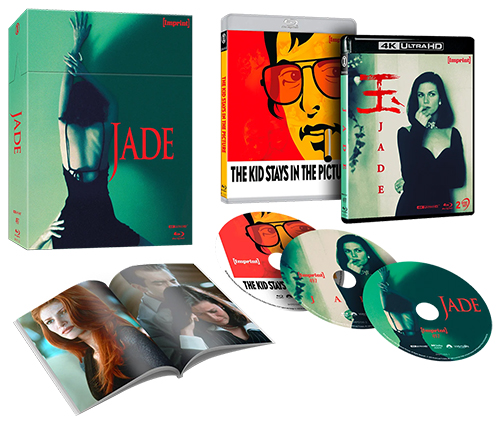
Via Vision’s Region-Free Limited Edition 4K Ultra HD release of Jade is #497 in their Imprint Films line, and it’s limited to 1500 units. It’s a three-disc set that includes one Blu-ray with a 1080p copy of the film and a second Blu-ray with the 2002 documentary about producer Robert Evans, The Kid Stays in the Picture. The film discs are housed in one Amaray case while The Kid Stays in the Picture is in its own case (presumably so that the latter can be easily dropped from future standard editions). There’s also a 26-page hardbound booklet featuring production notes from the original pressbook materials. Everything comes housed in one of Imprint’s rigid Hardboxes that opens up at the top. The following extras are included:
DISC ONE: JADE (UHD)
- Commentary by Jennifer Moorman
- Commentary by William Bibbiani, Augie Hess, and Darrin Navarro
- Commentary by Nina K. Martin and Will Dodson
- Theatrical Trailer (Upscaled SD – 2:43)
DISC TWO: JADE (BD)
- Commentary by Jennifer Moorman
- Commentary by William Bibbiani, Augie Hess, and Darrin Navarro
- Commentary by Nina K. Martin and Will Dodson
- Friedkin’s Enigma (HD – 30:26)
- The Subversive Heart of William Friedkin’s Jade (HD – 11:42)
- Interview with Darrin Navarro (HD – 19:21)
- Eszterhas, Friedkin, and Jade (HD – 7:02)
- Hysterical Blindness: William Friedkin at Paramount (HD – 22:07)
- Archival Interviews:
- Linda Fiorentino (Upscaled SD – 5:08)
- Chazz Palminteri (Upscaled SD – 4:00)
- David Caruso (Upscaled SD – 4:26)
- Michael Biehn (Upscaled SD – :52)
- Ken King (Upscaled SD – 7:49)
- Angie Everhart (Upscaled SD – 5:04)
- Theatrical Trailer (Upscaled SD – 2:43)
For this edition, Via Vision has added two new commentaries, two new visual essays, a new interview, and a collection of previously unavailable archival interviews. (Note that all three commentaries in the set are available for the theatrical cut only.) The first commentary teams critic William Bibbiani with original editor Augie Hess and assistant editor Darrin Navarro. They examine Jade from within and without, with Bibbiani providing an overview of the production, a thematic analysis, and a look at that phase of Friedkin’s career, while Hess and Navarro provide a lot of practical details (they also correct Bibbiani on a few points). They also cover the careers of David Caruso and Linda Fiorentino, among others, and discuss erotic thrillers in general. (Bibbiani affirms my point that a satirical edge is what separated the collaboration between Eszterhas and Verhoeven from his collaboration with Friedkin.)
The second commentary pairs film professors Will Dodson and Nina K. Martin, the latter of whom is the author of Sexy Thrills: Undressing the Erotic Thriller. Dodson moderates the track, providing context while asking Martin questions about Jade and the erotic thriller genre. They differentiate Jade from Eszterhas’ work with Verhoeven by saying that it displays less overt camp (although I would argue that with Verhoeven, camp and satire go hand in hand). They focus more on the thematic and stylistic kinks (no pun intended) of Jade and erotic thrillers in general. They also make the interesting point that from Katrina’s perspective, Jade is about losing control of her own agency and having to be rescued by a man, which means that the film ultimately offers a depressingly conservative perspective on female sexuality.
Friedkin’s Enigma is a visual essay by filmmaker Chris O’Neill, which opens by quoting from Linda Ruth Williams’ 2005 interview with Friedkin where he stated that “Jade is my favorite of all the films that I’ve made. I think, though it seems like it’s one of the most simplistic, it’s really one of the most complex, and it still carries its secrets with it.” From there, O’Neill delves into what he considers to be some of those secrets, making the fair point that Jade is a difficult film to get a bead on after a single viewing. Further viewings reveal that displays the cynical heart that was present in Friedkin’s other work, with an obsessive protagonist, ambiguous details, and moral ambivalence toward corruption. O’Neill also discusses some of the differences between the theatrical cut and the extended one.
The Subversive Heart of William Friedkin’s Jade is a visual essay by critic Michelle Kisner, who says that Jade is tonally at odds with itself, with the slick surface hiding the cynical heart that lies beneath. Kisner reads great meaning into the title Jade, quoting from the Confucian text The Book of Rites to show how jade has long been seen a polished surface with flaws showing through its transparency, and when unadorned, it usually represents chastity. It serves as a metaphor for the duality of Katrina’s double life, operating as both the subject and object of her story.
The new interview with assistant editor Darrin Navarro covers his career working with William Friedkin and his experiences on Jade. However much that the film may have had a troubled release, Navarro says that the postproduction process went smoothly. Navarro also fast forwards to later Friedkin films like Bug, noting that Friedkin seemed happy to tell stories that upset some people. Finally, there’s also a collection of archival EPK interviews with various cast members that were originally conducted back in 1995. Since they’re promotional interviews, they’re not too revealing, but it’s still interesting to see everyone putting on their game faces in order to hype the film.
Via Vision has also ported over the commentary from Vinegar Syndrome’s 2025 UHD. It features Fordham University scholar Jennifer Moorman, who specializes in questions of gender, sexuality, race, class, and ability in film and other media. She addresses most of those issues in her commentary, and also breaks down the story (including many of the changes that were made to it during rewrites). She’s definitely more interested in Jade on a visual and thematic level than she is in recounting the tortured tale of its making, but she does give a few tidbits here and there. She covers Friedkin’s claims that he rewrote the entire script, but says that it still feels like the work of Joe Eszterhas (which says a lot about Eszterhas!) Still, it’s Moorman’s analysis that’s the draw here, and she offers an interesting breakdown of the erotic thriller genre from that era and how Jade does (and doesn’t) fit comfortably into it.
Eszterhas, Friedkin, and Jade gives the writer the opportunity to tell his own version of the story. He details the history of his original treatment and script, including how Sherry Lansing eventually bought it at Paramount and brought in Friedkin to direct. According to Eszterhas, Friedkin initially said that he wasn’t going to change a comma of the original script, but that’s just not how it worked out. Yet Eszterhas doesn’t put the failure of the film entirely on Friedkin, admitting that he made the mistake of listening to his own press after Jagged Edge and Basic Instinct, and his personal life was also bottoming out at that point (happy ending, though, since he cleaned up and got married to a person he’s still with to this very day).
Hysterical Blindness: William Friedkin at Paramount is an interview with editors Augie Hess and Darrin Navarro, who explain the complicated history of editing during that period with the transition from editing on film to using digital nonlinear systems like Lightworks (Friedkin’s Blue Chips was edited both ways). While they agree that the actual shooting and editing of Jade went pretty smoothly, they do have a few unkind stories to tell about producer Bob Evans. They reinforce the point that Friedkin had final cut and the theatrical cut is every bit his own version, with the studio being responsible for pushing the extended cut for home video. They also provide a portrait of Friedkin as a person, with Navarro describing the director as the most cordial filmmaker he’s ever worked with, at least until he wasn’t—when things went wrong, Friedkin could indeed became unbearable. The key was to get everything right the first time.
DISC THREE: THE KID STAYS IN THE PICTURE (BD)
- Commentary by Brett Morgan and Nanette Burstein
- The Truth According to Bob Featurettes:
- The Film That Saved Paramount (Upscaled SD – 7:44)
- On the Red Carpet (Upscaled SD – 1:12)
- Up Close with the Kid (Upscaled SD – 5:12)
- Receiving the Spirit of Life Award (Upscaled SD – 15:18)
- Receiving the Lifetime Achievement Award (Upscaled SD – 12:35)
- The Truth According to Others Featurettes:
- Showgirls on Evans (Upscaled SD – 1:26)
- Evans Gag Reel (Upscaled SD – 8:39)
- On the Red Carpet (Upscaled SD – 11:07)
- Trailer (Upscaled SD – 1:34)
The Kid Stays in the Picture is a 2002 documentary directed by Nanette Burstein and Brett Morgan, based on Robert Evans’ 1994 memoir of the same name. It blends a variety of archival materials like photographs, film, and video, with Evans serving as the narrator for his life story. Since it’s based on his own book, The Kid Stays in the Picture is hardly an unvarnished portrait of the producer, even opening with a quote from him saying that “There are three sides to every story: Your side, my side, and the truth. And no one is lying. Memories shared serve each differently.” So it’s not the truth about Robert Evans, but rather his side of the story—personal truth, not objective truth. The Kid Stays in the Picture is presented here in full HD (although there’s plenty of upscaled SD material within it), with English 5.1 DTS-HD Master Audio and 2.0 LPCM, plus optional English SDH subtitles.
THE KID STAYS IN THE PICTURE (FILM/VIDEO/AUDIO): B-/B/B+
The extras appear to be identical to the ones that were including on Kino Lorber’s 2021 Blu-ray, most of which (aside from the commentary) were ported over from the earlier DVD releases of the film. The commentary features directors Burstein and Morgen—or to be more precise, it’s two consecutive commentaries that were recorded separately, with Morgen speaking during the first half and Burstein taking over for the second half. They provide plenty of details regarding the making of The Kid Stays in the Picture and dealing with the irascible Evans. There’s also The Truth According to Bob and The Truth According to Others, both of which collect unedited archival footage and interviews that only appeared in excerpted form during the film. The most interesting of them is probably the Evans Gag Reel, which includes a set of outtakes from Marathon Man featuring Dustin Hoffman and Roy Scheider doing impressions of Evans, plus Hoffman interviewing Evans as Evans for television.
Taking The Kid Stays in the Picture as an extra in and of itself (let alone the fact that it has a set of extras of its own), Via Vision’s Limited Edition 4K Ultra HD release is as stacked as set as we’re probably ever going to see for a much-maligned film like Jade. The only thing that’s missing here from previous releases is the 1995 Friedkin interview on The Charlie Rose Show that Vinegar Syndrome included with their 2025 UHD. Otherwise, all of the other VS extras have been carried forward, with a healthy dose of new ones, and The Kid Stays in the Picture as the icing on the cake. Does Jade really warrant that kind of lavish attention? Objectively speaking, probably not. Yet the whole point of home video special editions, going all the way back to the LaserDisc days, hasn’t been just to celebrate films that are universally praised, but also to rescue so-called “lesser” films from obscurity. A great special edition is great regardless of the quality of the film itself, and however you may feel about Jade, this is unquestionably a great special edition. Will it make you rethink the film? Maybe not, but if you assay all of the copious extras that are included here, they can’t help but give you more appreciation for the film, if not necessarily more respect. Good, bad, or ugly, Jade is a fascinating film, and this is an exceptional special edition. It’s not cheap, but it’s well worth adding to your collection.
- Stephen Bjork
(You can follow Stephen on social media at these links: Twitter, Facebook, BlueSky, and Letterboxd).