
Ghost, The: Limited Edition (4K UHD Review)
Director
Riccardo FredaRelease Date(s)
1963 (February 24, 2026)Studio(s)
Panda Societa per L'Industria Cinematografica (Severin Films)- Film/Program Grade: B
- Video Grade: A-
- Audio Grade: B
- Extras Grade: A+

Review
Among the various Italian Gothic horror films of the 1950s and 1960s, Riccardo Freda made several of the most memorable and most revered by modern film critics. Featuring lush cinematography and set primarily in the 19th and early 20th centuries, these films, along with the work of the much more celebrated Mario Bava, also carry a particular aesthetic that was different from the oft-compared to output by Hammer Film Productions in the UK. Barbara Steele, one of the legendarily standout actresses of this era, collaborated with Riccardo Freda on 1962’s The Horrible Dr. Hichcock, and returned for its 1963 follow-up, Lo Spettro, or The Ghost.
In a remote castle in early 20th century Scotland lives the immobilized Dr. John Hichcock (Elio Jotta), stricken with illness and overseen by his physician, Dr. Charles Livingstone (Peter Baldwin). Living in solitude with his wife Margaret (Barbara Steele) and their housekeeper and spiritual medium Catherine (Harriet Medin), John has been instructing Charles to inject him with an experimental but powerful poison, followed by the antidote, which he hopes will eventually cure him of his disability over time. Meanwhile, Margaret has been having an affair with Charles, and the two plot to murder John, subsequently injecting him with the poison and withholding the antidote. In the aftermath of John’s demise, Margaret and Charles are dismayed to find that his willed money and valuables are missing; and even worse, they’re being terrorized by his ghost, who also speaks to them through Catherine, driving Margaret to the brink of madness.
For a more “modern” comparison, The Ghost is ultimately akin to an episode of Tales from the Crypt. There isn’t much plot to decipher as it’s fairly obvious what the conclusion will be, especially if you’ve seen these types of stories before. However, the story is not necessarily the film’s driving force. It’s mostly the aesthetic, or rather the atmosphere, as well as the gorgeous visuals. It’s not an overtly stylized horror film, but it has a particular look and feel that’s closely associated with Gothic horror, but put through a uniquely Italian lens. Barbara Steele gives another towering performance as the beautiful and deadly, yet sympathetic Margaret. Though her role is meant to be more villainous, at least in practice, her journey to insanity makes her a little more commiserative. She’s certainly not an innocent bystander by any means, but you wind up feeling a little sorry for her, particularly in the finale when she receives her “just desserts.”
The Ghost is also not really a sequel to The Horrible Dr. Hichcock, so much as it is a re-use of its character namesake, who was portrayed by Robert Flemying under the name “Bernard” Hichcock is the previous film. There are similarities in so much as the notion of deadly injections and Barbara Steele’s presence, but outside of that, this is a completely different narrative and environment. It was released in the United States as simply The Ghost, though it saw releases in the UK under the title The Spectre, and in Italy and France as Lo spettro de Dr. Hichcock and Le Spectre du professeur Hichcock, respectively. Regardless of its regional moniker, it’s a quintessentially spooky and invaluable part of the Italian Gothic horror landscape.
The Ghost was shot by cinematographer Raffaele Masciocchi on 35mm film with spherical lenses, finished photochemically, and presented in the aspect ratio of 1.85:1. Severin Films debuts the film on Ultra HD with a new 4K restoration from the newly-rediscovered original camera negative by Augustus Color, which is occasionally supplemented with a scan of a 35mm print for sections that are deteriorated. The results have been graded for High Dynamic Range in HDR10 and encoded to a triple-layered BD-100 disc. It’s a beautiful presentation with the only minor caveat being the print-based sections, which are very few. The bitrate sits in the 70 to 90Mbps range, primarily in the middle, with higher levels of fine detail hidden in previous presentations, especially in the shadows and on black surfaces. Everything is crisp and organic with heavy but well-attenuated grain. Titles and optical transitions are obviously sourced from printed-down material, but for me personally, this is preferred to preserve its filmic quality. The HDR pass boosts blues and greens, and especially reds, particularly during Catherine’s séance later in the film when she’s completely bathed in it. Flesh tones are natural and blacks are super deep, though crushed with limited detail in the print-based sections. However, these moments blend a little better into the presentation than one might expect. The image is also stable and clean aside from occasional mild scratches and speckling. It’s an outstanding-looking picture.
Audio is included in English and Italian 2.0 mono DTS-HD Master Audio with optional subtitles in English SDH for the English audio and English for the Italian audio. Both tracks are limited in their range, perhaps more narrow than expected, though the Italian dubbing has little more bottom to it comparatively. However, the score in the English track has just a bit more width. Both tracks have a touch of sibilance, but they’re otherwise clean. Although this is an Italian film, the English track appears to be the main option for viewing, but as far as performances are concerned, it’s a toss-up.
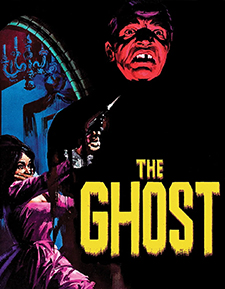
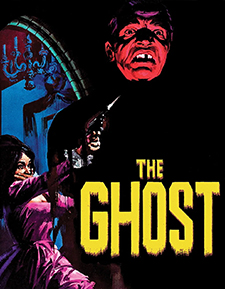
The Severin Films Limited Edition 4-Disc 4K Ultra HD release of The Ghost sits in a black Amaray case alongside two 1080p Blu-rays, a CD soundtrack, and an insert card with a CD track listing. The inner sleeve features the original US theatrical poster artwork while the slipcover features the original Italian theatrical poster artwork, but with the English title. Severin is also offering a 2-Disc standard version featuring the first two discs only and no slipcover, as well as a single-disc Blu-ray option. For this release, the following extras and audio tracks are included on each disc, all of them in HD:
DISC ONE: UHD (FILM)
- Audio Commentary with Kat Ellinger
- Audio Interview with Barbara Steele
- Italian Theatrical Trailer (3:21)
- US Theatrical Trailer (2:03)
DISC TWO: BD (FILM)
- Audio Commentary with Kat Ellinger
- Audio Interview with Barbara Steele
- Audio Interview with Harriet Medin by Tim Lucas (10:39)
- Barbara Steele Presents The Ghost 4K Restoration in Venice & Paris (16:58)
- Till Death Returns (22:27)
- Wounds of Deceit (11:22)
- Give Up the Ghost: Tim Lucas on Lo Spettro (28:41)
- Italian Theatrical Trailer (3:21)
- US Theatrical Trailer (2:03)
DISC THREE: BD (BONUS)
- Executioners, Masks, Secrets: Italian Horror of the 1960s (80:36)
DISC FOUR: CD (SOUNDTRACKS)
- Lo Spettro (The Ghost):
- Preludio ad un dramma (1:19)
- Incubo notturno (2:42)
- Melanconia autunnale (2:58)
- Ansiosa attesa (4:21)
- La bambola melodica (1:03)
- Risvolti nel terrore (2:03)
- Tragedia nella notte (2:54)
- Rapina al quartiere Ovest:
- Quartiere ovest – Seq. 1 (2:05)
- Quartiere ovest – Seq. 3 (2:02)
- Quartiere ovest – Seq. 6 (3:18)
- Quartiere ovest – Seq. 7 (3:15)
- Quartiere ovest – Seq. 10 (1:13)
- Quartiere ovest – Seq. 12 (2:53)
- Quartiere ovest – Seq. 13 (3:50)
- I familiari delle vittime non saranno avvertiti (Crime Boss):
- I familiari delle vittime non saranno avvertiti – Seq. 1 (1:59)
- I familiari delle vittime non saranno avvertiti – Seq. 2 (2:59)
- I familiari delle vittime non saranno avvertiti – Seq. 3 (2:32)
- I familiari delle vittime non saranno avvertiti – Seq. 5 (1:32)
- I familiari delle vittime non saranno avvertiti – Seq. 7 (2:53)
- I familiari delle vittime non saranno avvertiti – Seq. 14 (2:22)
- I familiari delle vittime non saranno avvertiti – Seq. 21 (2:45)
- The Big Game:
- The Story of a Dream (2:22)
- The Night is Ours (2:58)
- Daylight in Tight (1:10)
- Hong Kong Promenade (1:35)
- Running Against the Time (3:58)
- Time on My Hands (2:51)
- No War, Please (2:53)
The audio commentary features Italian horror film historian Kat Ellinger, author of Daughters of Darkness. She also produced this release and explains that Italian Gothic horror hasn’t gotten the same kind of attention on home video as other Italian film genres, which has been recently remedied by companies like Severin Films (as well as Arrow, if I may interject) in recent years, and we’re all the better for it. Rather that discussing the careers of the cast and crew in detail, she instead delves more into the thematic side of the film, making comparisons to other films made in the US and the UK at that time, mostly in style and content. A defense against the idea that Hammer and others like them were the only ones making Gothic horror at the time is made, as well as the notion that The Ghost can be viewed as a prototype for the Italian giallo. She explores the deeply Freudian psychology and religious attitudes that inform Italian horror, the importance of Riccardo Freda and Barbara Steele to the genre, women’s roles in the genre over time, the film’s place within everything that led up to the popularity of the giallo, and her own personal feeling that Steele’s character is the least villainous of the characters (I agree).
Acting as a sort of audio commentary is a post-screening Q&A with Barbara Steele at one of the film’s screenings in 2005, featuring David Gregory. It only lasts 43:07 of the film’s running time, but it’s very valuable as she’s her usual warm, but off-the-cuff self. Next is a stitched-together archival audio interview with actress Harriet Medin by film historian Tim Lucas, author of Mario Bava: All the Colors of the Dark. Though the recordings have some quality fluctuations, they’re invaluable to have Harriet Medin on the record discussing her work, albeit briefly. More material of Barbara Steele and David Gregory presenting the film at the Venice International Film Festival and the L’etrange Festival in Paris in 2025 is featured, along with an additional Q&A, and some brief side-by-side restoration comparisons. Till Death Returns is a new interview with film historian Roberto Curti, author of Italian Gothic Horror Films, 1957–1969, who talks about the project extensively, from conception to execution. He seems to have access to production information and other similar materials, meaning that he has the full skinny on everything about the making of The Ghost. He also speaks about the careers of those involved.
Wounds of Deceit is a new video essay by Dr. Alexandra Heller-Nicholas, author of 1000 Women in Horror, 1895–2018, who examines women’s roles in Italian Gothic horror, and Barbara Steele’s impact upon the genre. Give Up the Ghost is a new video essay by the aforementioned Tim Lucas in which he delves into the idea that The Ghost is more a multiversal follow-up to The Horrible Dr. Hichcock rather than a straight sequel. He also discusses the film’s cast, its content, how it came into being, and the state of Italian horror at that moment in time. Closing out the first two discs are the film’s Italian and US theatrical trailers.
Executioners, Masks, Secrets: Italian Horror of the 1960s (aka Boia, maschere, segreti: l’horror italiano degli anni sessanta) is a very fine 2019 documentary by critic and filmmaker Steve Della Casa that gives an overview of Italian horror leading up to the moment when it was transformed by gialli. It uses a number of high quality sources for its film clips and features interviews with directors Dario Argento, Pupi Avati, Carlo Cotti, Riccardo Freda, Bertrand Tavernier, actress Barbara Steele, director of the Cinémathèque française Frédéric Bonnard, director of programming for the Cinémathèque française Jean-François Rauger, film critic Jean A. Gili, and Steve Della Casa himself. It becomes more of an extended clip show, but if you’re unfamiliar with much of this material, it will give you a fine summary of many classic titles to start with. These include An Angel for Satan (1966), Beatrice Cenci aka The Conspiracy of Torture (1956), Blood and Black Lace (1964), Bloody Pit of Horror (1965), Death Laid an Egg (1968), The Ghost (1963), The Horrible Dr. Hichcock (1962), Horror aka The Blancheville Monster (1963), Terror in the Crypt (1964), The Island Monster (1953), The Mad Butcher (1971), and Web of the Spider (1971). It’s presented in Italian with a high bitrate, looking and sounding terrific.
Last is a Musica De Masi Compilation CD, featuring a total of 28 selections of composer Franceso De Masi’s scores for the films Lo Spettro (The Ghost) (1963), Rapina al quartiere Ovest (1960), I familiari delle vittime non saranno avvertiti aka Crime Boss (1972), and The Big Game (1973).
The only extras of note that haven’t carried over were included on the Region-Free DVD release by Artus Films in France, which included a French-speaking interview with Alain Petit about Riccardo Freda, a still gallery, and the French theatrical trailer.
The Ghost is likely off the radar of most modern horror fans today, primarily because it’s been somewhat unavailable in decent home video presentations. It’s now being recognized as one of the touchstones of Italian Gothic horror, a genre which hasn’t had quite the attention that other Italian exports such as gialli and Westerns have had over multiple decades. Now presented in a much higher quality container, it can be re-evaluated by critics and audiences, especially in Severin’s absolutely packed 4K Ultra HD package. Highly recommended.
- Tim Salmons
(You can follow Tim on social media at these links: Twitter, Facebook, BlueSky, and Letterboxd. And be sure to subscribe to his YouTube channel here.)