
Beethoven (Blu-ray Review)
Director
Brian LevantRelease Date(s)
1992 (March 24, 2026)Studio(s)
Northern Lights Entertainment/Universal Pictures (Kino Lorber Studio Classics)- Film/Program Grade: A-
- Video Grade: A
- Audio Grade: A
- Extras Grade: B+

Review
Dogs have been a part of movie history from its beginnings. Rin-Tin-Tin was the first canine movie star in the 1920s, Asta was a scene stealer in The Thin Man movies a decade later, and Lassie drew audiences in the 1940s with her daring exploits. Other notable dog movies include Lady and the Tramp, Old Yeller, Max and A Dog’s Purpose. In 1992, Beethoven, a film about a St. Bernard that endears himself to a suburban family, became a runaway hit.
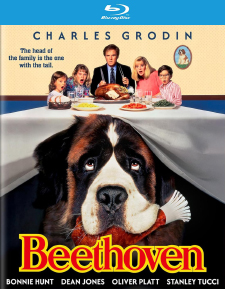
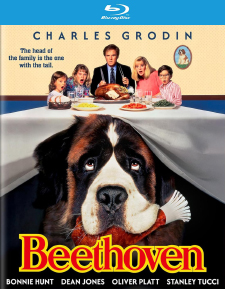
A crime spree is afoot. Dogs are being kidnapped for experimentation. Under cover of darkness, two bumbling thugs (Stanley Tucci, Oliver Platt) raid a pet shop. The dogs escape from their truck and a St. Bernard puppy wanders into the home of the Newtons. The three kids and mother Alice (Bonnie Hunt) are immediately won over by the ball of fur but father George (Charles Grodin) is a control freak who’s not thrilled at having a dog upset his routine. Ultimately, he gives in and they name the dog Beethoven. In a montage, we see the puppy grow into a huge dog that gets into all kinds of mischief, with George usually the prime recipient of Beethoven just being a dog.
Beethoven seems to have good intuition and helps the kids with their problems, serving as a matchmaker between older daughter Ryce (Nicholle Tom) and a boy she has a crush on and helping middle child Ted (Christopher Castile) stand up to bullies. The dog also proves himself far more responsible than a human babysitter when youngest child Emily (Sarah Rose Karr) is in danger.
Meanwhile, a high-powered couple, Brad and Brie (David Duchovny, Patricia Heaton), want to invest in George’s air freshener business. They don’t like kids or dogs. Beethoven is instrumental in preventing George from making a bad decision, leading to one of the film’s biggest sight gags.
It turns out the individual behind the dognapping is local veterinarian Dr. Varnick (Dean Jones). He’s been bribed to obtain a dog with a big skull so a munitions maker can test his new exploding bullets.
Charles Grodin brings his annoyed fussbudget persona to the role of George, making him the object of a lot of visual gags. Grodin’s facial expressions often top the gag itself as he stares off, quietly contemplating what indignity has just befallen him. Bonnie Hunt, in her first movie role, plays the supportive wife who’s being pressured to enter the work force, though she loves being a stay-at-home mother to her three kids. This creates some domestic tension while Beethoven’s antics dominate the household. Stanley Tucci and Oliver Platt are evil stumblebum dognappers. Their characters are similar to the would-be robbers in Home Alone, released two years earlier.
Beethoven, played by a series of St. Bernards to show him as a puppy and at various stages until he reaches full size, is a combination of a real dog, an animatronic dog (to give the dog’s eyes added expression) and, undetectable in a brief scene, a man in a dog costume.
Director Brian Levant nicely balances the numerous story lines, with Beethoven playing a key role in each. This is a family film in the best sense. It can be enjoyed by those of any age. The comedy is sometimes gentle, often broad, and sometimes simply charming. The actors comprising the Newton family seem like a real family—imperfect but loving. Each character has a problem to contend with and their individual stories are woven smoothly through the film.
Beethoven was a huge box office hit, inspiring seven sequels. The PG-rated movie devotes its early scenes to the havoc Beethoven causes in the Newton’s home, but since this approach can’t sustain a feature-length film, the script adds depth with the various subplots and suspense with the villainous veterinarian. Frequent close-ups of Beethoven are geared to elicit “Awwwws” from the viewer. The dog’s scene stealing is a delight.
Beethoven was shot by director of photography Victor J. Kemper on 35mm film with Panavision cameras and lenses and presented in the aspect ratio of 1.85:1. The Blu-ray features a brand new master from a 2K scan of the 35mm interpositive. Clarity is sharp and details well delineated. This is especially evident in the water showered on Charles Gordon when Beethoven decides to shake off his wet, muddy coat. You can discern separate droplets as they pelt Grodin. Other beautifully rendered details include the hair on Beethoven’s coat, decor in the kids’ rooms, cages in the crooks’ van, and the hole that Beethoven uses to escape his outdoor pen. The color palette is mostly composed of bright hues but when we see the crooks at night, there’s almost a film noir look. The close-to-the-ground roving camera shows how things appear to the dog. A comic set piece, shot from multiple angles and neatly edited, involves a table, two chairs and two people being dragged around the neighborhood by Beethoven.
The soundtrack is English 2.0 DTS-HD Master Audio. English subtitles are an option. Dialogue is clear and distinct. Key sound effects include dogs barking, a child splashing in a pool, teenage boys playing basketball, the ripping of clothing to simulate a dog attack, and a fist connecting with a face. The original score by Randy Edelman provides just the right uplifting lilt. An excerpt from Beethoven’s Symphony No.5 is heard when the puppy Beethoven barks along with a piano. Chuck Berry’s Roll Over Beethoven is performed by Paul Shaffer and The World’s Most Dangerous Band. Other songs include Lady Marmalade, sung by characters in the film, and Jimmy Olsen’s Blues, performed by the rock band Spin Doctors.
Bonus materials on the Blu-ray release from Kino Lorber Studio Classics include the following:
- Audio Commentary by Brian Levant and Douglas Hostile
- Audio Commentary by Joe Ramoni
- Trailers:
- Beethoven (2:07)
- Mouse Hunt (2:04)
- Kindergarten Cop (2:03)
- Black Sheep (2:21)
- Billy Madison (2:00)
- Babe (2:14)
Audio Commentary #1 – In this brand new commentary, director Brian Levant, moderated by filmmaker Douglas Hostile, says he’s delighted to talk about Beethoven 33 years after the film was completed. He refers to it as a “very unusual project.” John Hughes was the original writer of the screenplay. When Hughes went to another studio, Universal passed the script to executive producer Ivan Reitman. Many dogs were used during the making of the film. The puppy had to match the larger dog. Levant was hired to replace the original director and had only a weekend to prepare before filming was to begin. The actors had already been chosen, locations selected, etc. Levant says he got the job because he was the cheapest choice and had worked previously with animals and animatronics. His experience was writing family comedy, much of it for television so he understood the family dynamic. Because he wasn’t the original director, the crew gave him a cold reception but eventually they worked well together. Hughes originally planned to star John Candy. Charles Grodin was “persnickety.” He had played villains in Westerns and numerous character roles. There are many point-of-view shots showing what a dog would see. A 55-pound camera attached to a pole was used to show a dog’s-eye view. The chemistry between Charles Grodin and Bonnie Hunt is strong and they’re believable as a married couple even though Grodin was much older. Director Levant and the dog trainer didn’t get along because the trainer wouldn’t let anyone touch the dog. Training is all about food and deprivation.
Audio Commentary #2 – Film historian Joe Ramoni, in a new commentary, talks about elements in Beethoven that would appear in other John Hughes-scripted comedies, such as the two bumbling crooks. Hughes had a long history with Universal with such films as Weird Science and The Breakfast Club. When Ned Tanen, his champion at Universal, moved to Paramount as a producer/director, Hughes followed him. Things soured between Universal and Hughes because the studio started rewriting his scripts. Because of his role as patriarch George Newton, Charles Grodin would go on to other lead roles as head of the family. Though reviews weren’t glowing, it was a box office hit and a favorite on cable and on VHS. That success led to seven Beethoven sequels. The studio hired Brian Levant to direct because the studio was pleased with how he handled Problem Child. Levant is “a kid at heart.” He wanted to replicate the feel of Disney movies of the 1960s. The St. Bernards in the film were related to dogs once owned by silent comedian Buster Keaton. Keaton’s widow, Eleanor, raised many of the dogs used in the film. Beethoven popularized the breed as a pet. Producer Ivan Reitman had a long reputation with Universal with Twins and Kindergarten Cop. He was known as a Hollywood hit maker. The two main conflicts in the film are Grodin being swindled and canines being dognapped. Levant made Beethoven as an homage to the films he saw growing up, many of which featured animals. Though some reviewers thought the film was too cartoonish, it was nonetheless a hit. The last Beethoven film came out in 2014. Commentator Ramoni points out that the end of the film is reminiscent of an episode of The Honeymooners.
Anyone who loves dogs will instantly take to Beethoven. The script is entertaining, performances above average, and conflicts satisfyingly resolved. The camera loves the big, goofy St. Bernard, played by Chris. Much of the plot is predictable but the actors are all at their best. This is the perfect film to take your mind off your cares and have a few chuckles. Beethoven is a fast-paced, delightful movie with lots of comedy, a couple of dopey bad guys, and an irresistible canine star.
- Dennis Seuling