
Baskin (4K UHD Review)
Director
Can EvrenolRelease Date(s)
2015 (October 14, 2025)Studio(s)
Mo Film/The Salt Company International (Severin Films)- Film/Program Grade: B
- Video Grade: A-
- Audio Grade: B+
- Extras Grade: B+

Review
“On a night like this, when the doors open and the realms unite, we’re here in this chamber together. Hell is not a place you go. You carry Hell with you at all times. You carry it inside you. We are your humble companions on the road that fate chose for you. As the stones fall into place, we can only be your shepherds. And tonight, if fate put you first among the creatures that we are going to herd, there’s nothing we can do but guide you.”
So says The Father (Mehmet Cerrahoglu) in Can Evrenol’s Baskin, and along with his faithful sidekick The Servant (Sevket Süha Tezel), he is indeed about to shepherd his new flock along the road to their final(?) destinations. Yet fate had little to do with it, as his nominal victims are five unscrupulous police officers who have earned their place in this personal Hell: Boss Remzi (Ergun Kuyucu), Yavuz (Muharrem Bayrak), Arda (Görkem Kasal), Apo (Fatih Dokgöz), and Seyfi (Sabahattin Yakut). They have indeed been carrying Hell with them at all times, and if fate was involved with them choosing this road, it was only a Terminator 2 kind of fate—in other words, there was no fate but what they made for themselves. Still, the darkness that existed in their own lives could never have prepared them for what The Father, his Servant, and the rest of his minions have in store for them.
Baskin began life as a 2013 short subject directed by Evrenol, which had some success on the festival circuit and drew the attention of filmmakers like Eli Roth and Richard Stanley—in fact, Roth is the one who first encouraged Evrenol to expand it into a feature film. So, along with co-writers Cem Özüduru, Erçin Sadıkoğlu, and Eren Akay, he did just that, turning out a script in a matter of weeks and putting the production together quickly using some of the same cast and crew. That included non-professional actor Cerrahoglu, who had been cast in the short primarily because of his physical appearance due to suffering from GAPO syndrome, but he ended up having some ideas of his own that helped shape Baskin as a feature film, at least visually (he created some artwork after reading the script that influenced the design of the film).
The fact that the protagonists are all police officers is no accident, since Evrenol wanted to say something about toxic masculinity in Turkey, and he also felt that horror movies are best when they have an anti-authoritarian bent. And these particular officers are as toxic as they come, freely abusing their police powers whenever it suits them and showing utter contempt for the people whom they are supposed to be serving. If Midnight Express helped give Turkish prisons a bad name, then Baskin does the same for Turkish police officers—although in this case, the tables end up being turned, and with a vengeance, too. Yet this isn’t a simple “just desserts” story a la Tales from the Crypt; instead, it explores the self-perpetuating cycle of violence that toxic masculinity can engender. One of the younger officers is being mentored by Boss Remzi, but the dubious lessons that he’s learning from the veteran will continue the cycle of toxicity for generations to come.
While it’s not necessarily obvious at first blush, everything in Baskin is circular, with the end leading back to the beginning. The seemingly random event that precipitates the encounter with The Father is a car accident, but it’s not entirely clear where the cause of that crash begins and its effect ends. These officers have been carrying Hell inside of them for so long that they could have died ages ago and may have already been going through a cycle of punishment throughout all of eternity. Yet even if they aren’t, they still have an eternity of punishment awaiting them going forward. Regardless of whether the cycle has been ongoing or it’s just beginning, it’s still going to continue for the rest of their existence in this world and the next. Either way, The Father offers them a few words of reassurance, but it proves to be cold comfort indeed:
“You die as you sleep. You resurrect as you wake up. So, fear not.”
Sleep itself is a cycle, and if you die in a dream, you’re raised from the dead the following morning. Yet in this case, if these officers are indeed repeating a cycle, they’re only waking up in order to be plunged back into a waking nightmare that will never end, for all of eternity. “Fear not,” The Father told them, but in reality, they should have been very afraid indeed. The stones had already fallen into place, and nothing could have prevented them from meeting the fate that they had already made for themselves.
Cinematographer Alp Korfali captured Baskin digitally using Arri Amira Red Epic Dragon cameras (at least according to IMDb), but there doesn’t appear to be any other information available. Considering that it’s a Turkish film released in 2015, post-production work was probably completed as a 2K Digital Intermediate (framed at 2.39:1), although the capture resolutions were likely higher. The lack of information extends to this 4K version, which is presumably an upscale of the original 2K DI, and graded for High Dynamic Range in HDR10 only. But even if it was a 2K DI, it’s always a mistake to dismiss a 4K upscale performed at the uncompressed source rather than from compressed 1080p at the user’s end, especially where higher capture resolutions are involved. The image is sharp and refined, especially with subtle facial details like the stray facial hairs on Mehmet Cerrahoglu’s face. The color scheme is intentionally somewhat limited, but the garish red and blue lighting during key scenes really stands out. The contrast range is excellent as well, with deep black levels even in low-light shots. Baskin is all about atmosphere, and it’s moody as hell (no pun intended) in 4K.
Audio is offered in Turkish 5.1 and 2.0 DTS-HD Master Audio, with removable English subtitles. Those atmospherics extend to the sound mix, which provides an aggressive use of both loud “stinger” shock effects and subtle environmental sounds to create a suitably haunted ambiance. But it’s the music that really drives Baskin, from the score by JF (Ulas Pakkan and Volkan Akaalp) to the repeated use of Ezgi Bey’s industrial/techno track Sen—the latter of which brings to mind Coil’s remix of Nine Inch Nails’ Closer (Precursor) for the opening titles sequence in Se7en, which was doubtless intentional. (If you’re a Ruggero Deodato fan, listen closely during one of The Father’s punishments for the use of a familiar Riz Ortolani theme from one of his most infamous films.)
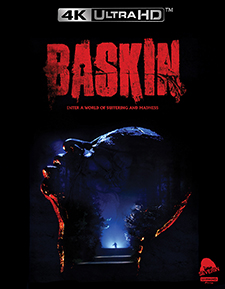
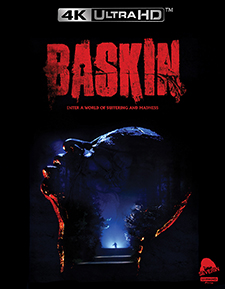
Severin’s Limited Edition 4K Ultra HD release of Baskin is a two-disc set that includes a Blu-ray with a 1080p copy of the film, as well as a slipcover. Said Blu-ray is also offered in a standalone release, as well. The following extras are included on each disc:
DISC ONE: UHD
- Commentary by Can Evrenol
- Theatrical Trailer (HD – 1:34)
- U.S. Trailer (HD – 2:25)
DISC TWO: BD
- Commentary by Can Evrenol
- Baskin 10 Years Later (HD – 21:09)
- The Making of Baskin (HD – 18:04)
- Baskin Original Short Film (2013) (HD – 11:46)
- To My Mother and Father (2010) (HD – 9:02)
- My Grandmother (2008) (Upscaled SD – 6:49)
- The Chest (2007) (Upscaled SD – 6:11)
- Screws (2006) (Upscaled SD – 10:25)
Severin has included all of the previously available extras for Baskin and added some new ones, starting with a commentary by Evrenol. He notes that he’s never done one before and apologizes for any language issues, but he needn’t have bothered because he acquits himself admirably for a first-time commentator working with a second language. He breaks down technical details about the making of Baskin, including the makeup effects and the locations, and he also explains a few references that won’t be obvious to western viewers. But some of the most interesting moments are when he acknowledges the film’s influences—he says that Baskin was written by four cinephiles, and it shows (that’s why there’s a blatant Goodfellas riff during the opening restaurant scene). Italian horror was an obvious influence, from the red and blue lighting to the score, but they also drew inspiration from New French Extremity, Kill List, Apocalypse Now (The Father is a Col. Kurtz figure), The Cell, eXistenZ, Pulp Fiction, and even the 1998 DreamForge Entertainment PC game Sanitarium (if you’re thinking that the cop standing with his head against the wall came from The Blair Witch Project, think again). It’s a really good track.
The Making of Baskin is a Turkish promotional featurette from 2015 that manages to squeeze a lot of information into a short period of time. But that was the modus operandi for the production as a whole, since Baskin was written quickly and shot on a short schedule. Most of the cast and crew appear for interviews, including Evrenol, writer Cem Özüduru, cinematographer Alp Korfali, Sabahattin Yakut, Ergun Kuyucu, Görkem Kasal, Muharrem Bayrak, Mehmet Cerrahoglu, Sevket Süha Tezel, and more. Baskin 10 Years Later is a new retrospective reuniting Evrenol with his cast and crew to visit some of the original Istanbul locations. They didn’t have permits for everything back in 2015 and some of the areas are still restricted today, but they were still able to get in to reminisce about making Baskin. (They do visit Mehmet Cerrahoglu as well, who sadly appears to have deteriorated further since 2015—most GAPO syndrome sufferers don’t live past middle age.)
Finally, there’s a collection shorts directed by Evrenol, starting with the original 2013 version of Baskin that started it all. That’s been available on previous releases of Baskin, but this time it’s accompanied by four more short subjects. To My Mother and Father (2010) is about a young boy who discovers a frightening mask and decides to hide in his parents’ closet in order to scare them with it, only to discover something far more terrifying. My Grandmother (2008) involves a young girl visiting her grandmother’s grave—although there may have been more to their relationship than meets the eye. The Chest (aka Sandik) follows another young boy as he delivers a wooden chest to a suburban family, sealing their gruesome fate when he opens it. Screws is an adaptation of one of Evrenol’s favorite Turkish short stories, where a man discovers a loose screw on the floor of his apartment, which leads to his mind slowly unraveling.
Needless to say, neither Baskin nor any of Evrenol’s shorts will be for all tastes; he may have been influenced by New French Extremity, but it would be fair to call his work New Turkish Extremity. Baskin is a harrowing ride for five “gentlemen” who may deserve their fates, but it’s still extremely unpleasant to watch them reap what they have sown. But thanks to Severin, it’s never looked better than it does here in 4K, and the extras are illuminating. Recommended for horror fans who can take the worst that an imaginative filmmaker can dish out.
-Stephen Bjork
(You can follow Stephen on social media at these links: Twitter, Facebook, BlueSky, and Letterboxd).