
Mr. Jones (Blu-ray Review)
- Review Date: Apr 27, 2026
- Format: Blu-ray Disc
-


Director
Mike FiggisRelease Date(s)
1993 (February 25, 2026)Studio(s)
Rastar/TriStar Pictures (Imprint Films/Via Vision Entertainment)- Film/Program Grade: C+
- Video Grade: A
- Audio Grade: A
- Extras Grade: F

Review
[Editor’s Note: This is a Region-Free Australian Blu-ray import.]
Mental illness has been tapped by the film industry as an intriguing source of drama for more than a century with such films as Dr. Jekyll and Mr. Hyde (1920), The Snake Pit (1948), One Flew Over the Cuckoo’s Nest (1975), A Beautiful Mind (2001), and Silver Linings Playbook (2012). The 1990s brought us Mr. Jones, a man suffering from bipolar disease who becomes the patient of a well-meaning psychiatrist.
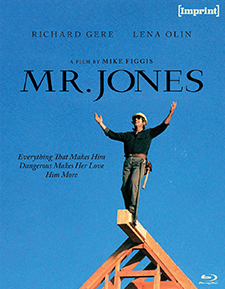
A man wearing a hard hat and tool belt comes to a construction site eager to work. The foreman refuses to hire the man, so he offers to work for free the first day. If the foreman is satisfied with his performance, he will pay the man for two days when he completes the second day. The man, called only Mr. Jones (Richard Gere), is put to work on the roof of a home under construction.
Outgoing and congenial, Mr. Jones makes the acquaintance of fellow worker Howard (Delroy Lindo). Shortly thereafter, Mr. Jones walks precariously across a narrow beam, savoring the feeling that he’s flying. Concerned that his new co-worker will fall to his death, Howard, tethered by a rope, grabs hm and pulls him to safety.
Mr. Jones winds up in a mental hospital, heavily sedated. When he comes to, he’s evaluated by psychiatrist Dr. Elizabeth “Libbie” Bowen (Lena Olin) and released. But when he barges onto the stage where an orchestra is playing Beethoven’s Ode to Joy, he once again finds himself in the hospital.
Mr. Jones has incredibly good days when he’s filled with euphoria and the world is wonderful. But there are also the rough days when he’s depressed and appears lost and unfocused. Libbie is charmed by his devil-may-care attitude and embrace of life. She admires his smile, his unbridled joy, and his enthusiasm about people and things. But she also recognizes this is only one facet of his personality. There are dark days when she fears he might be a danger to himself.
Gere plays a range of emotions and convinces as a man shackled by a terrible affliction. His Mr. Jones doesn’t like taking his meds because it deprives him of the joy he feels when he’s off them. Gere conveys charm and an almost childlike joy that’s hard to resist. He scares us when his character teeters above the street and his mania-driven activities are often tinged with humor, but he never plays Mr. Jones as an object of derision. The contrast between the highs and lows reflect the actor’s ability to capture those moments believably.
Olin must bring to believable life Libbie. Much of her performance is watching, thinking, and reacting to Mr. Jones. We can see that she’s intrigued by this good-looking oddball and does her best to remain professional. Her credibility dims when she fails to take herself off his case on recognizing that she’s feeling more than compassion for her patient. Yes, there would be no movie if she did that, but the role becomes a cliche of every leading lady who fell in love with her leading man. By 1993, shouldn’t Hollywood have moved on?
Delroy Lindo is very convincing in the unconvincing role of Howard, who after a short and harrowing acquaintance with Mr. Jones, assumes responsibility for this dangerously unstable man. Lindo conveys compassion, tenderness, understanding and a powerful sense of responsibility. Howard offers a friendship that Mr. Jones lacks, and a bond develops between them.
The film treats mental illness intelligently, which makes the character of Libbie so distracting. She’s portrayed as a professional dedicated to her job and we accept that. However, when she allows herself to become romantically involved with Mr. Jones, the movie falters badly. She should know better than to behave in a way that could doom her career. Introducing romance into a film that doesn’t need it dumbs down an otherwise smart story. Why not simply deal with Mr. Jones’ struggles? The best scenes focus on the title character and we become invested in what will happen to him.
Director Mike Figgis includes a few sub-plots about other patients, but none are developed adequately. They’re included more to show other forms of mental illness. Anne Bancroft plays Dr. Catherine Holland, head of the institution, but she has very little to do. What a waste to hire this Academy Award-winning actress and relegate her to what is essentially a cameo. The director opens up the numerous hospital sequences with several outdoor scenes for variety.
Mr. Jones was shot by director of photography Juan Ruiz Anchia on 35mm film with Panavision Panaflex cameras and spherical lenses, processed by Technicolor, Hollywood, CA, and presented in the aspect ratio of 1.85:1. The Blu-ray from Imprint Films features an aspect ratio of 1.78:1. There’s some gripping photography when Richard Gere walks on a narrow roof beam. Various angles show how high up he is, creating considerable suspense. The color palette varies by location. Outdoor scenes contain vivid colors that contrast with the subdued hues inside the hospital. The tones reflect Mr. Jones’ state of mind. Outside, he’s free and happy. In the hospital, he’s drugged and tied down.
The soundtrack is English 2.0 LPCM Stereo. English subtitles are an option. Dialogue is clear and distinct. In some scenes, Gere slurs his words because Mr. Jones is coming out of sedation. Olin speaks slowly, distinctly, and evenly when she meets with Mr. Jones. Gere’s manic moments involve wide-eyed wonderment, arms waving, and exaggerated bodily motions to express his character’s euphoria. His darker times reflect depression and disorientation. Maurice Jarre’s score nicely mirrors Mr. Jones’ extreme personality swings and bridges scene changes. The Ode to Joy scene builds in intensity as Mr. Jones moves deliberately down the theater aisle to mount the stage. Sound effects include ambulance sirens, ambient crowd noise, car engines, and waves lapping the shore.
There are no bonus materials on the all-Region Blu-ray release from Imprint Films.
Mr. Jones starts well. We are fascinated by a congenial person who would be so foolhardy that he would risk danger. We want to know more. But the film veers toward a romantic relationship that seems contrived. You can feel yourself losing interest when the movie heads off in an unimaginative and unlikely direction. Mr. Jones is a film in which the title character and the gifted actor who plays him deserve a better script.
- Dennis Seuling