
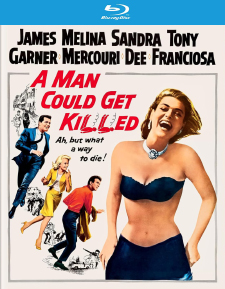
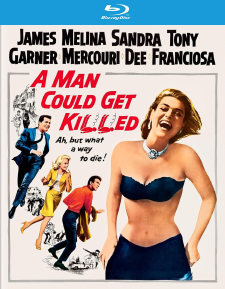
Man Could Get Killed, A (Blu-ray Review)
Director
Ronald Neame/Cliff OwenRelease Date(s)
1966 (June 16, 2026)Studio(s)
Cherokee Productions/Universal Pictures (Kino Lorber Studio Classics)- Film/Program Grade: C
- Video Grade: A
- Audio Grade: A
- Extras Grade: B+

Review
Movies are sometimes inspired by or even copied from others. In A Man Could Get Killed, director Ronald Neame draws on James Bond spy pictures with a heavy helping of North by Northwest for added panache.
American banker William Beddoes (James Garner) arrives in Lisbon to research a hydroelectric project. As soon as he gets off the plane, he’s mistaken for a spy with knowledge about smuggled diamonds by both the British ambassador (Cecil Parker) and assorted culprits eager to locate the valuable gems. The prime villain is Florian (Gregoire Aslan).
Beddoes soon comes in contact with the mysterious Aurora (Melina Mercouri) and American con man Steve (Anthony Franciosa), posing as a Portuguese smuggler. Steve is accompanied by American tourist Amy Franklin (Sandra Dee), who recognizes Steve from Seattle.
The screenplay by Richard Breen and T.E.B. Clarke is convoluted and difficult to follow. There are too many characters to keep track of, too many cross-connections and competitions among them, and some elaborate set-ups for humor that don’t pay off. The film starts by plunging Beddoes and the viewer into a whirlwind of exposition to set the stage for the main plot point—the location of the diamonds. This is what Alfred Hitchcock referred to as the “McGuffin,” the thing the characters are after but which is secondary to the characters’ attempt to get it. There’s little suspense or feeling of palpable danger as the plot awkwardly blends stereotypical bumbling villains with silly romantic moments.
Garner, who was at a career peak in the 1960s with such films as The Great Escape, The Americanization of Emily and 36 Hours under his belt, does his best with the sub-par material, trying to look confused while telling everyone that he’s not who they think he is. But he seems unsure of how to play Beddoes. Is the film a spoof of spy flicks? A romantic thriller? A serous thriller with humorous touches? This uncertainty is evident in his noncommittal performance.
Melina Mercouri, who had become a star in Never on Sunday six years earlier, vamps through the role of Aurora, batting her eyelashes, ogling Garner, and making aggressive sexual overtones. Mercouri is a strong screen presence but her performance here is over-exaggerated and her line deliveries are strictly amateurish.
Franciosa seems to be in an entirely different film. His character, Steve, is an enthusiastic smuggler who always seems to mess things up. Franciosa makes Steve’s charm, quick thinking larcenous bent but ultimate good nature entirely believable and a lot more interesting that Beddoes, who’s frequently upstaged by Steve’s spirited energy.
Sandra Dee looks lovely as the young Amy Franklin, smartly coiffed, deeply tanned and fashionably attired by Jean Louis. Yet she was a bit too mature to be believable as the ingenue. She handles her scenes adequately, but her character serves no real purpose other than to reveal to the audience that Steve isn’t who he says he is and be a minor impediment to Steve’s machinations.
Two of the supporting actors give the film a touch of class. Robert Coote plays Hatton-Jones, a British embassy official and one of the major figures who mistakenly identifies Beddoes as the emergency replacement for a recently deceased British spy. Gregoire Aslan plays Florian, a big-time, dangerous underworld figure who spies on and tracks Beddoes, hoping he will lead him to the diamonds. With an air of danger, Aslan makes the role memorable.
A Man Could Get Killed had a troubled production history. Cliff Owen was replaced as director by Ronald Neame because of cast dissatisfaction with Owen. Sandra Dee agreed to play Amy Franklin reluctantly because she owed a picture to Universal. Tensions between Garner and Franciosa led to a physical confrontation. The picture was shut down temporarily while the replacement director was sought.
A Man Could Get Killed was shot by director of photography Gabor Pogany on 35mm film with Panavision cameras and lenses and presented in the aspect ratio of 2.35:1. Clarity and contrast are excellent. Complexions are well rendered. The color palette ranges from the darker suits of the British officials to the brighter tones of Sandra Dee and Melina Mercouri’s attire. Details are nicely delineated, especially character lines on the men’s faces, Mercouri’s false eyelashes, details of her boudoir, close-ups of guns, and a series of oil drums.
The soundtrack is English 2.0 mono DTS-HD Master Audio. Optional English SDH subtitles are available. Dialogue is clear and distinct. The score by Bert Kaempfert alternates between ominous chords for action scenes and lighter melodies for romantic sequences. Sound effects include ambient street nose, car engines, bodies being pummeled, and screeching tires during a car chase.
Bonus materials on the Blu-ray release from Kino Lorber Studio Classics include the following:
- Audio Commentary by Steve Mitchell and Troy Howarth
- Audio Commentary by Max Allan Collins with Heath Holland
- Trailers:
- A Man Could Get Killed (2:39)
- The Art of Love (2:47)
- The Pink Jungle (2:42)
- Support Your Local Sheriff (3:04)
- Support Your Local Gunfighter (2:46)
- Tank (2:52)
Commentary #1 – Film historians Steve Mitchell and Troy Howarth share their thoughts on A Man Could Get Killed. The film is a “fusing of comedy, thriller, heist and action tropes” influenced by the cinematic spy movement of the 1960s. Intended to be in the style of Charade and Arabesque, A Man Could Get Killed was made when international travel for Americans was becoming increasingly popular. Films with exotic locations served as a kind of travelogue to introduce audiences to places they might want to visit. Made in the Hitchcock tradition, the film treated airports and travel by air as cool. There was a romance to travel. The film was directed at first by Cliff Owen and completed by Ronald Neame. This was unusual, but crediting both directors was even rarer. Neame generously insisted on sharing screen credit with his predecessor. Neame enjoyed a successful career in film with several British comedies, the musical Scrooge, and the box office hit The Poseidon Adventure. The original title was Welcome, Mr. Beddoes. Then it became Diamonds for Danger and finally A Man Could Get Killed. The commentators provide brief overviews of the screenwriters, who were known for comedy. David Esdaile Walker, the original author of the book on which the film is based, worked as a journalist while serving as a spy for British intelligence. Most films made by Universal in the 1960s were shot in Hollywood, so this film was more of an exotic picture for the studio with actual foreign locations enhancing production value. A considerable part of the commentary is devoted to Gabor Pogany’s cinematography with its dramatic use of shadows, colors that pop, and actors moving in and out of their key light. Many scenes have a film noir look even though the film is in color. Noting that the film has a European Keystone Cops element, the commentators say that the film is uneven. They point out that James Garner was an established movie star when he made A Man Could Get Killed, yet he was able to do television as well, particularly with The Rockford Files. During this period, new Hollywood was clashing with old Hollywood. Tastes were changing and Garner had appeared in a few films that didn’t do well. Universal seemed reluctant to give up their old ways.
Commentary #2 – Mystery writer and filmmaker Max Allan Collins and film historian and host of the Real at Midnight podcast, Heath Holland, share this commentary. They point out how Melina Mercouri dominates her scenes. She suggests older stars like Bette Davis who had the ability to communicate with their eyes. Mercouri has a European sensibility that’s both sensual and alluring. The melody that became the song Strangers in the Night and a big hit for Frank Sinatra is a song the singer hated. When lyrics were added, Bert Kaempfert suggested that Melina Mercouri sing it, but that never happened. James Garner was well liked in the industry and by audiences, making it easy for him to move between film and television. Though he had little stage experience, he learned to listen, putting him “in the scene.” He learned the kinds of roles audiences liked to see him in and gravitated to them. Anthony Franciosa had appeared on stage in A Hatful of Rain. A prime running gag of the film is the ineptness of the bad guys who constantly run into each other while Beddoes remains oblivious to what’s going on. The plot relies on a mistaken-identity chestnut that gets polished off from time to time. The cinematography is reminiscent of classic James Bond films. A Man Could Get Killed is a time capsule, capturing places that have since changed. Because of the British pedigree of the story, the commentators wonder whether the casting of Peter Sellers as Beddoes would have improved the film. Human frailties on the part of filmmakers show up as flaws in the film. The commentators read excerpts of reviews of the film from the period. They range from middling to negative. To enjoy a film, it’s important to put yourself into the mindset of the time. The final scene and how various elements are tied together are discussed in detail. In their concluding remarks, Collins and Holland refer to A Man Could Get Killed as unpretentious.
A Man Could Get Killed owes much to North by Northwest. In both films, mistaken identity kicks off the story. The central characters become embroiled in danger and intrigue. A beautiful, mysterious woman becomes involved with the main character. Intrigue surrounds a sought object. And there’s a lightness to the dialogue. Where the two differ is in the strength of their screenplays and the suitability of their leading men. At best, A Man Could Get Killed is a second-tier caper thriller. Perhaps the most interesting fact about the film relates to its music. One melody in Bert Kaempfert’s score was given lyrics and titled Strangers in the Night, which became a chart topper for Frank Sinatra and has been covered my many other singers through the years.
- Dennis Seuling