
All My Sons (1948) (Blu-ray Review)
Director
Irving ReisRelease Date(s)
1948 (March 30, 2026)Studio(s)
Universal-International Pictures (Indicator/Powerhouse Films)- Film/Program Grade: A-
- Video Grade: A
- Audio Grade: A
- Extras Grade: B+

Review
[Editor’s Note: This is a Region B-locked British Blu-ray import.]
In 1944, my grandmother was looking to send her eldest son and his younger brother—my father and uncle, then seven and six years old—to a Saturday matinee and in the newspaper spotted a movie playing called “The Mammy’s Cuss.” One presumes she imagined some kind of wholesome comedy about the Old South, perhaps starring Hattie McDaniel in the title role. But it turned out to be a misprint: in fact, they were sent to see The Mummy’s Curse and, difficult as it is to imagine now, never having seen a monster movie before, Lon Chaney Jr.’s lumbering, foot-dragging Kharis terrified them out of their wits, they spending most of the film hiding under their seats.
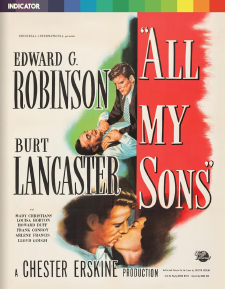
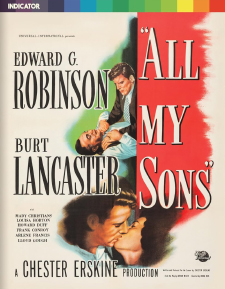
Similarly, when offered this Blu-ray to review, it was listed as “All My Songs.” Even Powerhouse Films’ check disc bears this moniker. Was this one of those early Jolson talkies? A biopic of Cole Porter? To my relief, it turned out to be All My Sons (1948), the noirish adaptation of Arthur Miller’s first major play (Death of a Salesman followed two years later), this film version starring Edward G. Robinson and Burt Lancaster. Though slightly artificial and unimaginatively directed, while altering Miller’s play slightly—producer/screenwriter Chester Erskine given more prominent billing for the adaptation than Miller in the credits—it’s a very good film overall.
In (apparently) suburban Illinois, Chris (Lancaster) informs his father, prosperous factory owner Joe Keller (Robinson), that he intends to marry Ann Deever (Louisa Horton), the former fiancée of Chris’s older brother, Larry, a soldier in the Army Air Corps, still missing in action and now, several years later, presumed dead. This poses a problem, as Chris’s mother, Kate (Mady Christians), refuses to accept her son’s death, keeping his bedroom clean and ready for his return some day and, in part, to marry Ann.
Another problem is that if Kate refuses to bless the marriage, Joe and Ann intend to move to Chicago, upsetting Joe’s plans to have Chris inherit the thriving family business, a factory manufacturing big kitchen appliances. Also complicating things is that while Chris and Ann love one another, Ann’s father, Herb, is serving a long prison sentence. During the war, when Herb was Joe’s business partner, he was convicted of shipping defective airplane cylinders that resulted in the death of 22 airmen. Joe was conveniently home sick with the flu at the time, but many of Joe’s neighbors believe Joe, rather than Herb, was really responsible. Ann’s attorney brother, George (Howard Duff), shows up, to try and convince Ann to call off the marriage, as he, too, believes Joe escaped justice.
For many years, All My Sons was a fairly difficult film to see. Possibly one reason is that was top-heavy with names gray- or blacklisted by Hollywood not long after: Robinson was graylisted; Mady Christians was blacklisted and died in 1951 at 59, allegedly from the stress of losing her career; Howard Duff, primarily a radio star at the time, was listed in Red Channels but his marriage to actress-director Ida Lupino saved him; Lloyd Gough (playing a neighbor) and his actress-wife, Karen Morley, invoked the Fifth Amendment before HUAC and Hollywood blacklisted them both, and he didn’t work again for a dozen years. Louis Horton only made one other film in the wake of All My Sons, working mostly out of New York in live television thereafter.
Possibly, too, is that the play’s themes touch upon how easy it was to for the man responsible for those deaths to forego safety in order to protect his immediate family’s economic security. In flashbacks, we see Joe and Herb under immense pressure from the military to deliver those parts on-time; any delay and they might lose their lucrative government contract and face financial ruin. A bit like Harry Lime, what’s the life of a couple of dozen strangers when money’s involved? Joe, is a self-made man, whose priority is providing for his family, and who can fault that? While Joe’s neighbors and, indeed, much of his community thinks he’s probably guilty, many remain friendly because, perhaps, they admire his presumed cleverness getting off.
Arthur Miller’s 1947 play, which starred Ed Begley as Joe, Arthur Kennedy as Chris, and Karl Malden as George, was a modest commercial success at 328 performances but won the New York Drama Critics’ Circle Award, and Tony Awards for Best Author and Best Director (Elia Kazan). The movie is a close adaptation, the main change, obviously in an attempt to “open it up,” is the addition of a scene where Chris visits Herb Deever (Frank Conroy, in a good performance) in prison. In the play the character, called “Steve,” is discussed but never seen. There are also flashbacks to the war, and a “Happy Ending” coda in the final seconds of the film subverts the tragic ending of the play a little. But, overall, it’s a good adaptation, more faithful than most of that period.
The performances are all good, Robinson expectedly so, but Lancaster is a surprise. He’s much subtler compared to his other ’40s work, and particularly impressive is Chris’s childlike admiration for Joe. Besides Lloyd Gough, other neighbors are played by Arlene Francis, Harry Morgan, and Sgt. Bilko’s girlfriend, Elisabeth Fraser.
As with all Powerhouse Films releases, The Digital Bits was sent only a check disc, with no booklet, no Blu-ray case, etc., and even the check disc was mislabeled. The Region “B” encoded Blu-ray presents the film in its original black-and-white, 1.37:1 standard frame aspect ratio. Licensed from Universal, it’s an excellent transfer, basically faultless, with excellent detail and strong blacks, while the LPCM 1.0 mono audio is more than adequate, supported by optional English subtitles.
Supplements consist of a new audio commentary track with critics Glenn Kenny and Farran Smith Nehme; a 30-minute Screen Directors Playhouse radio adaptation from 1949 with Robinson and Jeff Chandler, and a 56-minute radio adaptation for Lux Radio Theatre, also from 1949, with Burt Lancaster, Edward Arnold replacing Robinson this time. Also included is a trailer and image gallery. We didn’t get the 36-page booklet. This release is limited edition of 3,000 copies.
Like Arthur Miller’s Death of a Salesman, All My Sons is endlessly revived; interest in Miller’s plays is greater than ever, and this film adaptation is not a bad introduction. Recommended.
- Stuart Galbraith IV