
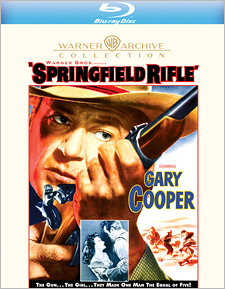
Springfield Rifle (Blu-ray Review)
- Review Date: Jun 24, 2025
- Format: Blu-ray Disc
-


Director
Andre de TothRelease Date(s)
1952 (April 29, 2025)Studio(s)
Warner Bros. (Warner Archive Collection)- Film/Program Grade: C+
- Video Grade: B+
- Audio Grade: A-
- Extras Grade: B+

Review
In 1952 actor Gary Cooper starred in two films, both Westerns. High Noon, directed by Fred Zinnemann and written by Carl Foreman, won for Coop an Academy Award, a Golden Globe, and a Photoplay Award as the top male movie star. It’s a great film that holds up as superbly as it did when it was new, the kind of movie even people that normally don’t like Westerns generally love. Springfield Rifle, on the other hand, is the kind of picture even hardcore Western genre fans will likely find disappointing.
A Civil War Western, Springfield Rifle begins with the Union Army desperate for fresh horses, but a Confederate spy has been tipping off rustlers—a large gang of Rebs and freebooters—intercepting and seizing horses that are resold to the South. Coop is Maj. Lex Kearney who, greatly outnumbered at one such ambush, abandons his horses to save his men, but this lands him a court-martial overseen by hard-headed arch-rival Capt. Tennick (Philip Carey), who brands Kearney a coward and sympathetic to the Confederacy to boot. Despite testimony in support of Kearney from enlisted men such as Pvt. Olie Larsen (Martin Milner) and Sgt. Snow (Guinn “Big Boy” Williams), Kearney is drummed out the service with a dishonorable discharge, a yellow streak literally painted down his back as he’s kicked out of the fort.
After much needless exposition to expose the requisite amount of film—the picture is just 93 minutes, even with all its unnecessary padding—Kearney goes to work for the rustlers, led by oddly-named Austin McCool (David Brian), with Pete Elm (Lon Chaney, Jr.) his slovenly, illiterate lieutenant, and including Confederate Sgt. Randolph (Fess Parker) and freeboot Mizzel (Alan Hale, Jr.).
Of course, Kearney hasn’t gone bad but is actually working undercover as a prototype counterintelligence spy to expose the rustlers, particularly its leader, working at a high level on the Union side.
Unmemorable, Springfield Rifle is depressingly ordinary and needlessly confusing, partly due to a couple of glaring continuity errors and historical inaccuracies, such as the opening scene in Washington, with the Capitol dome visible in the background, several years before its completion, as well as the titular rifle, not in service until after the Civil War.
It may have been rushed to capitalize on the enormous success of High Noon, which was shot in the summer/fall of 1951 and released in July 1952, while Springfield Rifle went into release just three months later, suggesting a fast postproduction turnaround. This may account for the picture’s many clumsy continuity errors, the kind of shot-to-shot mistakes this reviewer doesn’t usually notice unless they’re glaringly obvious.
In an already confusing film, with good guys that—surprise!—turn out to be bad guys and vice-versa, playing both sides up the middle, there’s a huge mistake over a crucial scene: Kearney instructs two of the rustlers to climb a nearby mountain and to signal the others using a mirror—hold the reflection steady for 30 seconds if the coast is clear, while shaking the mirror means Union soldiers are nearby and to stay put. Got that? Yet in the next scene, they spot a shaking mirror which pleases the rustlers who enthusiastically mount up and depart. At first, I thought this was a deliberate mistake, that the rustlers got the signals mixed-up and that they’re going to end up getting captured, but no. Rather, it was a glaring continuity error no one spotted or bothered to correct, but which generates only confusion for attentive moviegoers.
Cinematographer Edwin B. DuPar makes excellent use of the film’s Lone Pine locations, especially in its snowy higher elevations. But the film plays like it was originally conceived and budgeted for a star much less stellar than Gary Cooper, who might have joined the cast at the last-minute. (Director Andre de Toth had to fight to get him, reportedly.) Springfield Rifle has the appearance of a routine Western whose budget was upped a little once Cooper was aboard, and that might also explain its blah cast of lesser names: David Brian as the leader of the rustlers, Paul Kelly and Wilton Graff as Union officers, dull Philip Carey in a significant part, etc. Many in the cast were new faces like Milner, Parker, and Hale, or actors on the downslide like Chaney, Williams and Phyllis Thaxter, who plays particularly dull scenes opposite Cooper as his long-suffering wife.
Presented in its original 1.37:1 standard frame format, Warner Archive’s Springfield Rifle must have been a challenge for the label, it having been shot in WarnerColor, the studio’s version of the relatively new Eastman Color process. Straight cuts tend to look great, with hues and sharpness almost as good as three-strip Technicolor, but all process shots—and Springfield Rifle has scads of lingering dissolves—are grainy, blurry with ruddy, dull color, badly faded and poorly processed in 1952. That the image looks as good as it does is probably a minor miracle and commendable on the Archive’s part. The DTS-HD Master Audio (2.0 mono) is fine, and optional English subtitles are provided on this Region-Free disc.
Extras consist of a trailer and three short subjects from 1952: the Joe McDoakes (George McHanlon) comedy So You Want to Enjoy Life, directed by the long-lived Richard L. Bare, up-rezzed from standard-def, and two classic cartoons, in full HD: Rabbit’s Kin (with Bugs Bunny and Pete Puma) and, particularly great, Chuck Jones’s Feed the Kitty.
While Springfield Rifle fills a gap for Gary Cooper and Westerns completists, the movie is very disappointing, despite good locations and a couple of well-staged scenes. It’s the kind of picture you’ll forget you’ve seen mere months later.
- Stuart Galbraith IV