
Rhapsody in Blue (Blu-ray Review)
- Review Date: Jun 24, 2025
- Format: Blu-ray Disc
-


Director
Irving RapperRelease Date(s)
1945 (May 27, 2025)Studio(s)
Warner Bros. (Warner Archive Collection)- Film/Program Grade: B-
- Video Grade: B+
- Audio Grade: A
- Extras Grade: D-

Review
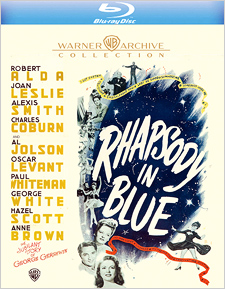
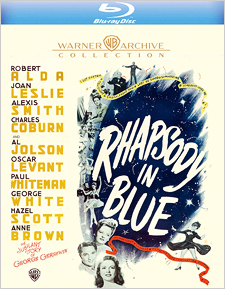
George Gershwin is a giant among American composers. A musical genius, he wrote popular music, songs for the Broadway stage, scores for Astaire/Rogers movie musicals, symphonic jazz-inflected classical pieces, and a full-scale folk opera. The 1945 motion picture Rhapsody in Blue presents a fictionalized version of his life and career.
We first see young George and his older brother Ira roller skating on Bronx streets. Their parents run a local grocery store. They’re of humble means but aspirational, and the boys’ mother (Rosemary DeCamp) buys a second-hand piano because it represents culture. She wants Ira to take piano lessons with Professor Franck (Albert Bassermann), but it’s George who takes to the piano immediately. Years pass, and as a young adult, George (Robert Alda, Alan’s father) finds work as a pianist in a vaudeville theater, then in a music store plugging popular songs. His dream is to become a composer.
George’s first big success comes with the song Swanee, which quickly becomes a hit thanks to Al Jolson’s spirited rendition. This leads to further success, and he’s signed to a contract by music publisher Max Dreyfus and composes songs for several editions of the George White’s Scandals revues. Ira (Herbert Rudley) proves to be a gifted wordsmith and writes the lyrics for many of George’s melodies.
At the urging of Prof. Franck, George composes Rhapsody in Blue. Now one of the most famous pieces of American classical music, it premiered in New York under the baton of noted jazz band leader Paul Whiteman and was received enthusiastically by both audiences and critics. Afterwards, George goes to Paris, hoping to study with Maurice Ravel, but the maestro declines, saying that studying with European composers would ruin Gershwin’s unique, jazz-influenced style. While in Paris, Gershwin writes An American in Paris. He also gets involved with an American expat, wealthy divorcee Christine Gilbert (Alexis Smith), and urges her to return with him to New York.
But George is so driven to keep composing that he spares little time for romance, and Christine soon finds herself just as disregarded as his previous girlfriend, musical comedy star Julie Adams (Joan Leslie). George is anxious about time, consumed with jumping immediately from one project to the next. Two other classical/jazz orchestral pieces, Concerto in F and Cuban Overture, quickly follow.
Tyrone Power was the first choice to play George Gershwin. Robert Alda is rather bland in the role and never adequately conveys Gershwin’s obsession with music. Rather than show it, he relies on the dialogue. We hear him pontificate about his deep love of music while he meanders through the script as if overwhelmed by the part. A studio pianist, Ray Turner, coached Alda, who played in some scenes, but the bulk of the piano playing was provided by Oscar Levant. Clever camera angles, close-ups, and editing create the illusion that Alda is actually fingering the keys.
As Christine, Alexis Smith looks terrific in elegant clothes and hats but her character is little more than a place marker in Gershwin’s career trajectory. Joan Leslie as Julie Adams, the girl Gershwin meets while plugging songs, is sweet, but disappears for a good part of the film. By the time she reappears, we’ve practically forgotten her. Morris Carnovsky and Rosemary DeCamp as Mr. and Mrs. Gershwin expertly deliver homespun dialogue that portrays them as supportive of their boy even though his early efforts reap dismal results.
Oscar Levant, an actual lifelong friend of Gershwin, plays himself and has a number of satirical one-liners that burst the bubble of pretension and artifice. He’s a welcome comic touch in the overly long biopic and grounds the film in reality. He finally takes the spotlight near the end of the film when he plays the Concerto in F. Other performers playing themselves include band leader Whiteman and jazz singer Hazel Scott. Anne Brown, the original Bess in Porgy and Bess, performs Summertime.
Other famous Gershwin songs heard in their entirety or in part include Liza, Clap Yo’ Hands, Fascinating Rhythm, S’ Wonderful, Stairway to Paradise, Somebody Loves Me, Embraceable You and the last song Gershwin composed before his untimely death, Love Walked In.
The film’s musical highlight is the premiere performance of Rhapsody in Blue at Aeolian Hall in 1924. Director Irwin Rapper employs numerous camera angles, cuts to specific sections of the orchestra, tracks in and out, shoots from a crane, uses alternating lighting effects and spotlights, shows audience reactions, and incorporates shadows of musicians to create constant visual interest. The 17-minute sequence is powerful and dynamic.
Rhapsody in Blue covers milestone moments in the short life and career of George Gershwin. He would die in 1937 from a brain tumor. Like many Hollywood biopics, much of the screenplay combines fiction with fact. The following year, Warners would make a picture about another American composer, Cole Porter. That film—Night and Day—was far worse in concocting the story, in part by fabricating romantic interests which ignored that Porter was gay.
The music in Rhapsody in Blue, of course, is glorious and much of it is staged elaborately with choreography by LeRoy Prinz. According to copy on the Blu-ray packaging, this edition “restores over twelve minutes of footage never before seen by the general public, and also includes the overture of Gershwin melodies that only accompanied the film during its New York and Hollywood premiere engagements.” An onscreen statement before the film begins warns viewers that it reflects the less-than-enlightened sensibilities of the time, which might refer specifically to Jolson’s performing in blackface. He would perform this way countless times during his career.
Rhapsody in Blue was shot by cinematographer Sol Polito on 35mm black & white film with spherical lenses, finished photochemically, and presented in the Academy aspect ratio of 1.37:1.The Blu-ray from the Warner Archive Collection is remastered from a 4K scan of nitrate materials. A recurring problem is a pulsating of brightness. This is subtle but annoying. Within the same shot, lighting often varies, causing an inconsistent look. Process photography is used extensively to show backgrounds of a moving car and a view of Paris from inside a hotel room. Montages trace Gershwin’s stay in Paris and a cross-county tour. Costumes by Milo Anderson include the fanciful attire of chorus girls and the elegant gowns worn by Alexis Smith’s Christine Gilbert. Set decoration is elaborate but can’t provide maximum impact because of the film’s monochromatic photography.
The soundtrack is English 2.0 mono DTS-HD Master Audio. English SDH subtitles are an available option. Dialogue is clear and distinct. The sound of the musical numbers varies from outstanding (Concerto in F, Rhapsody in Blue) to routine (Embraceable You). Sally Sweetland provides Joan Leslie’s singing voice. Al Jolson performs in his trademark broad manner complete with hand gestures.
The Warner Archive Blu-ray release contains a song chapter list so specific songs can be accessed easily. The only bonus material on the unrated release is the film’s theatrical trailer (2:19).
Rhapsody in Blue harks back to an era when biopics of famous individuals were not always 100% accurate. For purposes of streamlining, narrative flow, expedience, or a combination, factual details were interspersed with convenient fictions. Apart from showcasing his musical genius, the film is sparse in offering insight into Gershwin’s life. The film is underwhelming partly because of the uninspiring performance by Robert Alda. The musical numbers range from excellent (the title selection) to mediocre (Blue Monday Blues) to poorly conceived (Hazel Scott’s songs often being interrupted by dialogue). Color would certainly have added some welcome visual dazzle.
- Dennis Seuling